
In just a couple of years, sentiment toward Ford Model e, the company’s electric vehicle division, has swung from optimistic to pessimistic and back.
It all came to a head in 2025.
Model e had its best month of sales ever as buyers flocked to dealerships to take advantage of the $7,500 EV tax credit that expired in September.
Ford Model e losses by year
- 2025: $3.6 billion (through three quarters)
- 2024: $5.1 billion
- 2023: $4.7 billion
- 2022: $2.2 billion
However, despite those sales, Ford lost $1.4 billion on its EV division in the third quarter due to spending on new products and increased competition, according to Ford. Through three quarters, the company said it lost $3.6 billion on EVs, with about $3 billion of the loss attributed to its first-generation EV products, including the Mach-E, F-150 Lightning, Puma, Explorer, and Capri. The rest is from investments in its next-generation vehicles.
Coming into the year, Ford expected Model e to lose about $5 billion, and the good feelings about EV adoption have dissipated under the new presidential administration.
While EV sales reached a record 12% U.S. market share during the first three quarters of the year, that figure fell to 5% in the fourth quarter.
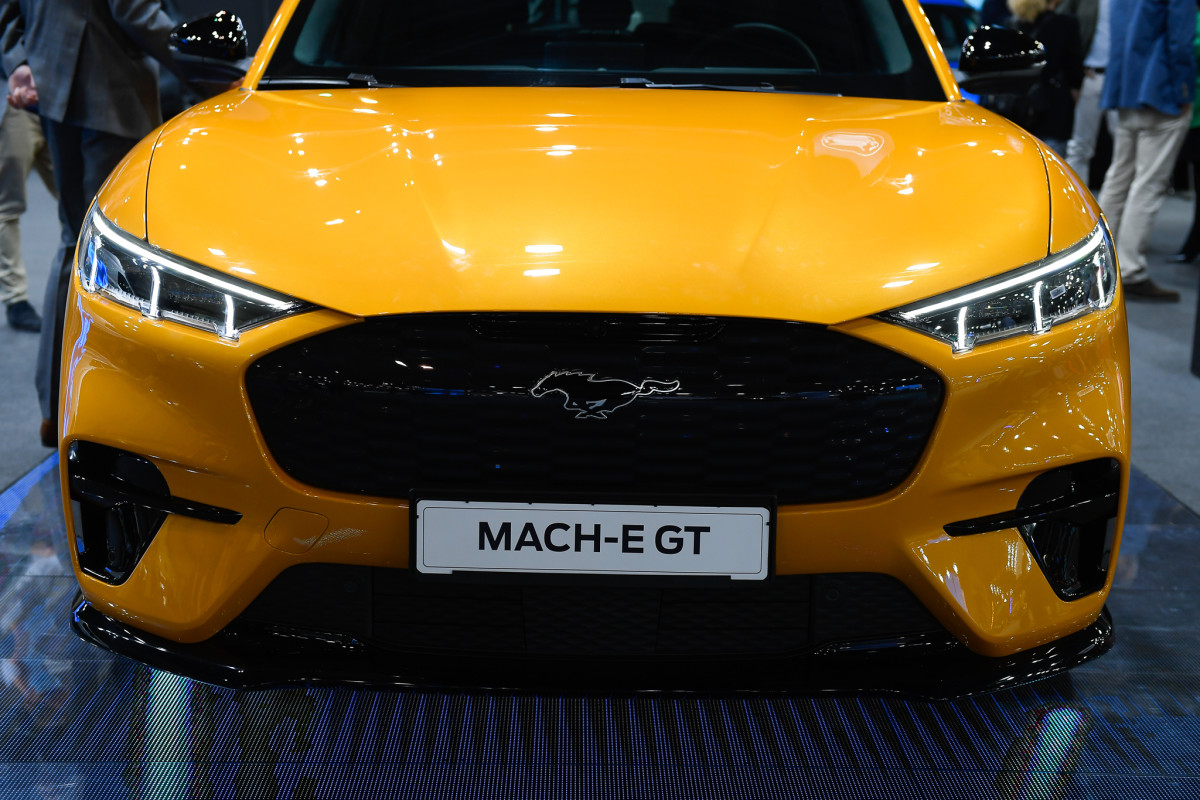 Ford is shifting its EV strategy from higher-priced cars to lower-priced models.
Photo by Anadolu on Getty Images
Ford CEO Jim Farley’s plan to make Model e profitable by 2029
Ford CEO Jim Farley recently gave a wide-ranging interview to Bloomberg.
During the interview, Fareley spoke candidly about the money Ford is losing on its EVs and its plan to turn things around.
Related: Popular Ford pickup faces expanded NHTSA probe over dangerous issue
When Farley was asked why, after billions upon billions of losses, he was confident that Ford could turn around its fortunes and make Model e profitable by 2029, he said he got his inspiration from Tesla rival, Chinese electric vehicle maker BYD.
World’s top EV markets in 2024
- China: 6.4 million EVs sold
- Europe: 2.2 million EVs sold
- U.S.: 1.2 million EVs sold
- Rest of world: 1 million EVs sold Source: International Energy Agency
“We think to make that business profitable, we have to get to a BYD cost,” Farley told Bloomberg last month. “And so this skunkworks project called the Universe Electric Vehicle that we’re making in Kentucky, that is designed to match the BYD cost in Mexico.”
BYD cars go for between $18,000 and $53,000 USD on the high end in Mexico, where it already accounts for about 70% of EV sales, according to Bloomberg.
But there is one distinguishing factor for Ford that BYD can’t compete with.
“We are here to compete globally. We’re not going to cede our future to the Chinese. The Chinese don’t know truck customers as we do,” Farley said, referring to Ford’s industry-leading F-series pickups.
Farley reiterated what the company had said in its December announcement: the company would be taking a $19.5 billion charge on its EV business with the majority of that being attributed to the fourth quarter.
But Ford expects $5.5 billion of that charge in cash effects with the majority paid this year and the remainder paid in 2027.
Ford switches its EV strategy amid massive losses
On Monday, Dec. 15, Ford officially waved the white flag.
The Blue Oval announced that it is taking a $19.5 billion pre-tax write-down on its electric vehicle division over the next two years as it shifts production away from EVs and toward hybrid and extended-range vehicles.
Related: Ford debuts plan to leapfrog key Tesla tech
“The really high-end EVs, the $50k, $60k, $70k EVs just weren’t selling,” CEO Jim Farley said in an interview Dec. 15.
The $19.5 billion (only $5.5 billion of which is cash charges, the rest is non-cash) announcement is once again a win for transparency, but the company has been signaling that Model e hasn’t been working for years.
Two years ago, Ford announced plans to reduce its EV production capacity by 35%.
Ford CEO Jim Farley estimates that EVs have shrunk to just about 5% of the U.S. market, so the plan is to pivot to hybrids and extended-range vehicles for which U.S. buyers have shown more of an appetite.
Ford expects half of its output to be hybrids or EREVs by 2030, up from 17% currently.
Farley explained that while the company ranks third in the country in hybrid sales, it leads in truck hybrids, representing approximately 80% of the market share.
Ford is scheduled to report its fourth-quarter and full-year results after the closing bell next Tuesday, February 10.
Even BYD is seeing signs of EV strain
China is living in the future when it comes to electric vehicles.
China not only sold more EVs in 2024 than the rest of the world combined, but it also nearly sold more plug-in hybrids (4.9 million) than the rest of the world sold EVs.
While looking at your more successful competitors for inspiration makes a lot of sense for Jim Farley in Ford, 2025 was also a rough year for Chinese automaker BYD.
On Sept. 4, BYD cut its 2025 sales target by as much as 16% to 4.6 million vehicles.
If those numbers hold, it would be the company’s slowest annual growth rate in five years. BYD had told investors earlier this year that it expected to sell 5.5 million vehicles, but after the latest quarter, those goals may prove a bit lofty.
Related: Ford, GM take issue with Elon Musk’s special treatment