
When new Stellantis CEO Antonio Filosa took over the multinational automaker, he knew he was stepping into a giant mess. On Friday, Feb. 6, Stellantis’ fourth-quarter and second-half 2025 results showed investors just how far the company still has to go to get back on track.
Under former CEO Carlos Tavares’ leadership, Stellantis laid off American factory workers, shuffled its C-suite, and forced its U.S. brands to push products that American customers didn’t like.
Filosa, 52, on the other hand, shared that he is moving the CEO’s office to Detroit, Michigan. Last May, the company announced plans to build a $388 million “megahub” in Van Buren Township, just outside Detroit.
But Filosa wasn’t focused only on Stellantis’ U.S. footprint.
On Oct. 8, he turned his attention to the European market and the rest of the world, naming several new lieutenants to head up operations.
Stellantis’ new executive movements
- Ralph Gilles: Joins Stellantis as global head of design
- Emanuele Cappellano: Appointed head of Enlarged Europe and European Brands, in addition to his current role leading Stellantis Pro One
- Jean-Phillipe Imparato: Head of Maserati
- Herlander Zola: New head of the South America region, currently head of Commercial Operations, Brazil, and South America Light Vehicles
- Grégoire Olivier: New head of the China and Asia-Pacific region, former head of China Strategy
On Feb. 6, the new global team assembled by Filosa faced investors for the first time, but markets did not like what they heard.
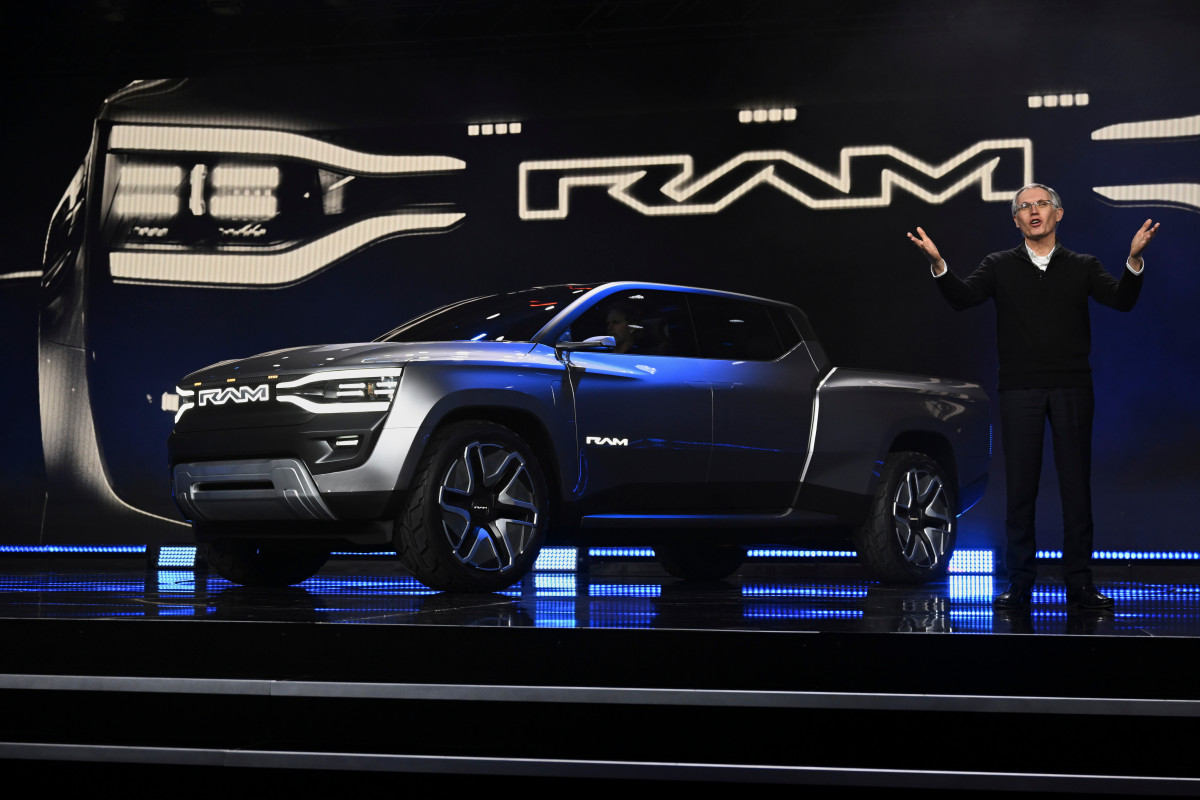 The Ram EV pickup truck championed by Stellantis’ former CEO hasn’t taken off with consumers.
Photo by Bloomberg on Getty Images
Stellantis stock tanks on $26 billion EV hit
On Feb. 6, Stellantis shares were down more than 24% at last check after the Jeep, Dodge, and Chrysler parent company revealed it would have to take a $26 billion (22 billion euro) charge as it rethinks its electric vehicle strategy.
Auto investors should be used to these eye-watering price tags by now, as General Motors and Ford both recently put 10- and 11-figure price tags on their near-future EV plans, respectively. Still, Stellantis’ costs are far and away the highest among the Detroit Big 3.
Related: Latest Stellantis recall adds to disturbing industry trend
“The charges announced today largely reflect the cost of over-estimating the pace of the energy transition that distanced us from many car buyers’ real-world needs, means and desires,” said Stellantis CEO Antonio Filosa.
Ford and GM said similar things, but Ford said its EV strategy shift will cost $19.5 billion, and General Motors said its new strategy will cost $7 billion. Stellantis’ number is nearly four times that amount.
As a result, Stellantis posted a net loss in 2025 and announced it will not pay a dividend this year, leading to Feb. 6’s stock run.
Here is what Stellantis is spending $26 billion on
According to Filosa, poor operational execution from his predecessors is responsible for the company’s current EV situation, and he seems focused on correcting those mistakes.
“We’ve gone deep into every corner of our business and are making the necessary changes, mobilizing all the passion and ingenuity we have within Stellantis,” he said. “In 2026, our unwavering focus is on closing past execution gaps to add further momentum to these early signs of renewed growth.”
Related: EV leaders in Europe return fire against Ford, Stellantis pressure campaign
Stellantis even broke down the $26 billion in charges by category.
About $3.43 billion was spent on canceling products. Another $8.3 billion went to fixing “impairments of certain platforms.” And $6.85 billion was allocated to cash payments expected over the next four years.
The company spent $2.1 billion on the “rationalization of battery manufacturing capacity in North America,” $4.84 billion on contractual warranties, and another $1.54 billion on workforce reductions.
Automakers get a break on U.S. emissions
Under the Biden administration, General Motors and Stellantis faced fines totaling hundreds of millions of dollars for violating emissions rules.
Last July, Reuters reported that General Motors agreed to pay a $145.8 million penalty and forfeit emission credits worth an additional $300 million. This followed a multi-year investigation that found 5.9 million vehicles from the 2012-2018 model years were emitting, on average, more than 10% higher carbon dioxide than GM’s initial compliance reports claimed.
GM also admitted that through 2023, its total costs expensed in connection with emission compliance were about $450 million.
In 2024, Stellantis paid $191 million in civil penalties for failing to meet fuel economy requirements for 2019 and 2020, following nearly $400 million in fines paid from 2016 through 2019, according to Reuters.
Not only has the Trump administration changed Corporate Average Fuel Economy (CAFE) rules so that Stellantis doesn’t have to worry about these penalties, but the new government regulations also allow Stellantis to invest less in money-losing EVs.
Despite a record-setting pace through the first three quarters of the year, Ford lost another $1.4 billion on its Model e EV division in the third quarter. It lost $5.1 billion in 2024 after losing $4.7 billion the year prior.
According to Cox Automotive, “the vast majority of EVs sell at a rate of far less than 2,000 units a month, or 6,000 units a quarter. In the volume-driven business of automotive manufacturing, low volume is the enemy; EV profitability remains a distant dream for nearly every automaker.”
Dealers sold 74,835 electric vehicles in the U.S. in October, according to Cox Automotive data, representing a 48.9% year-over-year decrease.
Related: Former Stellantis CEO has harsh message on Tesla’s future