
The International Monetary Fund just pumped the brakes on the recent wave of U.S. dollar anxiety.
IMF Managing Director Kristalina Georgieva on Monday, Feb. 9, warned markets to avoid overreacting on the back of the dollar’s recent sluggishness, arguing that she doesn’t foresee a global shakeup in its role “anytime soon,” per Seeking Alpha.
That reassurance comes at a unique point for the greenback.
The U.S. dollar index has fallen sharply compared to a year ago, and fiscal worries are back in the picture. Most recently, there’s chatter that China’s looking to trim its Treasury exposure, stoking the “dollar doomsday” narrative.
So all things considered, it isn’t too hard to see why investors are asking whether something more structural is breaking behind the scenes.
That sentiment aligns with Ernst & Young Chief Economist Gregory Daco’s take, which I covered. Daco warned that the strong U.S. economy story is far narrower than it appears.
That’s exactly the setup that feeds fresh worries about the U.S. dollar, with growth concentrated and fragile, leaving it vulnerable to a sudden shift in investor sentiment.
That’s exactly why legendary investors such as Ray Dalio are calling for greater allocations to gold, a view he reinforced recently at Davos.
However, the IMF believes that the recent weakness cannot affect the U.S. dollar’s long-term dominance, deeply entrenched in capital markets, backed by unmatched liquidity and a hefty supply of investable assets.
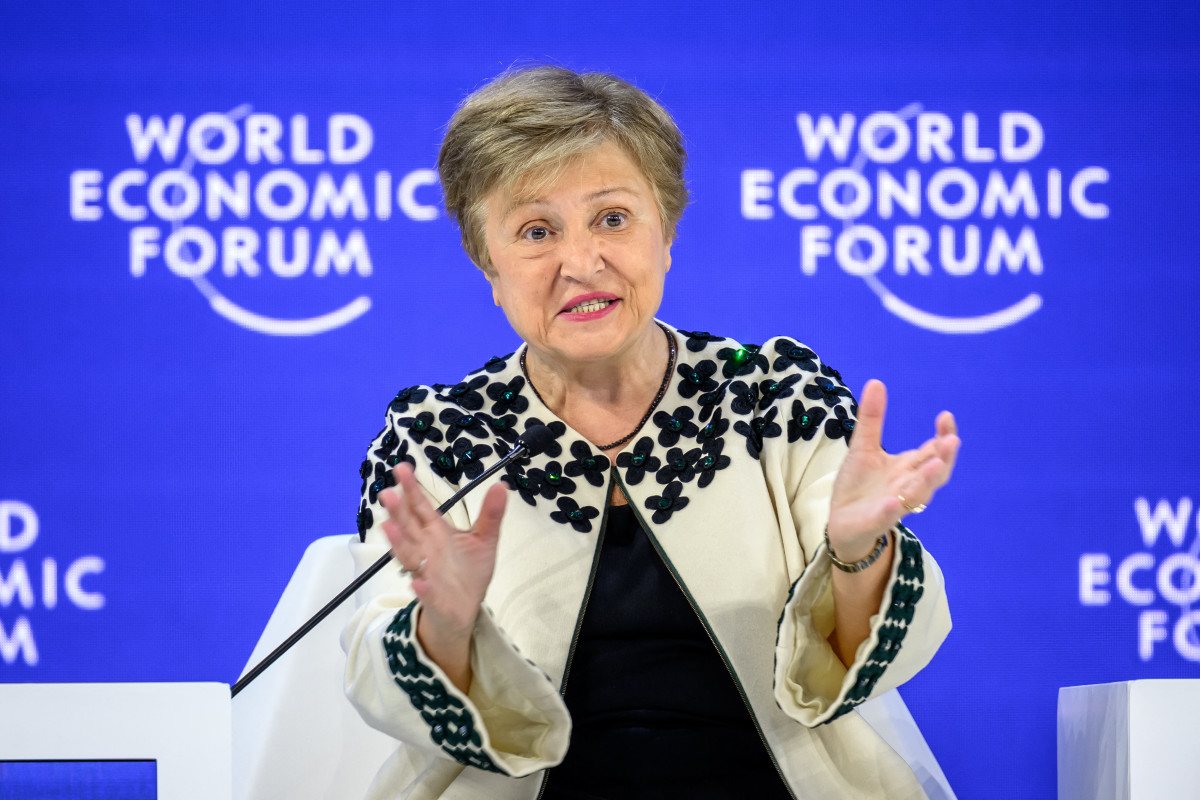 IMF chief Kristalina Georgieva pushes back on dollar panic as markets question U.S. currency dominance.
Photo by FABRICE COFFRINI on Getty Images
A quick snapshot of the dollar’s pullback and where money’s flowing
Clearly, the near-term tape is essentially a sluggish dollar along with a stronger “real assets” setup.
DXY is down over the past month, while gold continues to rip higher, which usually happens when investors become cautious on the currency/rates outlook.
Stocks are moving in a positive direction, but nowhere close to matching the shiny yellow metal’s move in the same window.
- ICE U.S. Dollar Index (DXY): 1M -2.24% | YTD -1.44%.
- Invesco DB Dollar Bullish ETF (UUP): 1M -0.22% | YTD -0.07%.
- WisdomTree Bloomberg Dollar Bullish ETF (USDU): 1M -0.62% | YTD -0.62%.
- Invesco DB Dollar Bearish ETF (UDN): 1M +1.48% | YTD +1.48%.
- SPDR S&P 500 ETF (SPY): 1M +1.44% | YTD +1.44%.
- SPDR Gold Shares (GLD): 1M +11.42% | YTD +14.93%. Sources: ETF Database, MarketWatch, Yahoo Finance
IMF sees dollar weakness as noise, not a turning point
In many ways, the IMF’s sharp take has everything to do with defending the architecture behind the U.S. dollar.
Georgieva feels the markets are essentially mistaking a cyclical move for a structural break. She warns investors against getting “carried away by short-term variations of the exchange rate,” even as the dollar index slides and posts its worst year-over-year declines.
More Federal Reserve:
- Billionaire Dalio sends 2-words on Fed pick Warsh
- Fed Chair Powell sends frustrating message on future interest-rate cuts
- Warsh nomination stirs Fed independence fears on Wall Street
She argues that it’s imperative for investors to effectively gauge the scale and plumbing.
In her own words, she says that it’s critical to look at “the depth and liquidity of capital markets in the United States, the size of the economy and the entrepreneurial spirit of the U.S.”
Another point to consider is that a softer dollar might not actually be universally bad. Georgieva notes that the setup could perhaps be a major tailwind for emerging markets by efficiently lowering the cost of servicing dollar-linked debt.
That’s exactly what BlackRock Global Chief Investment Officer of Global Fixed Income Rick Reeder alluded to in a recent interview with Bloomberg.
He said BlackRock has recently added to emerging markets, underscoring that the yield differential between EM and U.S. high yield is “as good as it’s ever been.”
China’s U.S. debt footprint isn’t what it used to be
As mentioned earlier, Chinese regulators, according to Reuters, have reportedly been nudging domestic banks to curb their exposure to U.S. Treasury securities, amid concerns over concentration risk and heightened market volatility.
Unsurprisingly, it revives the whole “sell America” chatter, but in reality, China’s footprint in the Treasury market is far less daunting than it was a decade ago.
For context, as of November 2025, Mainland China held roughly $682.6 billionin Treasuries, according to U.S. Treasury data.
That seems like a lot, but when you pit it against a Treasury market that’s nearly $30.3 trillion outstanding, that’s just a low-single-digit slice of the pie. Also, China’s own holdings are significantly lower than what they used to be, having peaked at more than 1.3 trillion in 2013, Trading Economics reported.
It seems that although Beijing will continue diversifying, it’s much less likely to be a “pull-the-rug” moment than the headlines suggest.
At the same time, the “everyone is fleeing Treasuries” narrative just isn’t entirely true.
For instance, countries such as Japan ($1.20 trillion) and the U.K. ($889 billion) still remain massive holders, and total foreign holdings were about $9.36 trillion in November, considerably higher than a year earlier.
Though some countries have trimmed (Brazil and India are lower year over year), the broader pattern looks mostly mixed at this point.
Related: Top bank revamps gold price target for rest of 2026