
Tesla CEO Elon Musk famously spent hundreds of millions of dollars to help Donald Trump win a second term as president of the United States.
His help didn’t stop there. Musk turned his social media platform into an engine for Trump’s online movement, playing yet another key role in his victory.
Not to suggest that they have a quid pro quo relationship, but since he took office, President Trump has repaid Musk’s leg up, and then some.
Tesla Q4 deliveries
- Q4 Model 3 and Y deliveries: 406,585
- Q4 all other models deliveries: 11,642
- Q4 Model 3/Y production: 422,652
- Q4 all other models production: 11,706
Amid falling sales earlier last year, the president held what could only be described as a live Tesla commercial taping on the White House lawn, for an advertisement that would never air. He and Musk hopped into a red $80,000 Model S sedan, with which Trump seemed very impressed.
“Wow, that’s beautiful,” President Trump said while settling into the car. “This is a different panel than I’ve had; it’s all computer!”
And that tiny gesture pales in comparison to the president’s gift of appointing Musk to head the Department of Government Efficiency, through a legal mechanism that allowed him to bypass a Senate confirmation hearing on his way to the cabinet position.
While their relationship has involved some very public domestic disputes, the two have seemingly patched things up in recent months and are as good friends as they’ve ever been.
Despite their rekindled friendship, Trump doesn’t seem to have Musk or Tesla in mind as he negotiates his latest trade deal with India.
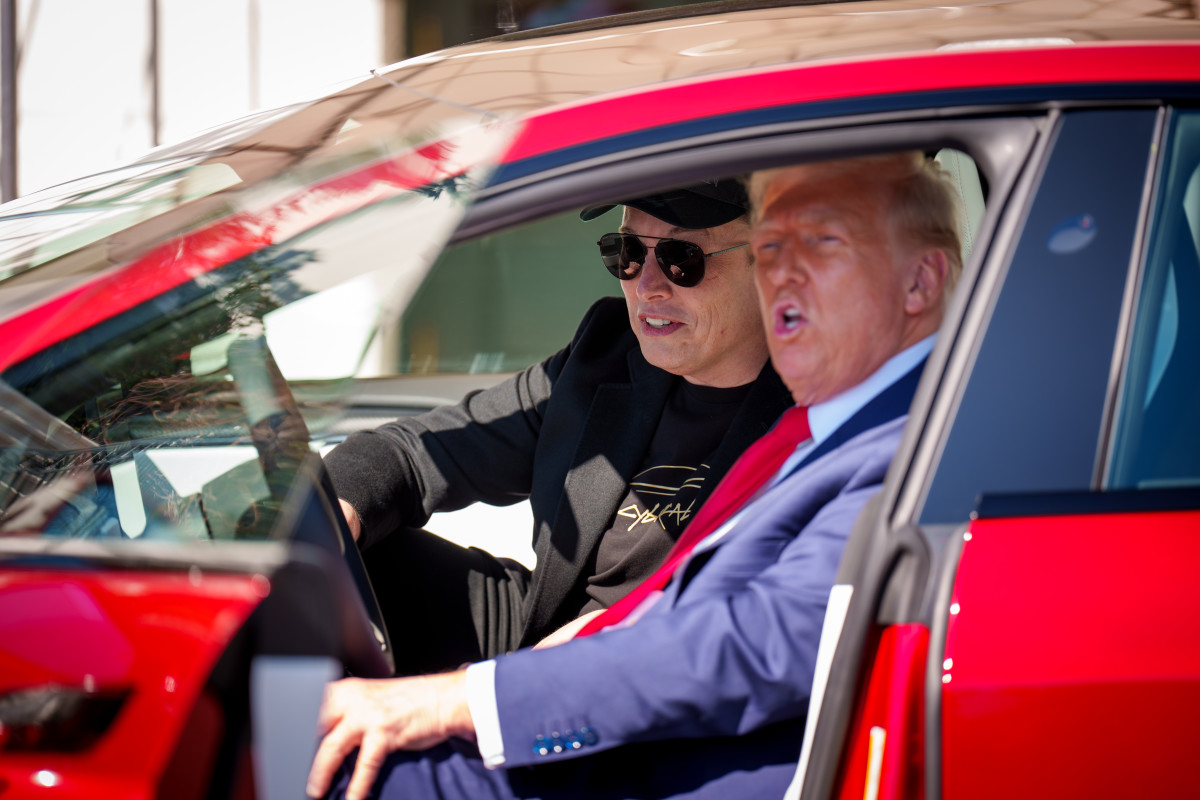 Tesla announced it is halting production of President Donald Trump’s beloved Model S in a few months.
Photo by Andrew Harnik on Getty Images
U.S.-India trade agreement leaves Tesla out of the equation
Last April, after weeks of delay, the U.S. finally unveiled the plan for its trade war. The president famously held up a posterboard showing all the “Liberation Day” tariffs that would be imposed on American trade partners.
But he also said the framework was malleable and that the U.S. would negotiate rates on an ongoing basis. Almost a year to the week after they began negotiations, the U.S. and India say they are close to reaching an agreement on trade policy.
Related: Tesla rival inspires Ford CEO Jim Farley’s push for EV profitability
Last week, the pair announced that they’ve reached a “framework for an interim agreement” that includes India eliminating or reducing tariffs with an emphasis on U.S. food and agricultural products, including dried distillers’ grains, red sorghum for animal feed, soybean oil, and other U.S. staple crops.
In return, the U.S. will apply an 18% “reciprocal tariff rate” on a wide range of industries, including textiles, organic chemicals, machinery, and other products, down from 50%. In exchange, the country will stop purchasing oil from Russia.
Over the weekend, officials told Reuters that India will cut tariffs on high-end American cars to 30% from as high as 110%. India will also eliminate tariffs on Harley-Davidson motorcycles under the interim agreement.
However, India will not make any concessions on electric vehicles, according to the report.
India is currently the third-largest automobile market behind China and the U.S., according to S&P Global. India’s government also says it wants to boost EV market share from the current 5% to reach 30% of the country’s automobile sector by 2030, Cornell University’s SC Johnson College of Business reported.
Elon Musk has repeatedly criticized India’s tariffs on imported autos, which range from 70% to 110%.
India leaves U.S. autos out in the cold
One of the tenets of modern warfare is the concept of blowback: Military victories on the battlefield can have unintended negative consequences off the battlefield.
One unintended consequence of President Trump’s trade war has been increased cooperation among countries not named the United States.
Related: Tesla forced to kill iconic design feature over new safety rules
India, for instance, while making a few concessions on U.S. vehicles, just announced a wide-ranging automotive tariff deal with the EU just two weeks ago. The agreement lowers tariffs on car imports from EU countries to 40% from 110%, with that rate potentially going down to 10% over time.
This immediately reduced prices on EU car imports, priced at about 15,000 euros ($17,700), according to Reuters, and lowered tariffs on as many as 200,000 vehicles, though negotiations are still ongoing.
So compared to the U.S., the EU was able to negotiate lower tariffs on a broader range of autos. This is really bad for Tesla, because India’s EV market is ready to explode.
Here’s why Tesla struggles to move vehicles in India
Unlike U.S. tariffs, India’s tariffs have successfully insulated the country’s automotive industry from foreign competitors.
Tesla received orders for just over 600 vehicles in the country between mid-July and September. After that revelation, the company said it planned to ship only 350 to 500 cars to India last year, falling well short of its internal estimates, sources told Bloomberg.
Tesla had expected to deliver its entire 2,500-car annual quota to the country, but the demand just isn’t there.
One reason for this lack of demand is that Tesla’s entry-level model in India is priced above 6 million rupees ($68,000), while domestic electric vehicles cost about a third of that. Fewer than 3,000 EVs priced between 4.5 million and 7 million rupees were sold in India during the first half of 2025, auto intelligence firm JATO Dynamics said, according to Bloomberg.
But it isn’t as though India hasn’t extended some olive branches to Tesla. In 2024, the country cut import taxes on EVs for global carmakers that committed to investing at least $500 million and starting local production within three years.
However, in 2025, HD Kumaraswamy, the country’s heavy industries minister, said Tesla was “not interested in manufacturing in India,” BBC reported. Unlike other car companies including Mercedes-Benz, Skoda-Volkswagen, Hyundai, and Kia, he said all “have shown interest. Tesla — we are not expecting from them.”
Tesla has flirted with an Indian Gigafactory for years, with vague promises from Musk about “trying to figure out the right timing” in 2023. But Musk sees what everyone else sees: India does not have enough EV demand for Tesla to justify building a whole factory there.
But this could leave Tesla looking from the outside in, as other carmakers flock to grab a piece of that huge market.
Related: Tesla reality plays catch-up with Elon Musk’s promises