
Bank of America (BAC) CEO Brian Moynihan isn’t buying into the “economic doom” narrative.
In fact, in a CNBC interview, he offered a surprisingly upbeat take on the U.S. economy, citing the bank’s real-time data on January activity, which is up nearly 5% year over year.
He feels those numbers align with a strong economic growth narrative, driven by rising consumer spending across low-, middle-, and high-income cohorts, just at different speeds.
Moynihan’s sharp take is a break from the bearish chatter about the economy, particularly the narrow growth drivers and recessionary fears that have dominated the conversation.
Recently, I wrote about Ernst & Young’s Gregory Daco calling the economy a “paradox,” with headline figures masking underlying polarization, despite relatively healthy consumer spending.
Also, the IMF issued a similar warning that U.S. economic growth is resting on a thin foundation, driven by heightened AI capex, rising stock valuations, and affluent consumers leading the wealth effect.
IMF chief economist Pierre-Olivier Gourinchas called out the incessant AI spending and nosebleed stock market valuations that continue obscuring broader weaknesses.
On the other hand, Moynihan’s tone is more reassuring, despite his “K-economy” framing. Though risks remain and are as relevant as ever, his take contrasts with the “only a few cylinders are firing” narrative.
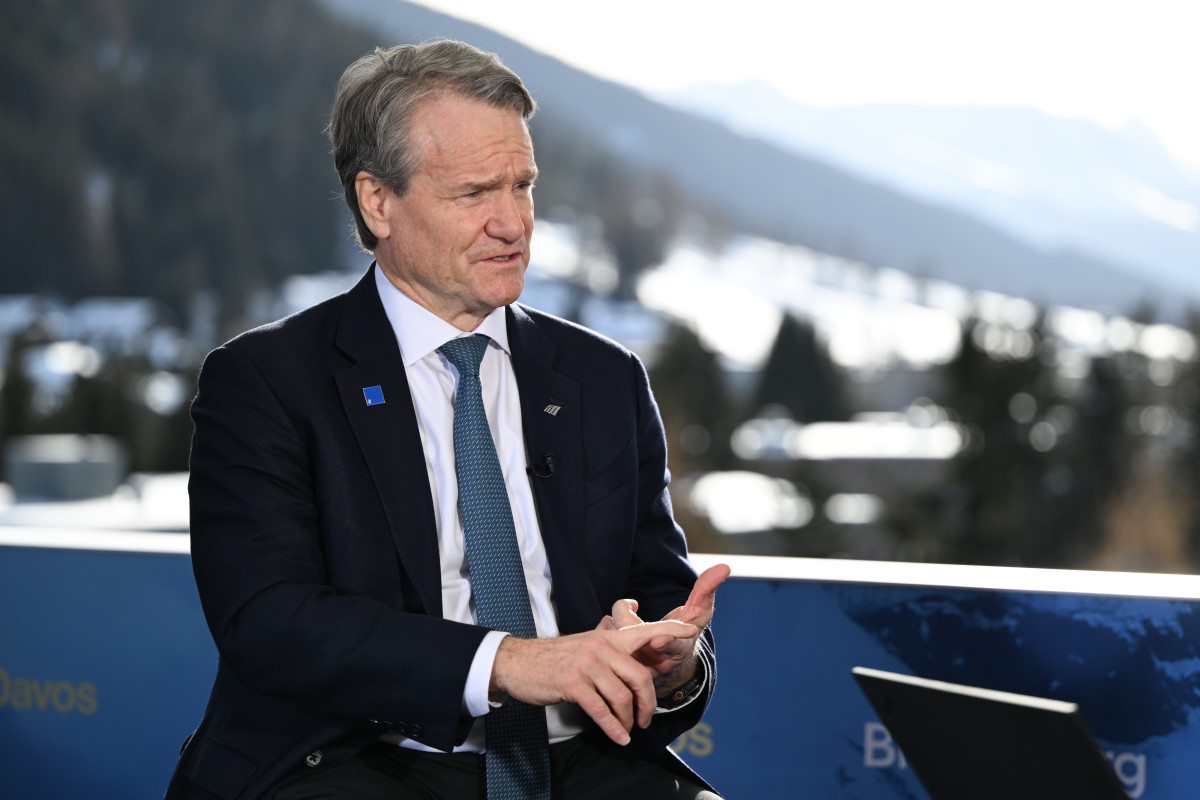 Bank of America CEO Brian Moynihan says January consumer activity rose 5%, signaling steady economic growth.
Photo by Bloomberg on Getty Images
Retail sales: the last six reads
- July 2025: Sales $726.3 billion, +0.5% m/m (advance)
- August 2025: Sales $732.0 billion, +0.6% m/m (advance)
- September 2025: Sales $733.3 billion, +0.2% m/m (advance)
- October 2025: Sales $732.6 billion, +0.0% m/m (virtually unchanged, advance)
- November 2025: Sales $735.9 billion, +0.6% m/m (advance)
- December 2025: Sales $735.0 billion, 0.0% m/m (virtually unchanged, advance) Source: U.S. Census Bureau, Advance Monthly Retail Trade Survey
Why the U.S. economy may be sturdier than it looks
Moynihan is making a broader point, telling CNBC he feels the market is overreacting to a single data print that has come out soft.
So instead of fixating on the relatively weak December retail sales number, he points to what the bank sees right now.
It’s mid-February, he notes, and January activity among BofA’s 68 million consumer customers is tracking above an encouraging 5% year over year, consistent with a robust economic environment.
MoreEconomic Analysis:
- Ernst & Young drops blunt reality check on the economy
- Federal Reserve official blasts latest interest-rate pause
- IMF drops blunt warning on US economy
Though that’s far from a boom economy, it’s still a claim of stability.
Nevertheless, there’s still a split beneath the surface.
Low-, middle-, and higher-income groups are “all growing,” but at varying rates, underscoring an uneven K-shaped dynamic. So clearly, affordability pressures remain, but they haven’t derailed spending.
The K-shaped divide is reshaping the economy
A K-shaped economy is characterized by divergence in spending and balance-sheet health across income levels.
Basically, some groups may perform exceptionally well, while others stall, largely because they fall into lower-income demographics.
Related: IMF takes unexpected stance on U.S. dollar as sentiment shifts
That’s naturally due to the wealth effect (assets held disproportionately by higher-income households), a jobs market that supports certain types of workers but leaves others anxious, and tighter affordability for essentials.
For context, a recent Moody’s Analytics breakdown cited by Axios showed that the lion’s share, at 59% of consumer spending, comes from the top 20% of earners, which makes growth a lot more dependent on the well-off.
Moynihan feels the core insight is behavioral.
Those comments suggest that people are employed and earning income, and that at this point, they seem to be adjusting, not retreating.
Moynihan then broadened the horizon by arguing that banks “reflect the economy,” and that if regulation offers a better balance, capital flows much more freely to support growth.
Where the U.S. GDP goalposts sit now
Considering the U.S. real GDP numbers of 2.5% in 2023 and 2.8% in 2024, the recent trends appear a lot sturdier than most expected.
Nevertheless, the latest 2026 forecasts are essentially in the low- to mid-2% range, indicating a moderating pace.
- IMF (Jan. 2026 WEO Update): U.S. real GDP +2.4% in 2026
- Federal Reserve (Dec. 2025 SEP, median): “Change in real GDP” +2.3% in 2026
- OECD (Dec. 2025 Economic Outlook): U.S. real GDP +1.7% in 2026
- CBO (Jan. 2026 outlook, summarized by AAF): Expects U.S. real GDP growth to total +2.2% in 2026
- World Bank (Jan 2026 Global Economic Prospects): U.S. GDP growth seen around +2.2% in 2026
Related: Bank of America sends quiet warning to stock market investors