
Politics sometimes makes strange bedfellows, and on Wednesday, Feb. 18, environmental groups that have opposed President Donald Trump every step of the way were fully behind his latest decision on fuel efficiency standards.
In October 2021, the Natural Resources Defense Council and Sierra Club petitioned the Department of Energy (DOE) to update the petroleum-equivalency factor (PEF) used by the Environmental Protection Agency (EPA) to calculate fuel-efficiency standards for electric vehicles, which had been in place since 2000.
They argued that the inflated miles-per-gallon-equivalent numbers, meant to appeal to consumers, were inaccurate and therefore a net negative for the environment.
The DOE agreed, and in April 2023, it ruled that the calculations underlying the PEF values were outdated because the technology and market penetration of EVs had changed significantly over the previous 25 years. It granted the NRDC and Sierra Club petition.
The term “strange bedfellows” is a well-known political concept. Another well-known reality in politics is that bureaucrats move slowly.
The final rule published by the EPA on March 29, 2024, doesn’t phase out the fuel standards (which the DOE agreed were outdated two years ago) until model year 2027, and it continues to phase vehicles in through model year 2032.
Once again, the DOE agreed with the petition’s conclusion.
However, the auto industry lobbied against the change and successfully got a softened version of the new EV fuel economy ratings rule passed instead.
That set up a court battle that ended in the 8th Circuit Court of Appeals in St. Louis, nullifying the rule last September. The judge in the case ruled that the Biden administration exceeded its authority by allowing a phase-out period for the pre-existing fuel content factor, because the multiplier was illegal in the first place.
On Feb. 18, the DOE made the court’s ruling official.
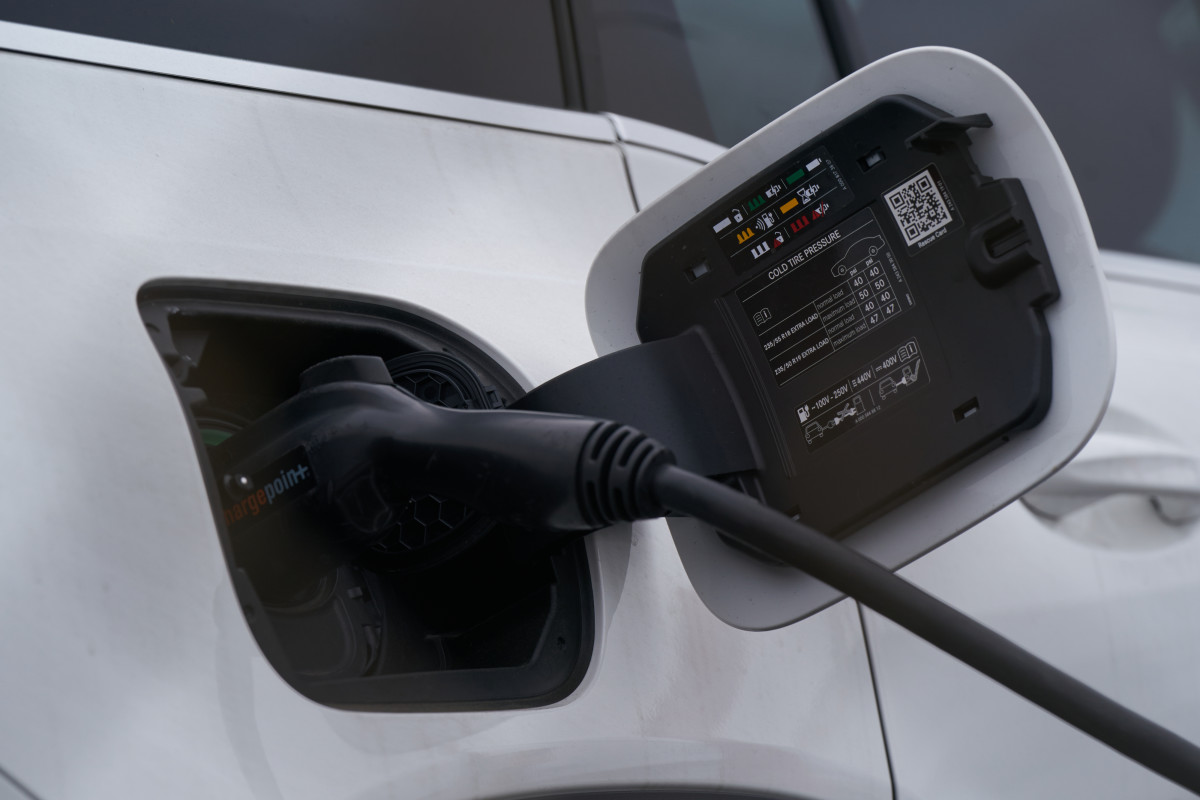 The Trump administration will soon eliminate the fuel content factor used to boost the calculated fuel economy of EVs.
Photo by Bloomberg on Getty Images
Trump administration strikes down Biden-era fuel efficiency ruling
Last September, the 8th Circuit Court of Appeals ruled that the DOE’s plan, which involved gradually phasing out a multiplier that increased the reported fuel efficiency for electric vehicles, was illegal.
The court held that the “fuel content factor — as currently determined and justified by the DOE — lacks statutory authority.”
Related: Ford refuses to shy away from EVs despite $19.5 billion cost
On Feb. 18, the Trump administration said it was eliminating the fuel content factor now, not in 2030, while proposing other broader regulatory changes for vehicles that don’t use gasoline.
“DOE agrees that the inputs[,] upon which the calculations and the PEF values are [based , are] outdated and have significantly changed since part 474 was revised in 2000,” the interim final rule said.
“DOE intends to complete this rulemaking in a timely manner so that the fully revised PEF values are available as soon as possible.”
President Trump eases EV penalties for the auto industry
Feb. 18 will probably be the last time the Sierra Club and NRDC are on the same page as the Trump administration.
Everything the president has done since returning to office has reversed his predecessor’s policies, including fining automakers for environmental violations.
Related: Ford F-150 shoppers may want to wait to buy
Under the Biden administration, General Motors and Stellantis faced fines of hundreds of millions of dollars over emissions rules.
In July 2024, Reuters reported that General Motors agreed to pay a $145.8 million penalty and forfeit emission credits worth an additional $300 million following a multi-year investigation that found 5.9 million vehicles from the 2012-2018 model years were emitting, on average, more than 10% higher carbon dioxide than GM’s initial compliance reports claimed.
GM also admitted that through 2023, its total costs expensed in connection with emission compliance were about $450 million.
In 2024, Stellantis paid $191 million in civil penalties for failing to meet fuel economy requirements for 2019 and 2020, following nearly $400 million in fines paid from 2016 through 2019, according to Reuters.
Under President Biden, cars and trucks were required to have an average fuel economy of 49 miles per gallon by model year 2026 as part of the administration’s plan to reduce carbon emissions by 2030, bringing them to between 50% and 52% below 2005 levels.
At the time, Ford said it would face $1 billion in fines from 2027 to 2032 under Biden’s rules.
In July, Congress eliminated CAFE penalties, meaning automakers will no longer face government fines for failing to meet fuel-economy standards.
Related: Waymo puts another passenger in a dangerous situation