
Are autonomous vehicles like Waymo really safer than human drivers?
It seems to be the trillion-dollar question that everyone from Alphabet (Waymo’s parent company) to Tesla to Amazon is asking.
On the one hand, robotaxis don’t drink and drive, don’t drive while tired, don’t drive distracted, and don’t get vengeful when someone cuts them off.
Waymo quick facts:
- Waymo One available 24/7 to customers in Los Angeles, Phoenix, and the San Francisco Bay Area, as of July 2025.
- Founded in 2009.
- Passed first U.S. state self-driving test in Las Vegas, Nevada, in 2012,reported IEEE Spectrum.
- Spun out from Alphabet as a separate subsidiary in 2016.
Half of U.S. states reported discernible blood alcohol concentration for at least 70% of fatally injured passenger-vehicle drivers in 2023, according to the Insurance Institute for Highway Safety (IIHS). Among these states, Hawaii had the highest estimated percentage of fatally injured drivers with BACs of 0.08% or higher (51%), while West Virginia had the lowest (17%).
It’s clear that eliminating drunken driving would significantly improve road safety. And clearing the roads of people whose driving ability is impaired for other reasons puts us well on our way to a transportation utopia.
On the other hand, driverless vehicles have displayed some disturbing patterns as they accumulate more miles on the road, leading to some awkward interactions with human drivers and even some dangerous situations with children and pedestrians.
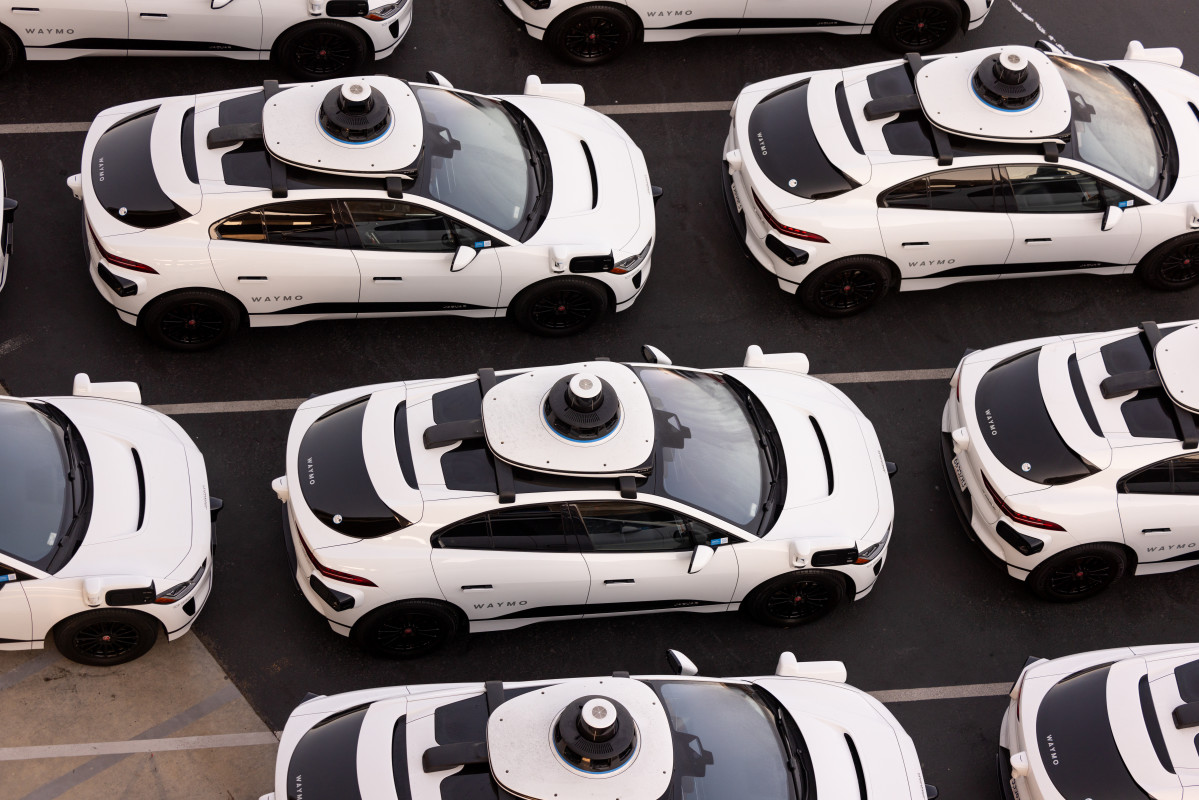 Big tech is betting that driverless cars are the future.
Photo by JasonDoiy on Getty Images
Autonomous vehicles are better than human drivers at some things, insurance analyst says
Waymo, which is the most active of the U.S robotaxi options, says that compared to those with human drivers, its autonomous vehicles have been involved in 90% fewer crashes resulting in serious injuries.
Auto insurance companies have a lot at stake with this new technology. Autonomous vehicles could change insurance pricing at the most minute level. The question is: will it raise rates or lower them?
Related: Waymo puts another passenger in a dangerous situation
Right now, the industry is in a wait-and-see pattern.
“I don’t think they have the data yet to make that kind of assessment,” David Kidd, vice president for vehicle research at the Insurance Institute of Highway Safety, told Bloomberg when asked which drivers are more likely to crash: autonomous or human. “Most insurers are extremely conservative, and they rely on historical data to assess risk accurately. There just isn’t enough information available yet.”
Trent Victor, Waymo’s director of safety research and best practices, recently gave an interview saying much of the same, acknowledging that, “there is not yet sufficient mileage to make statistical conclusions about fatal crashes alone,” adding that “as we accumulate more mileage, it will become possible to make statistically significant conclusions on other subsets of data, including fatal crashes as its own category.”
Waymo vehicles have driven approximately 127 million miles across the fleet and has been involved in at least two fatal crashes, MSN reported. However, the autonomous vehicle was not directly found responsible for either of them. Human drivers average about 123 million car miles traveled for every fatality, according to the IIHS.
So how can an AV company prove to IIHS that its vehicles are safer than human drivers?
“It would depend upon the use case,” according to Kidd. “If a trucking company operates AVs on interstates between two hubs, and they’re able to do that with very infrequent crashes compared to truck drivers, then I would say they provide a substantial safety improvement in that environment. But I wouldn’t generalize to say that means automation is safer across the board. Those assessments need to be done on a case-by-case basis.”
The case-by-case basis lies at the heart of the argument about who is the better driver, because while autonomous driving technology has improved tremendously over the last decade, the tech still regularly fumbles real-world situations that a human driver most likely wouldn’t find challenging.
Waymo has struggled with certain real-world situations
Before this month, it had been about 18 months since Waymo last held a funding round. The 2024 series C round raised $5.6 billion at a $45 billion valuation. This time around, the company raised $16 billion at a $126 billion post-money valuation.
“We are no longer proving a concept; we are scaling a commercial reality,” Waymo co-CEOs Tekedra Mawakana and Dmitri Dolgov said in a blog post.
Related: Waymo crosses major threshold amid nagging issues
“As a technology leader in the trillion-dollar transportation market, Waymo has moved beyond research milestones to achieve operational excellence, tripling its weekly paid rides in just one year while maintaining customer delight,” said Konstantine Buhler, Partner at Sequoia.
While Waymo’s financial future is secure, it has run into regulatory issues in recent months.
In December, after weeks of pressure from the Austin Independent School District, Waymo issued a voluntary recall of its autonomous vehicles due to a software issue that it said it had already patched.
In November, the Austin Independent School District publicized videos of the company’s robotaxis driving past Austin school buses with their stop signs and crossing bars deployed.
Waymo robotaxis were committing school bus traffic violations an average of 1.5 times per week in Austin, Texas, from the start of the school year to November 20.
On Dec. 5, Waymo announced that it will file for a voluntary recall “early next week” to address the issue.
But this wasn’t the first time Waymo faced scrutiny for this issue.
The NHTSA opened a Preliminary Evaluation in October to investigate an estimated 2,000 Waymo 5th-gen automated driving system-equipped vehicles, following a Georgia media report that revealed the same school bus violation.
But that isn’t the only real-world situation it has struggled with.
In recent months, two videos of a Waymo robotaxi driving through an active police standoff in two different cities have circulated online.
While most drivers would be able to navigate those scenarios fairly easily, Waymo has not been able to. And one professor says he know why.
“In like 95% of situations where a disengagement or accident happens with autonomous vehicles, it’s a very regular, routine situation for humans,” Henry Liu, professor of engineering at the University of Michigan, said recently. “These are not challenging situations whatsoever.”
“We have seen many reports from autonomous vehicle developers, and it looks like the numbers are very good and promising,” Liu said. “But I haven’t seen any unbiased, transparent analysis on autonomous vehicle safety. We don’t have the raw data.”
Even Waymo’s data are suspect, according to Liu.
Waymo vehicles primarily drive on urban streets with a speed limit of 35 miles per hour or less. “It’s not really fair to compare that with human driving,” according to Liu.
Related: Alphabet’s quiet $110B Waymo move blows up ‘other bets’ narrative