
Many people remember the once-uncool chunky sneakers with thick soles, wide silhouettes, grey colorways, and purely practical designs. They became the unofficial uniform for middle-aged suburban dads on family vacations, weekend errands, and daily dog walks.
What was once a fashion faux pas is now one of the industry’s most influential trends. So much so that even luxury fashion houses such as Balenciaga, Golden Goose, and Gucci have released their own versions.
But the origin of the modern “dad shoe” can only be credited to a single pioneer.
In 1982, New Balance launched the 990, a performance shoe retailing at $100, making it the most expensive sneaker in its collection at the time. To justify the price, the company emphasized its made-in-USA craftsmanship, durability, and comfort.
The model’s features and price point resonated primarily with middle-aged and senior consumers, positioning the shoes as a health-focused investment rather than a fashion statement.
However, over time, the 990 transcended its original audience, gaining traction across generations. More than four decades later, the model remains one of New Balance’s most popular and best-selling shoes, with multiple versions frequently selling out due to their high demand, according to the company’s online inventory.
New Balance reveals its full fiscal year 2025 earnings
In full fiscal year 2025, New Balance reported $9.5 billion in sales, up 19% year over year and around 180% since 2020, according to CNBC.
Growth drivers
- Premium brand positioning: Allows it to remain competitive with industry leaders such as Nike, which also holds a premium positioning
- Selective distribution and reduced discounts: Helped increase average selling price by about 30% over the last five years
- Expansion of direct-to-consumer channels: Opened 80 new stores in 2025
While physical retail expansion increases market presence, it also requires significant investment and time to generate returns. New Balance did not disclose these figures in detail.
“We want to make sure that our goal is to show up the best and not have it be the biggest part of our business,” said New Balance CEO Joe Preston in a statement to CNBC. “I don’t want to get in the way with how the consumer wants to shop. We want to make sure that we are enabling the consumer to shop how they want to shop.”
Reviving its 990 model has helped New Balance gain a foothold in the lifestyle category, expanding beyond performance and fitness. The strategy taps into nostalgia, comfort, and trends, attributes that resonate strongly with younger consumers seeking everyday stylish footwear.
Google Trends data shows that searches for “New Balance 990” have risen since 2021 as of February 23, 2026.
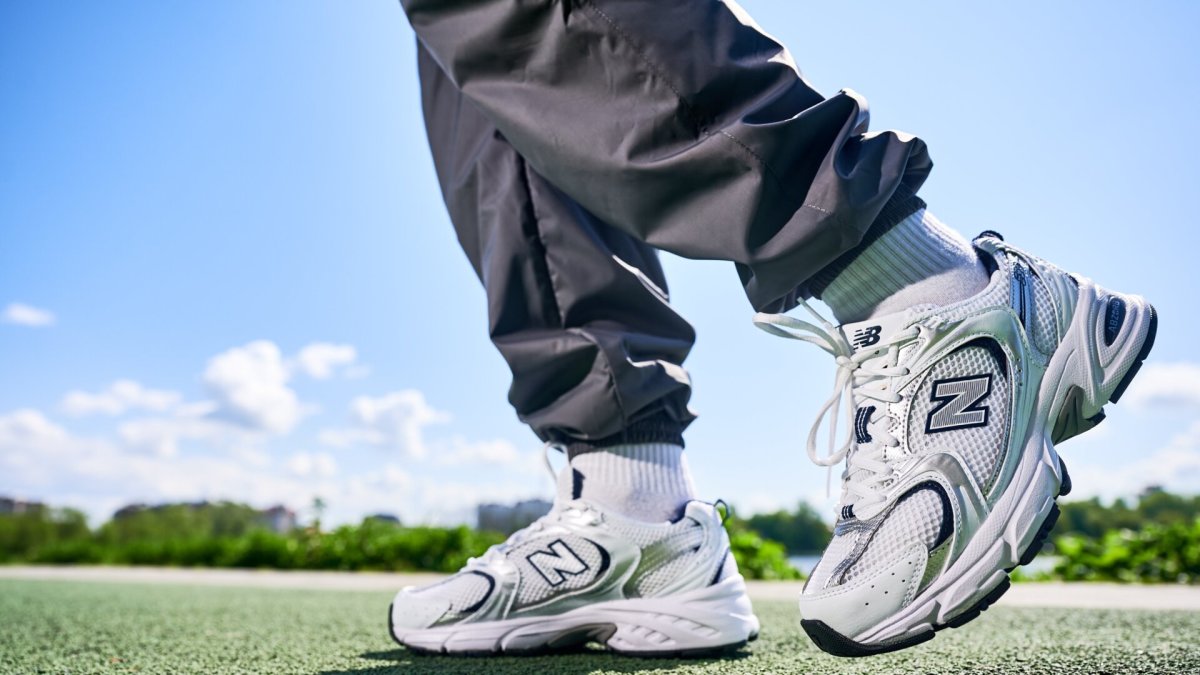 New Balance reports $9.5 billion in sales for 2025 thanks to its iconic “dad shoes.”
Nike loses market share to rivals
Despite remaining the global footwear leader, reaching $46.3 billion in total revenue for fiscal year 2025, Nike’s (NKE) revenue declined 10% year over year, signaling a slowdown.
During the Covid pandemic, the company reduced its wholesale partnerships to prioritize direct-to-consumer sales. While the strategy initially boosted sales, it opened shelf space for competitors at key retailers and limited product visibility.
To get its business back on track, Nike implemented the “Win Now” turnaround plan, comprising five actions to boost growth.
Nike’s 5 turnaround pillars
- Accelerating product innovation
- Rebalancing wholesale and direct-to-consumer channels
- Reducing promotions to support full-price selling
- Strengthening brand distinction
These efforts have already shown early signs of stabilization in the second quarter of 2026, with revenues increasing 1%, wholesale up 8%, and a continued 8% decline in direct-to-consumer sales.
While both Nike and New Balance continue to prioritize direct-to-consumer sales, the results highlight the stronger consumer demand for wholesale.
“We are making progress in the areas we prioritized first and remain confident in the actions we’re taking to drive the long-term growth and profitability of our brands,” said Nike CEO Elliott Hill in the earnings report. “We are making the shifts required to position our portfolio for a full recovery and driving real-time decisions in service of the long-term health of our brands.”
The global footwear industry outlook
The global footwear market was valued at approximately $457.1 billion in 2024 and is projected to reach $588.2 billion by 2030, growing at a 4.3% CAGR, according to Grand View Research.
North America holds the largest revenue share at 25.3% in 2024, and is predicted to grow at a CAGR of 3.7% through 2030.
The study also found that the non-athletic segment accounted for 66.3% of global revenue in 2024, highlighting rapid growth, while the athletic segment is projected to grow at a 5% CAGR, reflecting strong expansion.
What analysts and retail experts are saying
Rack Room Shoes Senior Buyer Nichole Duck told Women’s Wear Daily that Hoka, Pikolinos, Brooks, and New Balance are predicted to be the top-performing brands for fall 2026, with “dad shoes” as the favored style.
“These brands consistently resonate with our customers because they deliver on fit, comfort and quality — key factors that drive both trust and repeat purchases,” said Duck.
“We’re seeing momentum slow around oversized ‘dad sneaker’ silhouettes. While comfort remains essential, trends are clearly shifting toward more refined, streamlined sneaker profiles that feel polished and versatile.”
Complex Sneaker Industry Expert and Writer Mike Destefano noted that New Balance’s success stems from its performance-first philosophy by aiming to produce “the best running sneakers on the market.”
“New Balance is the only major footwear brand still producing more than 4,000,000 pairs of athletic shoes per year in the United States,” Destefano added.
Analysts believe New Balance still has future growth opportunities.
“New Balance’s market opportunities include expansion in diverse global markets, focusing on e-commerce growth, leveraging its strong brand portfolio, and tapping into the rising demand for sporty and fashion-forward products,” said Research and Markets Analysts.
“These strategies can enhance collaboration with specialty retailers and boost its competitive edge.”
More Retail Business News:
- Aritzia brings back iconic fashion brand after shutdown
- Shein invests $42 million as Amazon’s growth raises the stakes
- Luxury brand shares surprising F1 partnership
As for Nike, analysts acknowledge its ongoing struggles and well below-average margins.
“Nike is doing a lot of discounting right now to clear out older merchandise that hasn’t been selling well, and that’s affecting the selling prices and the margins on those products,” Morningstar Senior Analyst David Swartz told Yahoo Finance.
However, Swartz remains hopeful for Nike’s next two years.
“It’s really been about two years now that Nike has been in a tough situation, and it’s been just over one year since the company made a CEO change and brought in Elliot Hill,” Swartz added. “There really is a transition going on, and the hope is that we start to see stronger results in the second half of the current fiscal year and then into fiscal year 2027.”
Related: Luxury giant to close more than 200 stores after sales drop