
JPMorgan Chase (JPM) CEO Jamie Dimon does not sugarcoat things. At his bank’s annual investor update on Monday, he delivered his sharpest economic warning in months, and Wall Street took notice.
With stocks near all-time highs and bullish sentiment running hot, Dimon sees risks building beneath the surface. He told investors to “watch out.” The man who steered JPMorgan through the 2008 financial crisis says the complacency he is seeing right now feels uncomfortably familiar.
“My anxiety is high over it,” Dimon said Monday. “I’m not assuaged by the fact that asset prices are high. In fact, I think that adds to the risk.”
Why Dimon says today feels like 2005 all over again
Dimon drew direct parallels between today’s market and the three years leading into the 2008 financial crisis. The current environment, he said, has the same fingerprints.
“Everyone was making a lot of money, people were leveraging, the sky was the limit,” he said at the event. He added that some financial firms are already “doing some dumb things” chasing interest income, though he declined to name them publicly.
The S&P 500 currently trades at roughly 24 times earnings, well above its long-term historical average. Private credit has ballooned to nearly $2 trillion, funding borrowers that regulated banks would not touch. Those are not abstract concerns to Dimon. They are the same conditions he watched build, and then collapse, nearly two decades ago.
MoreEconomic Analysis:
- Ernst & Young drops blunt reality check on the economy
- Federal Reserve official blasts latest interest-rate pause
- IMF drops blunt warning on US economy
Dimon also warned that when the cycle turns, the industries hit hardest are rarely the ones investors expect. Utilities and telecoms were considered safe in 2007. They still got crushed. He suggested software stocks, inflated by artificial intelligence optimism, could be the sector that surprises investors next time around. “There’s always an element of surprise,” he told the audience.
The four risks Dimon flagged for investors
- Elevated asset prices. Equities are trading at stretched valuations. Dimon said high prices do not signal stability. They signal risk, especially when optimism is this widespread.
- Private credit stress. Blue Owl sold $1.4 billion in loans and restricted investor redemptions, rattling Apollo, KKR and Blackstone. JPMorgan co-head Troy Rohrbaugh warned the stress could quickly become “more broad-based” across loan markets.
- Banks chasing returns. Competitive pressure is pushing lenders into riskier corners of the market, echoing the exact yield-hunting behavior that preceded the last crisis.
- Macro wildcards. Tariff shocks, political pressure on the Federal Reserve, and loose fiscal policy all add to what Dimon described as an already fragile backdrop for growth.
How Dimon’s track record shapes his credibility
Critics have called Dimon perma-bearish before. His 2022 “hurricane” warning came early. His inflation fears proved premature. But the important detail is what happened through every one of those warnings: JPMorgan kept growing, and growing fast.
That matters because it separates Dimon’s warnings from routine Wall Street pessimism. He is not talking from a position of fear. He is talking from a position of dominance, and that is exactly why his caution carries more weight than most.
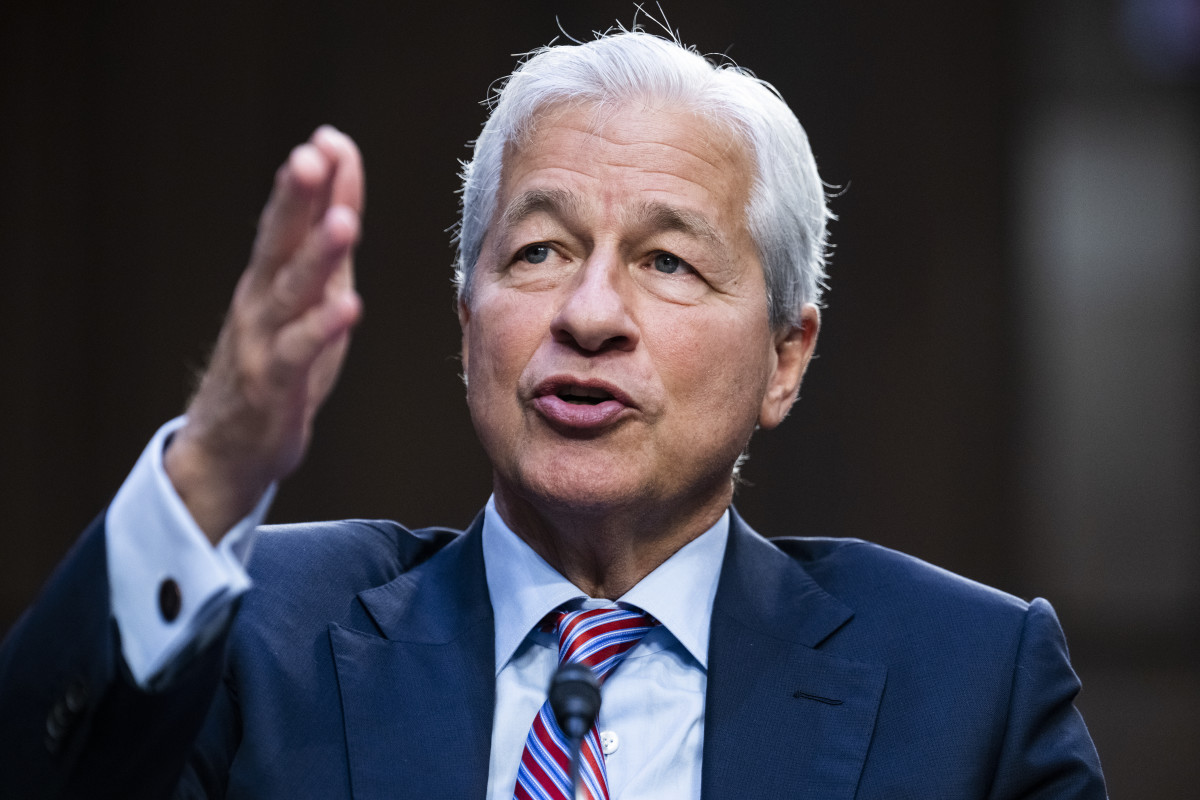
Photo by Tom Williams on Getty Images
The bank posted record profits last year and grew deposits while regional rivals fought outflows. Its trading desks printed roughly $3 billion per quarter. Net interest income climbed to all-time highs. Dimon’s caution has never come at the cost of performance.
He speaks from a position of real institutional strength. JPMorgan now commands $4 trillion in assets and $2.5 trillion in deposits, making it the largest bank in the country by market capitalization. That scale gives him visibility into credit conditions, deposit flows, and borrower stress that most investors simply cannot access from the outside.
Related: Wall Street legend sends frank message on stocks
He also lived through the last meltdown firsthand. JPMorgan acquired Bear Stearns and Washington Mutual at distressed prices as competitors collapsed in 2008. That experience sharpens his instincts when familiar patterns begin to resurface.
What this means for investors right now
Dimon stopped short of calling for a crash or setting a timeline. “There will be a cycle one day,” he said Monday. “I don’t know when. I don’t know what confluence of events will cause it.”
His guidance for investors was direct: stress-test portfolios, build cash reserves, and resist the false comfort that comes with rising markets. Complacency, he said, is precisely what makes downturns so destructive when they finally arrive.
JPMorgan runs four internal scenarios at all times, from a soft landing to a full crash, and holds $4 billion in loan loss reserves as a cushion. Dimon’s message Monday was straightforward: match that discipline before the cycle turns, not after it does.
JPM shares rose about 2% Monday. Wall Street is rewarding the vigilance for now. But Dimon’s warning is aimed squarely at what happens when that confidence starts to crack, and history suggests it always does eventually.