
Purveyors of autonomous vehicle technology promise us a future with robotic drivers that outperform human ones in every way.
But in the present, Waymo, the leading U.S. AV company, is still struggling to do things a human driver with just a learner’s permit could do easily.
Over the weekend, a tragic mass shooting unfolded in Austin, Texas, where two people were killed, and 14 others were injured, CNN reported. As one might imagine, the response from emergency vehicles was rapid and robust, befitting such a large-scale calamity.
But one emergency vehicle was filmed being severely delayed by an obstruction in the road that refused to move: a malfunctioning Waymo.
This isn’t the first time Waymo vehicles have failed to navigate emergency situations properly.
In February, a driverless Waymo vehicle with a passenger in the back drove into the middle of an active police scene before stopping in Atlanta, Georgia.
A local television news station that has been covering Waymo’s failure to stop at school buses with their stop signs deployed just happened to be on the scene filming the police standoff with an armed suspect, who had fired at law enforcement, grazing one in the head.
The camera crew filmed the motionless vehicle after it reportedly bypassed squad cars and police officers before stopping in the middle of a crime scene. A policeman can be seen in the front seat attempting to move the vehicle out of the way.
Prior to that, in December, a viral video posted on X (the former Twitter) showed a Waymo vehicle turning left onto a major avenue in Los Angeles. There is no oncoming traffic while the vehicle makes a left turn because a wall of police cars blocks the traffic coming from the opposite direction.
The police cars are empty as the police are all outside of their vehicles, pointing their guns at the driver of another car, who is lying face-first on the ground.
A police helicopter searchlight follows the Waymo as it slowly traverses the intersection, putting the vehicle directly in the police’s line of fire. Even the suspect on the ground seems confused by the car driving past him.
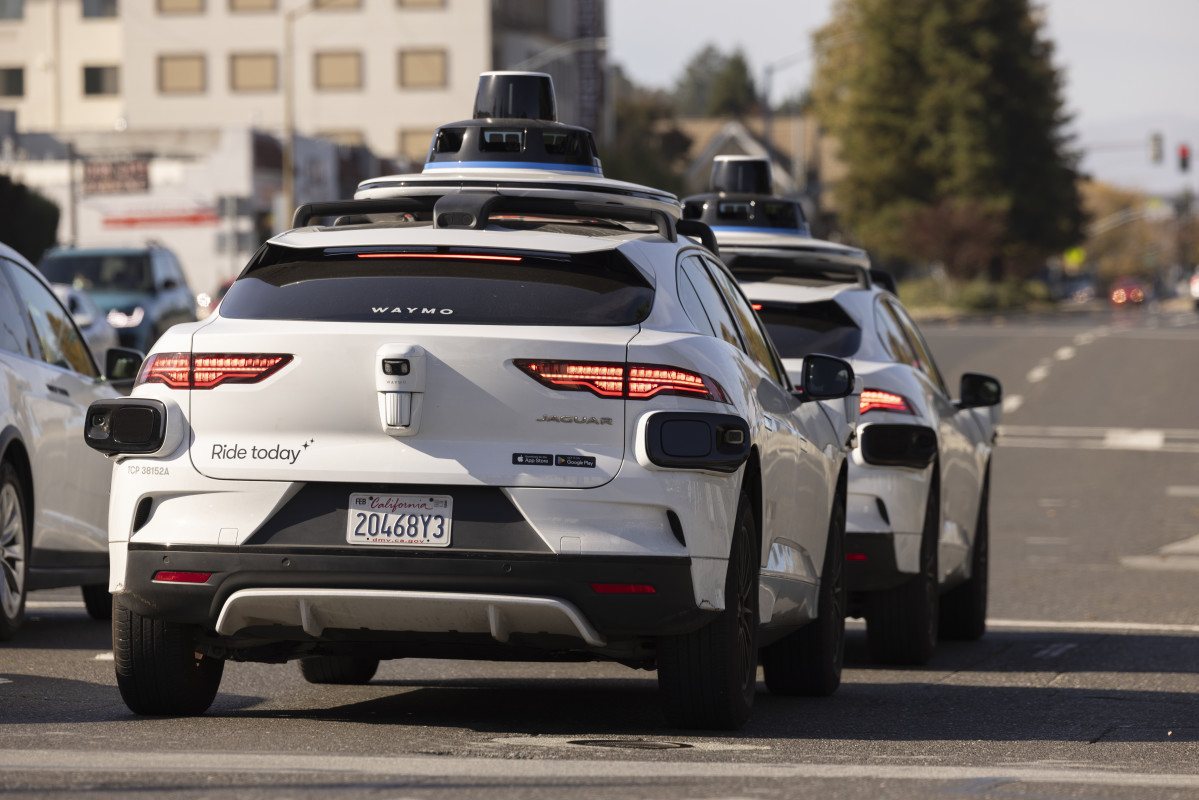 A Waymo vehicle struggled to navigate a recent emergency situation in Austin, Texas.
Photo by MattGush on Getty Images
Waymo blocks an ambulance in Austin during emergency event
A video circulating on X shows a Waymo vehicle frozen as an ambulance tries to pass. The vehicle rocks back and forth, perpendicular to the flow of traffic, completely blocking the emergency vehicle.
Eventually, a police officer opens the vehicle and moves it, but by the time he does, the ambulance’s human driver has already navigated around the malfunctioning Waymo. A bystander even shouted encouraging words to the robot to get it to move out of the way, saying, “Waymo, come on!”
Related: Waymo puts another passenger in a dangerous situation
Waymo did not immediately return a request for comment on this incident, but it did have a comment last month about the Atlanta incident in which the vehicle froze in a similar fashion in the middle of an active police scene.
“As our protocols are designed and we’ve trained first responders to do, a police officer disengaged the vehicle, and our roadside assistance team retrieved it,” Waymo said in a statement to 11Alive.
That appears to be how the Austin incident was handled. A first responder knew to open the door and move the vehicle manually.
While the situation could have been worse, three incidents represent a definite trend, and at least one expert has an explanation for what we are seeing.
Human drivers outperform autonomous vehicles in one key area
Waymo’s safety data show that its vehicles are significantly safer than human drivers, but the closer you look at the numbers, the less convincing they become.
Waymo says that, compared to those with human drivers, its autonomous vehicles have been involved in 90% fewer crashes resulting in serious injuries.
Related: Waymo crosses major threshold amid nagging issues
But one researcher says that while Waymo can fall back on that number, the vehicle still struggles with basic situations that most humans wouldn’t find challenging at all, such as allowing an ambulance to pass and avoiding police shootouts.
“In like 95% of situations where a disengagement or accident happens with autonomous vehicles, it’s a very regular, routine situation for humans,” Henry Liu, professor of engineering at the University of Michigan, said recently, Bloomberg reported. “These are not challenging situations whatsoever.”
“We have seen many reports from autonomous vehicle developers, and it looks like the numbers are very good and promising,” Liu said. “But I haven’t seen any unbiased, transparent analysis on autonomous vehicle safety. We don’t have the raw data.”
Even Waymo’s data are suspect, according to Liu.
Waymo vehicles primarily drive on urban streets with a speed limit of 35 miles per hour or less. “It’s not really fair to compare that with human driving,” according to Liu.
Waymo ostensibly agrees with Liu, to an extent.
“Waymo is already improving road safety in the cities where we operate, achieving more than a tenfold reduction in serious injury or worse crashes,” Trent Victor, Waymo’s director of safety research and best practices, recently told Bloomberg.
Related: Alphabet’s quiet $110B Waymo move blows up ‘other bets’ narrative