
Alan Greenspan, the 13th Chair of the U.S. Federal Reserve, is one of the most powerful and influential economists in history. First appointed by President Ronald Reagan, Greenspan was reappointed four more times by three other Presidents due to his ability to keep inflation low, foster long-term economic expansion, and manage crises.
During his tenure, which spanned an amazing 18 years, from August 11, 1987, until January 31, 2006, Greenspan’s decisions had far-reaching effects; in fact, many believe his influence is still felt in the economy today.
As the “Maestro” of economic policy approaches his 100th birthday, we take a look at Greenspan’s life and legacy, along with the substantial net worth he has amassed through the years, which makes him one of the richest Fed Chairs, second only to Jerome Powell.
What is Alan Greenspan’s net worth in 2026?
According to most sources, Alan Greenspan has a net worth of $20 million in 2026. His wealth stems from consulting fees, public speaking engagements, and book deals—he received $8.5 million from Penguin Press for his 2007 memoir, The Age of Turbulence: Adventures in a New World, which was one of the largest nonfiction book advances in publishing history.
Ben Bernanke, in comparison, earned around $1 million for his 2015 memoir, The Courage to Act.
In fact, compared with the other recent Fed Chairs, Greenspan sits near the top of the monetary heap:
Jerome Powell
February 2018–present
$20–$55 million
Executive roles in private equity, investment banking, and his consulting firm, Severn Capital Partners
Alan Greenspan
August 1987–January 2006
$20 million
Consulting fees, speaking engagements, book sales
Janet Yellen
February 2014–February 2018
$16 million
Speaking engagements, academic career, investments, real estate
Ben Bernanke
February 2006–January 2014
$5 million
Consulting fees, academic career, speaking engagements, textbook sales
Paul Volcker
August 1979–August 1987
$15 million (posthumous)
Consulting, Board roles
Source: Celebrity Net Worth
Why is Alan Greenspan important? How did he differ from other Fed chairs?
You could say that under Greenspan, the Federal Reserve transformed from a mostly reactive institution into one that actively supported asset markets during times of crisis. The “Black Monday” stock market crash of 1987 is one example.
On October 19, 1987, the Dow Jones Industrial Average lost 22.6% of its value, wiping out $500 billion in one trading session. The crash was triggered by a breakdown in the computerized trading systems of the era.
Astonishingly, bank runs and a greater financial meltdown were largely averted, thanks to Greenspan’s swift actions. The Fed cut interest rates by 50 basis points the next day and also began a round of what would later become known as quantitative easing. Greenspan also released a statement that restored confidence to rattled investors:
These actions helped usher in a new era for the Fed, one marked by increased transparency and communication, with language and testimony serving as policy tools.
And by doing so, the Fed chair became an economic rock star.
Alan Greenspan’s early life and career
Alan Greenspan was born on March 6, 1926, in Washington Heights, New York City. His parents, Herbert Greenspan and Rose Goldsmith, divorced when he was a child. The New York Times reported that Rose was just 17 years old when they married, and that the Stock Market Crash of 1929 “sealed their fate.”
After their divorce, Greenspan and his mother moved with his mother’s parents into a cramped one-bedroom apartment. Rose made ends meet during the Great Depression by working at a department store. Greenspan hardly ever saw his father, who was a stockbroker, but when he did, he was “ecstatic.”
On one of their infrequent visits together, Herbert gave Greenspan a book he had written, Recovery Ahead!, which detailed President Franklin D. Roosevelt’s New Deal. He inscribed it to his son, writing:
But despite his father’s best intentions, life happened, and Greenspan’s interests changed. In fact, as a student at George Washington High School, Greenspan took up the clarinet and saxophone and even played alongside famed musician Stan Getz.
After being declared medically unfit for World War II military service due to an issue with his lungs, Greenspan briefly attended the Juilliard School but dropped out to play in Henry Jerome’s traveling dance band.
Greenspan recalled that he was a “good amateur” but an “average professional,” compared to musicians like Getz. Between sets, Greenspan would often read books on economics and mathematics; he also handled the band’s accounting, which sparked his interest in economics.
In 1945, Greenspan left the band to study at New York University’s Stern School of Business, earning a master’s degree in economics. After briefly studying at Columbia University, Greenspan eventually earned his PhD in economics from NYU in 1977. In the meantime, Greenspan joined the consulting firm, Townsend-Greenspan & Co., with bond trader William Townsend, who recognized his talents.
After Townsend’s death in 1957, Greenspan led the firm for several decades, advising corporations like Alcoa, General Motors, and U.S. Steel. In addition, he served as an economic adviser for President Richard Nixon and as Chair of the Council of Economic Advisers under President Gerald Ford. He was also on President Ronald Reagan’s Economic Policy Advisory Board before his appointment to Chair the Federal Reserve Board of Governors in 1987.
Alan Greenspan’s Federal Reserve tenure
With Greenspan at the Fed’s helm, the U.S. economy enjoyed one of its longest uninterrupted expansions in history, with the S&P 500 rising roughly 550% between August 1987 and January 2006 (excluding reinvested dividends).
Greenspan finished the task of moderating inflation to 2%—something his predecessor, Paul Volcker, had drastically reduced, from its nearly impossibly steep peak of 15% in 1980 down to 4% in 1983.
But instead of sudden, sharp rate hikes, like Volcker had employed, Greenspan utilized a more gradual approach, a “measured pace,” in his words, that signaled the Fed’s next steps through its FOMC statements and testimony.
Greenspan wasn’t afraid to ignore political pressure from the White House, either, which marked another shift in Fed leadership philosophy. For instance, facing re-election amidst a sluggish economy, President George H.W. Bush pressured Greenspan to cut rates in 1992, but Greenspan did not concede.
Greenspan actually raised rates in 1994, despite pressure from the Clinton Administration, from 3% to 6% over 13 months to combat rising inflation. His actions cooled the economy without triggering a recession, a feat known as a “soft landing.”
By doing so, Greenspan also helped to establish a new benchmark for the central bank’s independence.
Why is Alan Greenspan’s legacy complicated?
But hindsight is always 20/20, and despite Greenspan’s achievements, his actions have received much criticism in recent years for fueling long-term asset bubbles, particularly in technology and housing, while ignoring the rise of risky derivatives.
In fact, as early as December 1996, Greenspan admitted the markets may have been overvalued, stating, “How do we know when irrational exuberance has unduly escalated asset values, which then become subject to unexpected and prolonged contractions as they have in Japan over the past decade?”
These asset bubbles would pop—to spectacular effect—resulting in the dot-com crash, the 2008 Financial Crisis, and the Great Recession.
(In The Age of Turbulence, Greenspan revealed the term “irrational exuberance” came to him while he was in the bathtub, writing a speech.)
Does Alan Greenspan follow Ayn Rand?
Likewise, Greenspan’s “laissez-faire” approach to financial regulation has received much censure in recent years, as has his association with the philosopher Ayn Rand. In the 1950s and 60s, Greenspan was a member of “The Collective,” Ayn Rand’s inner circle, and even contributed essays to her book Capitalism: The Unknown Ideal (1966).
Greenspan often advocated for the market’s “rational self-interest” and employed a “hands-off” regulatory approach, principles that align with Objectivism, a movement Rand founded.
More on economic crises:
- What Was the Financial Crisis of 2007–2008? Causes, Outcomes & Lessons Learned
- What Was the Dot-Com Bubble & Why Did It Burst?
- What Was the Stock Market Crash of 1929? Definition, Causes & Outcomes
Critics have also derided “The Greenspan Put,” as it came to be known, the practice through which the central bank employed interest rate cuts whenever the markets were in distress, since it effectively incentivized risky market behavior.
In the midst of the Financial Crisis, on October 23, 2008, Greenspan was called before the House Committee on Oversight and Government Reform, where he admitted that he had “made a mistake in presuming that the self-interest of organizations, specifically banks and others, were such is that they were best capable of protecting their own shareholders and their equity in the firms.”
In other words, he conceded that his belief in the self-correcting nature of free markets was flawed.
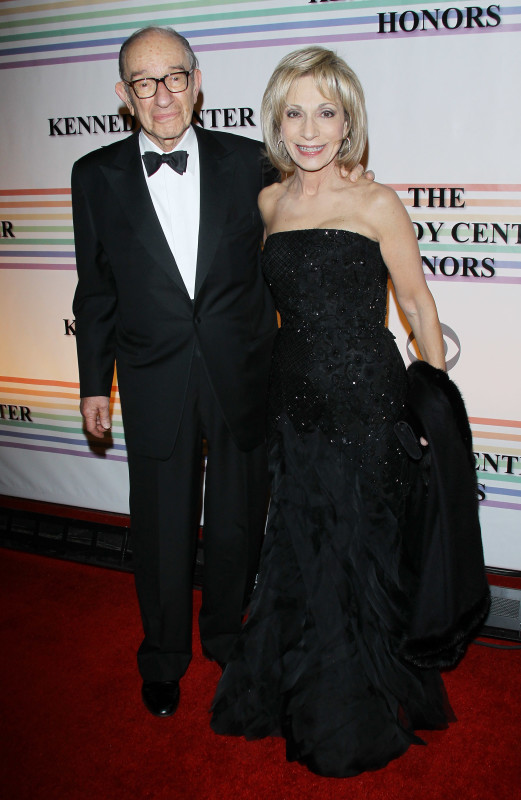 Alan Greenspan and his wife, reporter Andrea Mitchell, at the 34th Kennedy Center Honors on December 4, 2011, in Washington, DC.
Michael Tran/Getty Images
Alan Greenspan’s personal life
Known as “a glamorous figure in academic circles,” Greenspan dated TV anchor Barbara Walters in the 1970s while he was working on his PhD dissertation.
His first marriage, to artist Joan Mitchell, was annulled in 1952.
Greenspan began dating NBC News reporter Andrea Mitchell in 1984; despite their 20-year age difference (he was 58 and she was 38), their relationship stood the test of time. They were married on April 6, 1997, in a ceremony officiated by Supreme Court Justice Ruth Bader Ginsburg. They remain married today and have been photographed together at numerous high-profile events.
Greenspan and Mitchell split their time between New York City and Washington, DC.
What is Alan Greenspan doing now?
Although he has largely withdrawn from the public eye in recent years, Greenspan actively maintains his consulting firm, Greenspan Associates, LLC. His last high-profile appearances surrounded his 2018 book, Capitalism in America: A History.
That year, he also survived a Twitter hoax announcing his death.
His wife, Andrea, took to the platform, stating, “By now you know the rumors are a hoax. Alan’s doing great. In fact, he has a book out next week!”