
Bill Ackman is making waves yet again, marking another run at the public markets. However, there is a difference. This time around, Ackman is giving investors something much more exciting.
Ackman’s Pershing Square filed documents for a combined U.S. initial public offering of the hedge fund management company and a new investment vehicle called Pershing Square USA.
The structure will see the return of a plan that was abandoned in 2024, when Ackman quickly set aside plans for the company to go public.
The new structure is more layered and more nuanced. Pershing Square USA is seeking to raise between $5 billion and $10 billion through an IPOand private placement. Shares will be priced at $50 each,
People who invest in the new offering will also get shares in Pershing Square itself, giving an extra layer of sauce to the deal Ackman is hoping will entice investors.
That main theme is for the offering to stand out. It’s not merely an attempt for Ackman to make the offering stand out. Investors are not being told to target Ackman’s stock-picking strategy. They are being asked to buy into a structure that ties a new fund to the management company behind it.
For Ackman, the filing represents more of a financing incident. It’s a fresh test to see whether investors are willing and able to splash their cash on one of Wall Street’s most visible and closely followed hedge fund brands.
“While the structure is innovative, it may be overly convoluted for retail investors,” said Troy Hooper, co-head of equity capital markets, North America, at Mergermarket.
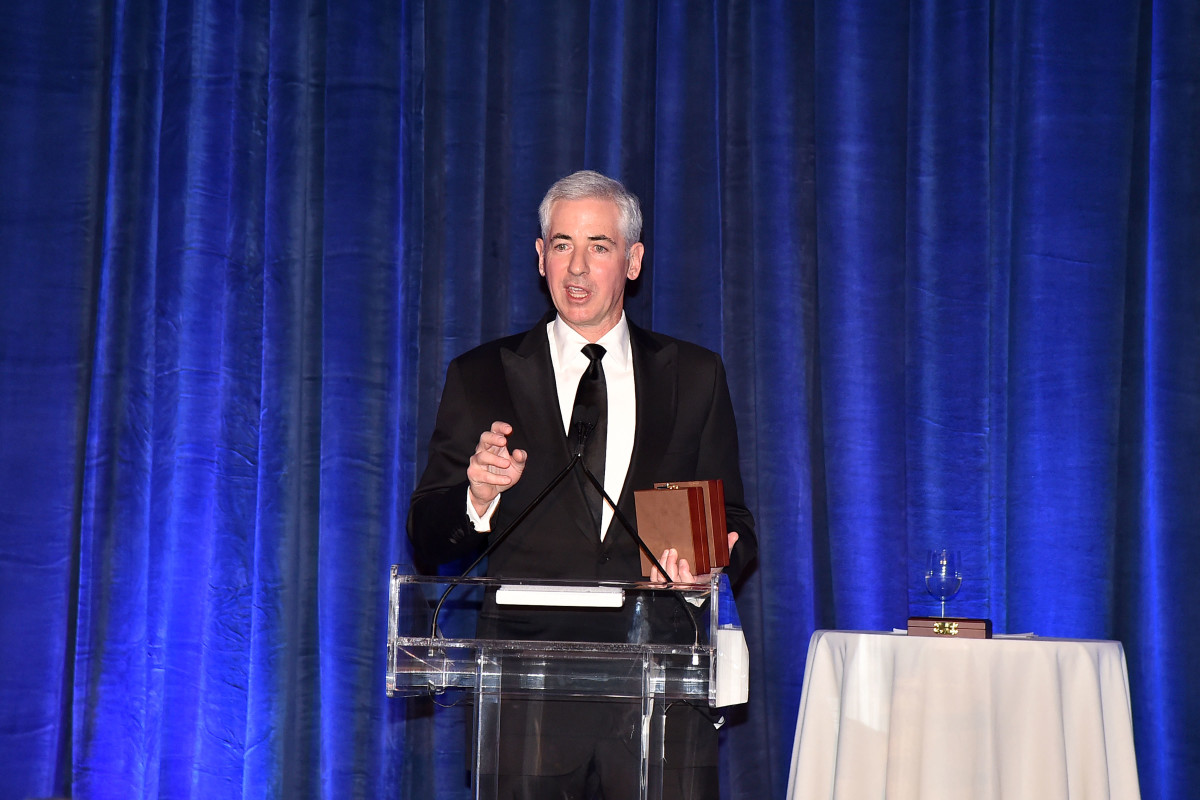 While the structure is innovative, it may be overly convoluted for retail investors.
Photo by Patrick McMullan on Getty Images
Pershing Square IPO structure adds complexity for investors
Ackman’s latest move does not represent a comeback of last year’s failed Pershing Square USA offering. Instead, it is part of a bigger effort to get both the investment manager and the new fund in front of public investors at the same time.
More Fund Managers:
- Ray Dalio’s Bridgewater invests $253 million in major AI stock
- JPMorgan builds $2.93 billion stake in health care stock
- Jim Simons’ Renaissance drops $520 million on surging tech stock
Pershing Square will list on the New York Stock Exchange under the symbol PS, while Pershing Square USA will trade under the symbol PSUS. Investors who purchase stock in PSUS will get 20 shares in Pershing Square for every 100 shares bought in the new investment vehicle.
Related: Oil shock sends blunt message on stock market inflation risk
Investors in the private placement will get 30 Pershing Square shares for every 100 PSUS shares they buy.
That sweetener is the main point of the pitch. If an investor buys the stock, they will get dual access to the investment vehicle. This means that the investor gets to see not only the fund’s holdings but also the management company’s finances.
Ackman is effectively trying to make the deal more attractive by bundling two bets together.
But for me, the issue is that the move also makes the investment harder to evaluate because it complicates the assessment of the individual performance of each component of the bundled investment.
Pershing Square USA is likely to be similar to Ackman’s current hedge fund and put money into 12 to 15 undervalued companies that are listed on North American stock exchanges. It won’t charge performance fees, which could make the vehicle more appealing to a wider range of investors.
The bigger concern remains the closed-end structure. The issue may irk a certain section of investors who will not be able to redeem shares for the underlying assets, which means the stock could fall below net asset value.
That risk is common in closed-end funds, and more Pershing Square shares may not fully make up for it if sentiment drops.
People who like Ackman might think the structure is creative. Some people might see it as one more risk in a market that hasn’t always rewarded complexity.
On a positive side note, Pershing Square USA already has $2.8 billion in private placement commitments from family offices, pension funds, and insurance companies.
Ackman already has premium-style backing before he opens the offering to regular stockholders, demonstrating how the broader market views the investment.
That kind of support matters because IPO buyers are growing more picky, as they increasingly seek investments with strong backing and proven track records to mitigate risks associated with new offerings.
A recognizable name like Bill Ackman certainly helps. However, when it comes to a complex offering like the one we are discussing, strong demand is important to succeed. What Ackman is betting on is his reputation.
When investors such as Ackman and Cathie Wood, as an example, speak about something or come out with an offering, there are very few that do not sit up and take notice. In short, his track record and the added share incentive will be enough to overcome those concerns.
Ackman said that unstable markets might actually be beneficial for an investment vehicle like PSUS. He said that a fund can do better when market disruptions create better buying opportunities, which is not the case with a typical operating company.
That may prove true. But what that means is that investors must believe in and respect not only Ackman’s long-term instincts, but also his timing.
Bill Ackman’s public profile is part of the Pershing Square bet
Ackman is not your average money manager, and that is what makes this deal unique.
He no longer works on traditional activist campaigns. Instead, what he focuses on is a more concentrated style that focuses on just a few investments. The emphasis is on patience and conviction for Ackman.
Related: Stock Market Today: Morgan Stanley makes bold S&P 500 projection as U.S. dollar weakens
That approach is what has helped Pershing Square become one of the most followed and valued firms on Wall Street. It has also made Ackman himself part of the investment thesis.
Pershing Square holds roughly $30.7 billion in assets under management at the end of December 2025, with most of that capital invested in London-listed Pershing Square Holdings. The firm also disposed of a 10% stake to institutional investors and family offices in 2024 at a $10.5 billion valuation ahead of the earlier planned IPO.
Those figures will give investors reason for pause. However, within the context of the latest filing, they do not answer the main question that is circulating: how much are public investors willing to pay for exposure to Ackman himself?
Unlike many hedge fund executives, Ackman boasts a big public profile in the investing world. His comments on X and on political and economic issues will impact the man on the street as much as big executives on Wall Street. That level of visibility has helped him become a well-known market figure that few asset managers can match.
Key takeaways from the Pershing Square filing
- Pershing Square and Pershing Square USA filed for IPOs on March 10.
- Pershing Square plans to trade under PS and Pershing Square USA under PSUS.
- Pershing Square USA is seeking to raise between $5 billion and $10 billion.
- Shares in Pershing Square USA are being offered at $50 each.
- Public investors in PSUS would receive 20 Pershing Square shares for every 100 PSUS shares purchased.
- Private-placement investors would receive 30 Pershing Square shares for every 100 PSUS shares purchased.
- Pershing Square USA has secured $2.8 billion in private-placement commitments, Reuters reports.
- The new fund is expected to invest in 12 to 15 undervalued North American-listed companies.
Such visibility can go both ways. Investors may be interested in Ackman because he is confident, well-known, and has a history of making big, risky bets. But there is a real risk to the company’s reputation, especially when the manager’s public image is so closely linked to the brand. Negative public perception or failed investments can significantly impact both the manager’s credibility and, ultimately, the investment in said IPO.
That is why this IPO is much more about valuation than how it is structured. This IPO also determines whether investors desire to have access to Ackman’s strategy, style, and influence as primary investors.
If they do, Pershing Square could finally get the public debut it has been waiting for. If not, the market might decide that even having a lot of star power isn’t enough.