
Rivian isn’t out of the woods yet, but the startup electric vehicle manufacturer is on the right path following its recent partnership with Uber, according to a new note from analysts at JPMorgan.
Last week, on March 19, Rivian and Uber announced a partnership in which Uber will invest up to $1.25 billion in Rivian and deploy as many as 50,000 autonomous R2 vehicles on its ride-hailing platform.
The vehicle’s autonomous rides are expected to launch in San Francisco and Miami in 2028, with plans to expand to as many as 25 cities across North America and Europe by 2031.
If everything goes to plan, the deal also gives the companies the option to negotiate the purchase of up to 40,000 more autonomous Rivian R2s beginning in 2030.
“We couldn’t be more excited about this partnership with Uber — it will help accelerate our path to level 4 autonomy to create one of the safest and most convenient autonomous platforms in the world,” Rivian CEO RJ Scaringe said.
And analysts at JPMorgan agree with Scaringe’s excitement, saying in an analyst note over the weekend that the deal is “mostly positive.”
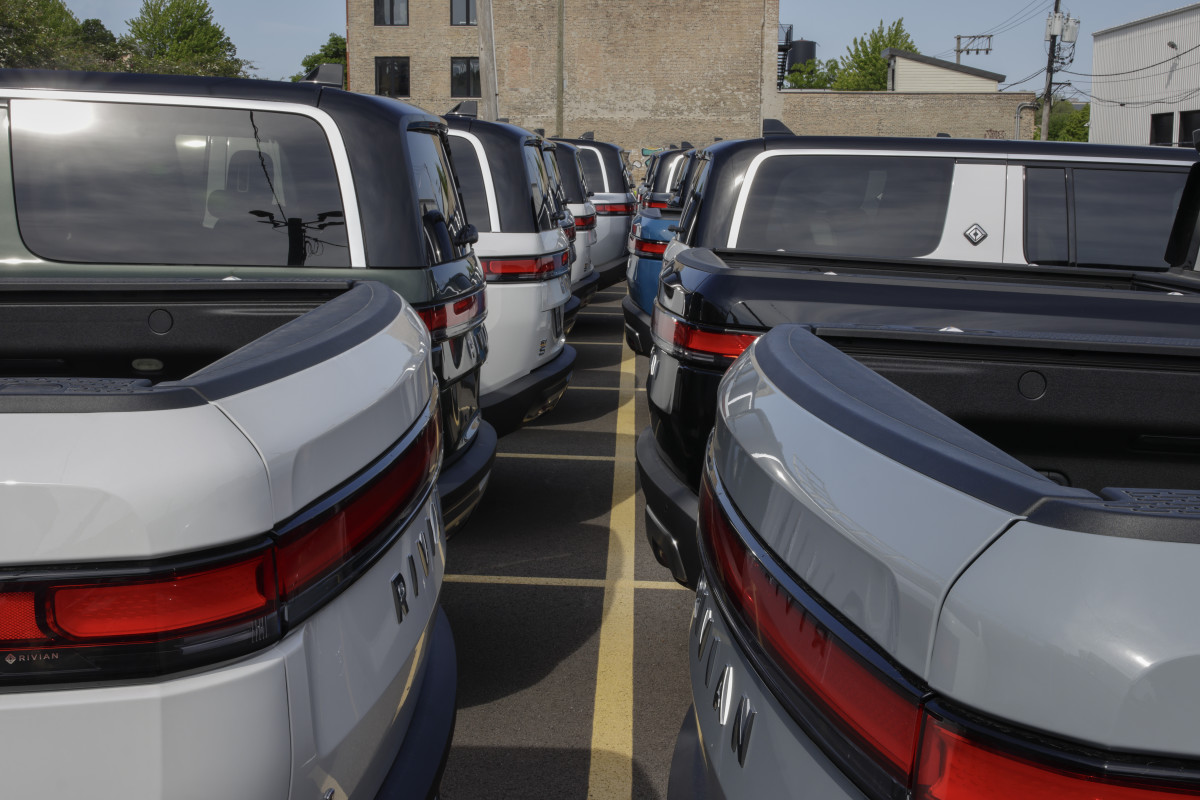
Photo by jetcityimage on Getty Images
JPMorgan analysts back Rivian deal with Uber
Over the weekend, JPMorgan analysts gave their seal of approval to Uber’s $1.25 billion investment in Rivian, saying that the deal to supply the ride-hailing company with tens of thousands of autonomous vehicles in two years was promising.
While the firm maintained its “underweight” rating and $9 price target on Tesla’s main domestic rival, the firm says the deal helps alleviate some of Rivian’s excessive cash burn as the electric vehicle maker continues to report “persistently large” operating losses and free cash outflows.
Related: Rivian, Uber stocks struggle, but robotaxi deal may change the story
That extra cash will come in handy as Rivian navigates what analysts describe as a “seemingly increasingly structurally unprofitable” EV market, according to TipRanks.
In the fourth quarter, Rivian reported an adjusted loss of 54 cents per share on revenue of $1.29 billion. For the first time ever in 2025, Rivian closed out the full year with an annual gross profit of $144 million, thanks to an 8% increase in revenue to about $5.4 billion.
But much of that profit was due to Rivian’s software and services segment, since its automotive business lost $432 million dollars last year.
According to an SEC filing last week, Rivian no longer expects positive EBITDA by 2027, due to increased research and development spending on autonomous driving resulting from the Uber deal.
Rivian unveils updated AI strategy at Autonomy & AI Day
Rivian understands that to compete with Tesla, it must be more than just a car company; it must also be a technology leader.
Tesla Full Self-Driving (Supervised) is an industry-leading advanced driver assistance system, and Rivian believes it has the tech to surpass FSD.
Related: Consumer Reports names 5 popular EVs with the worst range
Rivian states that it is investing in hardware and compute infrastructure, developing an advanced, end-to-end AI autonomy system that scales, and harnessing a “shared data foundation” that will transform the ownership experience for its customers.
During its Autonomy & AI Day in December, Rivian introduced the Gen 3 Autonomy Computer, its third-generation compute platform, which it says will have the “leading combination of vehicle sensors and inference available in North America.”
The Gen 3 Autonomy Computer can process 5 billion pixels per second, thanks to the Rivian Autonomy Processor, its proprietary silicon chip that Rivian claims is among the first multi-chip modules used in high-compute applications in the automotive industry.
The company also announced that it is integrating LiDAR into its fleet, starting with future R2 models, marking another difference from Tesla. Musk has called LiDAR expensive and unnecessary.
LiDAR (light detection and ranging) uses laser lights to measure distances and create more precise 3D maps, and Rivian says the tech “provides detailed, three-dimensional spatial data and redundant sensing,” adding another layer of safety to its system.
At the time, Rivian said its vehicles would achieve point-to-point, hands-free navigation by March of this year.
“You can be on your phone or reading a book, no longer needing to be actively involved in the operation of the vehicle,” Scaringe said, according to the Wall Street Journal.
Starting in March, charged for the hands-free feature. Customers can either purchase a $50-per-month subscription or pay a one-time charge of $2,500.
But recent testing suggests there are still many bugs to be resolved.