
In the beginning, there was Pico Canyon.
The location in California’s Santa Susana Mountains entered history in 1865 when a hunter named Ramon Peria noticed dark, green-colored oil in a spring.
Peria concluded the stuff was valuable, the Los Angeles Times reported in 1882, and, boy, was he right. Pico Canyon became the first commercially successful oil well in the Western United States and is considered the birthplace of California’s oil industry.
Star Oil began drilling there in 1876. While three wells showed promise, Well No. 4 was the gusher. And the company that grew out of the Pico Canyon operation would eventually become Chevron (CVX) we know today.
Here’s how it happened.
Chevron’s early years & former names
The company became part of Standard Oil in 1900 and later operated under several names, including Pacific Coast Oil, Standard Oil of California, Socal, and ChevronTexaco, before settling on Chevron in 1984.
Chevron is one of the largest companies in the world and the second-largest U.S.-based oil company by revenue, second only to ExxonMobil (XOM).
Both companies sprang from the landmark 1911 Supreme Court ruling that found Standard Oil was an illegal monopoly and broke it up into 39 different entities.
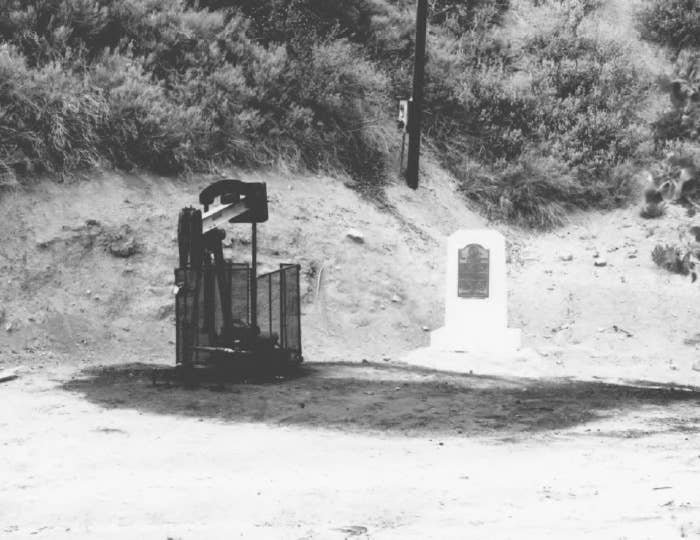 Pico Canyon Well Number 4, the “gusher” that started it all, is pictured here in 1961.
National Park Service, public domain via Wikimedia Commons

Chevron & the Dow Jones
Chevron has had a lengthy relationship with the Dow Jones Industrial Average.
Standard Oil Co. of California, as the company was known at the time, first entered the Dow in February 1924 before leaving in August 1925.
The company rejoined the 30-company index in 1930 and got caught up in a major market shakeup in 1999 that saw Chevron, Goodyear (GT), Sears, and Union Carbide replaced by Microsoft (MSFT), Intel (INTC), Home Depot (HD), and SBC Communications.
Related: Who owns Chevron? Understanding who controls one of the world’s largest energy companies
Chevron rejoined the Dow in 2008 along with Bank of America (BAC), replacing tobacco company Altria Group (MO) and industrial manufacturer Honeywell International (HON).
Active in more than 180 countries, the company is now the last remaining oil-and-gas component of the Dow Jones Industrial Average since ExxonMobil exited the index in 2020 and was replaced by Salesforce. (CRM)
Chevron’s stock split history
Chevron has split its stock five times, most recently on Sept. 13, 2004. Previous splits occurred in 1994, 1981, 1973, and 1962.
Had the company never split its stock, a single share would have been worth over $3,400 as of late March 2026.
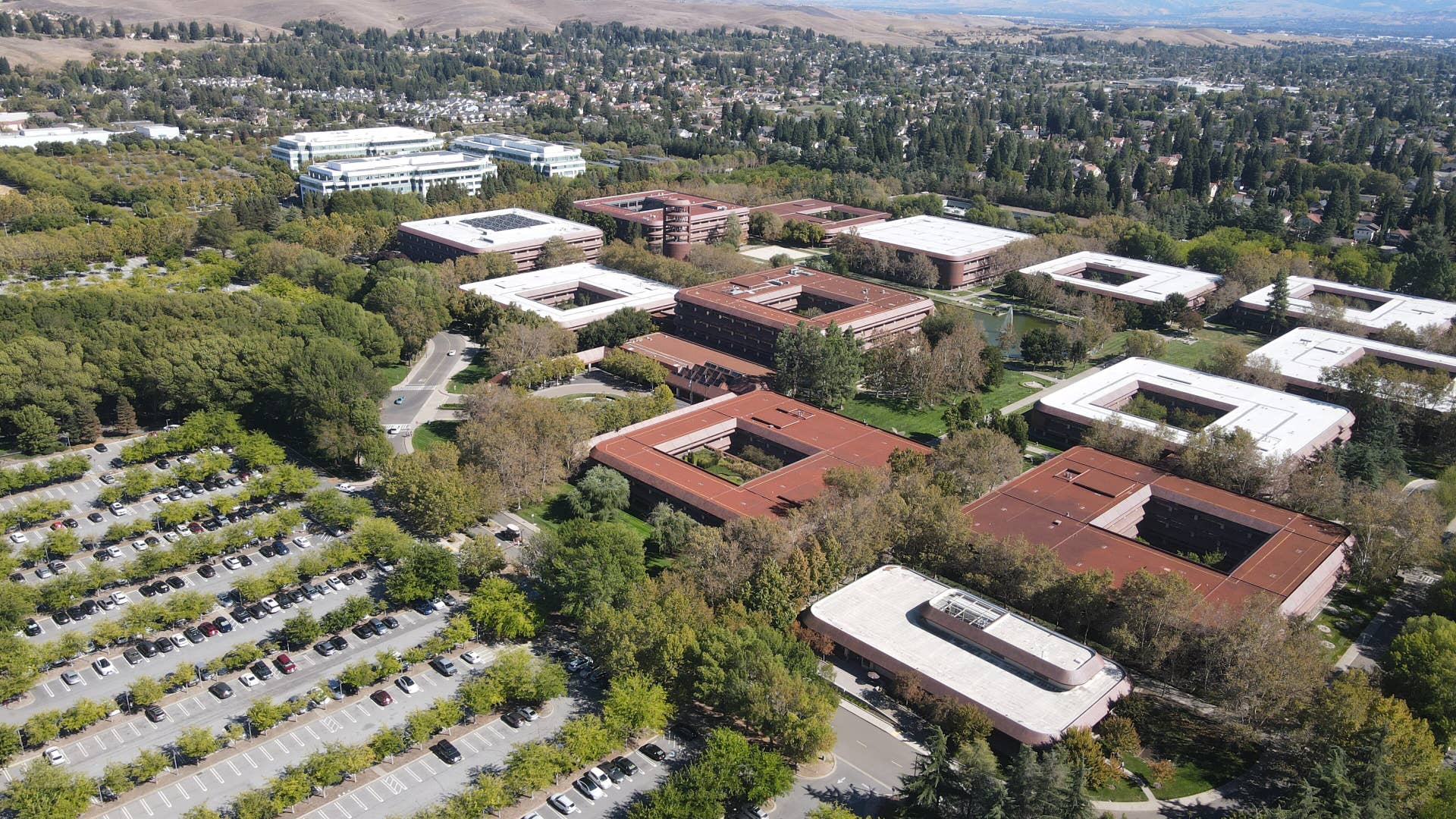 Pictured here are Chevron’s former headquarters in San Ramon, CA.
InvadingInvader, CC-BY-SA-4.0 via Wikimedia Commons

Chevron’s layoffs and the future of its stock
Even as it celebrates a long history, Chevron is reshaping its business for the future.
In 2024, for instance, the company announced it would relocate its headquarters from San Ramon, California, to Houston, Texas.
Chevron also announced that it is planning to slash between 15% and 20% of its 41,000 workers worldwide by the end of 2026 in a massive round of layoffs. Chevron had said earlier that its goal was to save between $2 billion and $3 billion through “structural” cost reductions.
“Chevron is taking action to simplify our organizational structure, execute faster and more effectively and position the company for stronger long-term competitiveness,” a company spokesperson said.
Chevron shares were up about 24% in 2026 as of this article’s last update, and CEO and Chairman Mike Wirth told analysts in January that the company is “bigger, stronger, and more resilient than ever.”
“We’re entering 2026 from a position of strength and will continue building on our momentum in the years ahead,” Wirth said during the company’s fourth-quarter earnings call. “2025 was a year of execution. We set records, started up major projects, and strengthened our portfolio.”
“And for the fourth consecutive year, we returned a record cash to shareholders, delivering on our consistent approach to superior shareholder returns.”
Related: Is Chevron a good long-term investment? Its buy-and-hold prospects explained
In July 2025, Chevron closed its $55 billion acquisition of Hess after prevailing against Exxon Mobil in a legal dispute over offshore oil assets in Guyana.
The ruling by the International Chamber of Commerce was a huge win for Chevron, which had sought to buy Hess to gain access to the vast Guyana oil reserves.
“We have maintained from the beginning that this is the outcome that we expected. It’s a straightforward interpretation of contract language, and we’re very pleased that the transaction has now closed,” Wirth told CNBC.
Chevron’s financials: Revenue, income & dividends
For the full year 2025, Chevron (CVX) reported annual revenue of roughly $189.03 billion, down about 6.79% year-over-year, reflecting a lower-price commodity environment despite record production levels, particularly following the integration of Hess Corp.
Net income for 2025 was $12.48 billion, a nearly 30% decline from 2024, driven by lower oil prices.
Chevron recently raised its dividend by 4%, extending its dividend growth streak to 39 consecutive years. The stock currently yields about 3.9%, more than triple the roughly 1.2% yield of the S&P 500.
Related: Does Chevron pay dividends? When & how often?
Matt Diallo, a contributing Motley Fool stock market analyst, called Chevron “a dividend-paying juggernaut.”
Bank of America analyst Jean Ann Salisbury recently said Wall Street may be underestimating Chevron’s affiliate cash flows and the durability of the geopolitical risk premium in crude prices.
Chevron’s milestones: A company timeline
1876: Chevron predecessor Star Oil begins pumping oil at the Pico Canyon Oilfield in the Santa Susana Mountains north of Los Angeles.
1879: Pacific Coast Oil Co. acquires Star Oil’s assets.
1900: Standard Oil Co. & Trust purchases Pacific Coast Oil.
1911: Standard Oil Co. (California) becomes an independent following the antitrust breakup of the Standard Oil trust.
1930s–1940s: The company expands globally, discovering oil in Bahrain (1932) and Saudi Arabia (1938).
1984: Chevron merges with Gulf Oil Corporation, leading to a name change to Chevron Corporation.
2001: Chevron merges with Texaco, temporarily becoming ChevronTexaco.
2005: The company acquires Unocal Corporation and rebrands as Chevron.
2020–2023: Chevron expands its portfolio with acquisitions of Noble Energy (2020), Renewable Energy Group (2022), and Hess Corporation (2023).
2024: Chevron announces the relocation of its headquarters from San Ramon, California, to Houston, Texas.
2025: Chevron completes its $53 billion acquisition of Hess Corporation.
Related: What does Chevron mean? A look inside its corporate logo