
Jensen Huang just said something the AI industry has been tiptoeing around for years. On the Lex Fridman podcast released March 22, the Nvidia CEO said plainly: “I think it’s now. I think we’ve achieved AGI.”
The clip spread immediately. It is a loaded statement from the man whose company’s chips power roughly 80% of AI training worldwide. When Huang says artificial general intelligence (AGI) has arrived, the industry pays attention. Even if most of it disagrees.
What Huang actually said about AGI
The context matters. Fridman posed a specific definition of AGI before asking the question. His benchmark was an AI system capable of starting, growing, and running a successful technology company worth more than $1 billion.
He asked Huang for a timeline. Huang did not hesitate. “I think it’s now,” he said.
Then he immediately hedged. Huang noted that Fridman had said a billion-dollar company, but not for how long. “You said a billion, and you didn’t say forever,” he told Fridman.
More Nvidia:
- Goldman Sachs sends blunt message on Nvidia stock after GTC
- Nvidia CEO makes bombshell call on AI’s next big thing
- Bank of America resets Nvidia stock forecast after meeting with CFO
His example was OpenClaw, an open-source AI agent platform that has gone viral as developers use individual agents to launch social applications and creative experiments. Huang said he “wouldn’t be surprised if some social thing happened or somebody created a digital influencer” through these tools. That, in his framing, already clears Fridman’s bar.
Fridman’s response was telling. “You’re gonna get a lot of people excited with that statement,” he said.
What Huang’s definition of artificial general intelligence includes and excludes
Huang is not describing the sci-fi version of AGI. He acknowledged limits within the same conversation. His framework, drawn directly from the transcript, looks like this.
- What qualifies: AI agents that autonomously create something of economic value, such as a billion-dollar app or service, even briefly.
- What does not qualify: Building and sustaining a complex institution over decades. Huang admitted that even hundreds of thousands of agents could not build Nvidia.
- The missing pieces he acknowledges: Physical world understanding, long-horizon strategy, and common-sense reasoning that humans develop through lived experience.
That is a narrow definition. It measures economic output, not cognitive breadth. It is either a pragmatic reframing of AGI or a redefinition that moves the goalposts, depending on who you ask.
Why Huang’s AGI enthusiasm matters now
The tech industry has spent recent months retreating from the AGI label. Companies have introduced softer terminology designed to manage expectations and reduce regulatory scrutiny.
Huang is doing the opposite. He is embracing the term at full volume. That matters because the word carries real contractual weight. At companies including OpenAI and Microsoft, performance benchmarks and risk clauses are tied to whether AGI has been officially achieved.
Critics are pushing back on the substance. Academic researchers argue that AGI requires human-level performance across all cognitive tasks. Current AI systems still hallucinate facts, struggle with novel reasoning, and lack genuine understanding in the way humans build it through experience.
The gap between what AI does today and what most researchers mean by AGI remains significant.
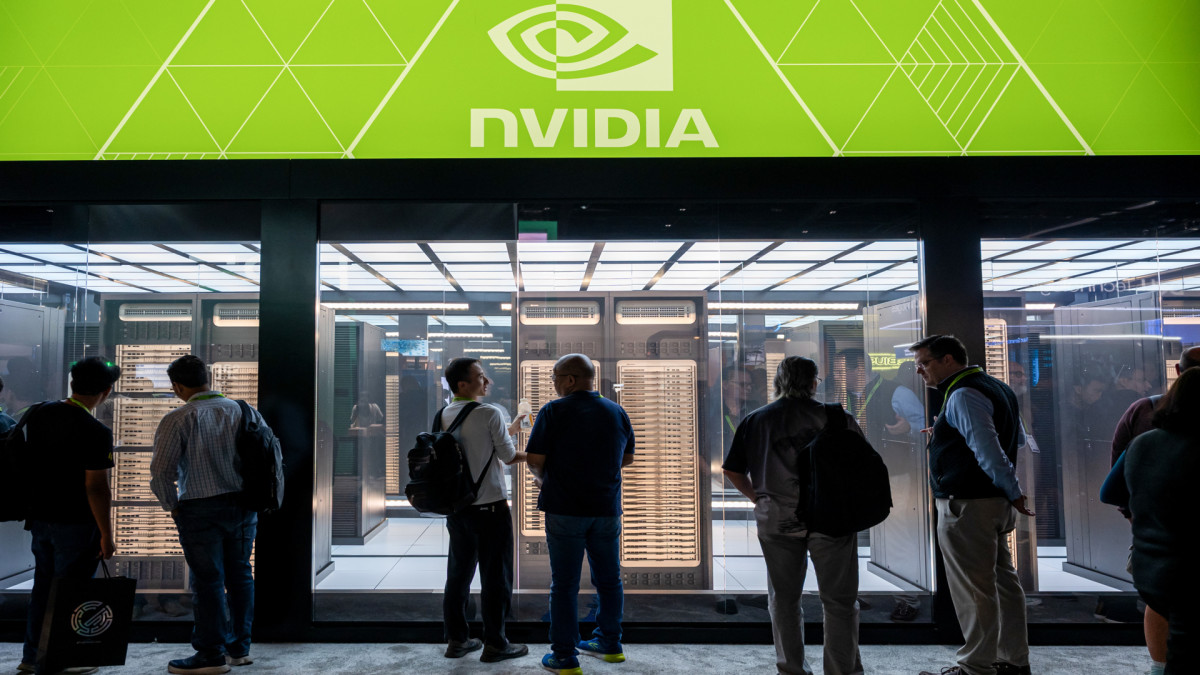 Nvidia CEO Jensen Huang’s definition of artificial general intelligence (AGI) emphasizes value creation rather than cognitive range.
Morris/Bloomberg via Getty Images
Systems can pass bar exams and write production code. They cannot yet navigate an unfamiliar kitchen, reason about a novel physical situation, or sustain a complex strategy across months the way a person can. Huang’s definition skips these entirely by measuring value creation rather than cognitive range.
Huang’s economic definition sidesteps these limitations entirely. That represents either bold pragmatism or a convenient redefinition from the man who profits most from the belief that AGI has arrived.
What this means for Nvidia investors
For investors in Nvidia (NVDA), Huang’s AGI framing connects directly to the business case. If AGI has arrived, demand for AI compute has no near-term ceiling. Every company that believes AGI is here, or coming, needs more chips. Nvidia makes these chips.
The stock was trading at about $176 on March 23. At GTC earlier in March, Huang projected at least $1 trillion in chip sales from Blackwell and Vera Rubin platforms through 2027. That beat Wall Street consensus and added roughly $500 billion in new order visibility since October 2025.
The AGI debate Huang reignited will not be settled by a podcast clip. But it will shape how investors, regulators, and competitors frame the next phase of AI development.
Nvidia controls the infrastructure that makes any definition of AGI commercially viable. That is exactly the kind of narrative leverage that has made this stock so difficult to bet against.