
Samsung just ended one of mobile’s most persistent frustrations. The Galaxy S26 series can now send files directly to iPhones, iPads, and Macs using Apple’s AirDrop protocol through Quick Share. No third-party apps. No cloud links. No QR codes. Just tap, select, and send.
The rollout of native AirDrop compatibility began March 23 in South Korea. The United States is set to follow, with Europe, Hong Kong, Japan, Latin America, Southeast Asia, and Taiwan also in the expansion roadmap. Samsung has not specified exact dates for regions outside Korea.
How to enable AirDrop file sharing on Galaxy S26
AirDrop support for Quick Share is not turned on by default. Galaxy S26 owners need to activate it manually. Here is the full setup process.
- On your Galaxy S26: Go to Settings > Connected devices > Quick Share and toggle on “Share with Apple devices.”
- On the iPhone: Open Control Center, long-press the AirDrop icon, and set it to “Everyone.” This allows the Galaxy to detect it.
- To send a file: Open Gallery or Files, select what you want to share, tap Share > Quick Share, and nearby Apple devices will appear automatically.
- Technical requirement: Your Galaxy S26 must have Google Play Services version 26.11 or newer, Android Authority notes. If the toggle does not appear, check for a Play Services update in Settings > Apps > Google Play Services.
Samsung also notes that the device may temporarily disconnect from Wi-Fi networks while searching for or transferring to Apple devices. This is something worth knowing before you use it in the middle of a video call.
AirDrop support on Samsung Galaxy: what works and what doesn’t
AirDrop support works on the Galaxy S26, S26+, and S26 Ultra. That’s it for now — older Galaxy devices, including the S25 series, foldables, and A-series phones, are not yet supported.
Samsung has confirmed additional devices will follow, but it has not yet shared a device list or a timeline for that expansion.
More Tech Stocks:
- Morgan Stanley sets jaw-dropping Micron price target after event
- Nvidia’s China chip problem isn’t what most investors think
- Quantum Computing makes $110 million move nobody saw coming
The reverse direction works, too. iPhones can AirDrop files to the Galaxy S26, and Samsung receives them through Quick Share.
That bidirectional capability is what separates this from the earlier Pixel implementation, which initially only supported receiving from Apple devices. Both users need to have their respective sharing settings open for discovery to work.
How AirDrop compatibility on Quick Share came to exist
Google introduced AirDrop compatibility on Quick Share with the Pixel 10 in late 2025. It expanded to the Pixel 9 series more recently.
The development was driven in part by EU regulations that required Apple to implement Wi-Fi Aware technology in iOS’s native file-sharing feature, opening the door for Android manufacturers to build compatible implementations.
Samsung is now the largest Android manufacturer to add AirDrop support, and it will not be the last. Other companies including Nothing and Qualcomm have already confirmed compatibility.
Google’s Android VP Eric Kay stated in February that AirDrop support would expand to “a lot more devices” across Android in 2026. The standard is becoming universal rather than exclusive.
Why this matters for consumers
Sharing files between an iPhone and an Android phone has been unnecessarily complicated for years. The standard workarounds involved emailing files to yourself, using Google Drive or iCloud links, or downloading third-party apps that both people needed to have installed.
All of that friction has now gone away for Galaxy S26 owners and anyone they interact with on iPhone.
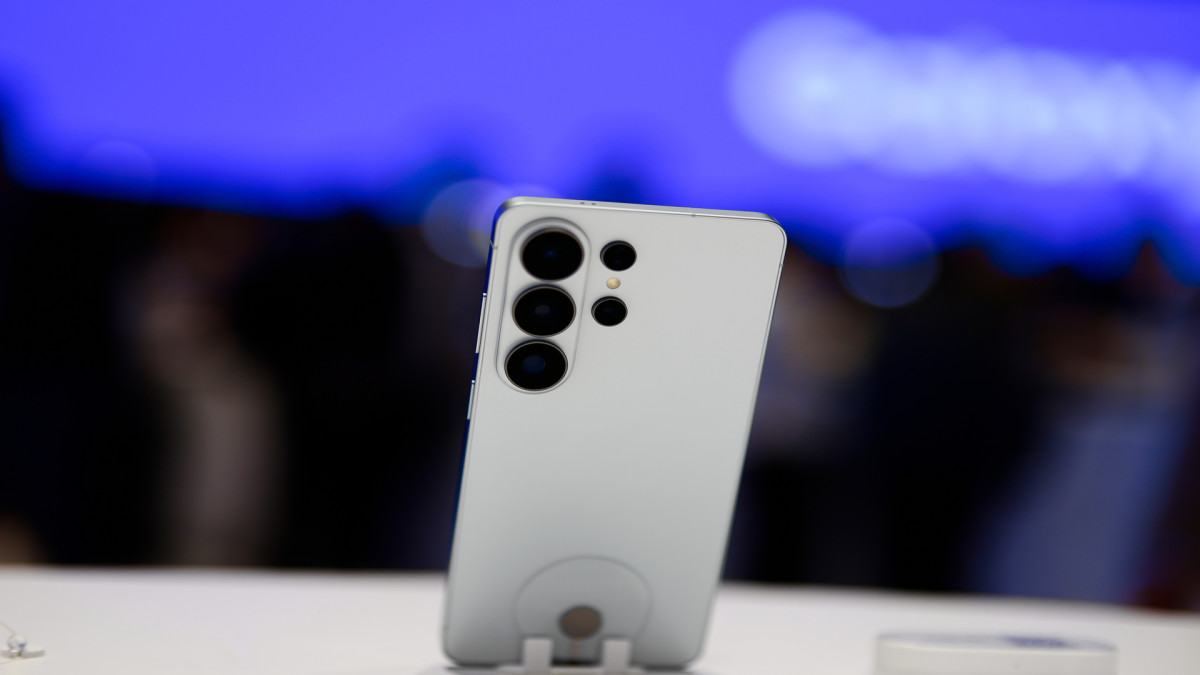 Samsung is now the largest Android manufacturer to add AirDrop support.
Cros/GettyImages
Mixed-device households, offices, and social situations are the obvious beneficiaries. Think of the parent trying to share a child’s birthday video with grandparents on different phones, or colleagues passing a presentation file across platforms before a meeting.
The use case is simple, and the demand has always been there. The only thing missing was the technical bridge.
For Apple, the development is a quiet erosion of one of the ecosystem advantages that made iPhones stickier for users who also owned other Apple products. AirDrop was not the reason most people bought an iPhone, but it was a feature that made staying in the Apple ecosystem feel frictionless. That frictionlessness now works across the Android divide, too.
The bigger picture here is a broader shift toward interoperability across mobile platforms. RCS messaging between iPhone and Android arrived in 2024. AirDrop compatibility is now here for Galaxy.
The walls between the two ecosystems are coming down piece by piece, driven by a combination of regulatory pressure in Europe and competitive pressure from manufacturers who want to remove reasons to switch.
For consumers, that is a straightforward win.