
Gold investors had spent four days clawing back ground. Then President Donald Trump stepped to the podium.
Spot gold fell 2% to $4,664.39 per ounce on April 2, snapping a four-day winning streak, after the president delivered a prime-time address on April 1 pledging to escalate military operations in Iran over the next two to three weeks.
U.S. gold futures slid 2.5% to $4,691.10. The pullback reversed a rally that had carried bullion to its highest level since March 19.
Silver fell 4.6% to $71.67 per ounce. Platinum dropped 2.5% to $1,914.61, and palladium shed 1.4% to $1,451.92, per Reuters.
What President Trump said about Iran
Speaking from the White House on April 1, the president said the U.S. would hit Iran “extremely hard” over the next two to three weeks, per CNBC. He threatened to target each of Iran’s electric generating plants and its oil infrastructure if a deal was not reached.
“We’re going to hit them extremely hard over the next two to three weeks,” Trump said. “We’re going to bring them back to the stone ages, where they belong.”
Related: Analysts have a message for investors on the gold price drop
He said the U.S. was “very close” to completing its objectives and described discussions as ongoing, leaving a diplomatic resolution technically on the table. But markets focused on the escalation. Dow futures slid more than 260 points, S&P 500 futures fell 0.7%, and Nasdaq 100 futures dropped 0.8% shortly after the speech.
Iran’s Foreign Ministry pushed back the next day. “As far as the Iranian nation is concerned, we are absolutely determined and resolute to continue our defense against this aggression,” a spokesperson said, according to CNBC.
Why the president’s speech hurt gold
The reaction was counterintuitive. Geopolitical escalation typically supports gold as a safe haven. But the Iran conflict has upended that relationship, Newsweek noted.
Trump’s comments pushed Brent crude to $105 per barrel on April 2, per Upstox. Rising oil prices lift inflation expectations. That in turn pushes Treasury yields and the dollar higher. Gold, a non-yielding asset, loses appeal when real yields rise and the dollar strengthens.
“Higher interest rates make Treasury bonds and even cash more appealing compared with a metal that pays no income,” Newsweek reported. “If markets believe inflation will force central banks to stay tough on rates, real yields can rise, and that tends to push gold prices down.”
More Gold:
- Gold just saw its biggest decline since 1983: what’s next
- Gold and silver bugs face grim reality check
- Gold’s price is falling fast: Here’s what comes next
The U.S. dollar index rose 0.27% after the speech, Upstox indicated. Bets for a December Federal Reserve rate cut fell to just 12%, down from around 25% before Trump’s latest comments, Reuters reported.
The pattern has repeated throughout the five-week conflict. Investors have been liquidating gold positions to cover losses elsewhere, even as the war continues to intensify, Bloomberg confirmed. Gold has fallen more than 11% since the conflict began on Feb. 28, according to CNBC.
How markets moved after Trump’s address:
- Spot gold: Down 2% to $4,664.39, snapping a four-day winning streak, per Reuters
- Silver: Down 4.6% to $71.67 per ounce; platinum down 2.5% to $1,914.61
- Brent crude: Surged to $105 per barrel, according to Upstox
- S&P 500 futures: Fell 0.7% after the speech, CNBC noted
- December Fed rate cut odds: Fell to 12% from about 25%, Reuters reported
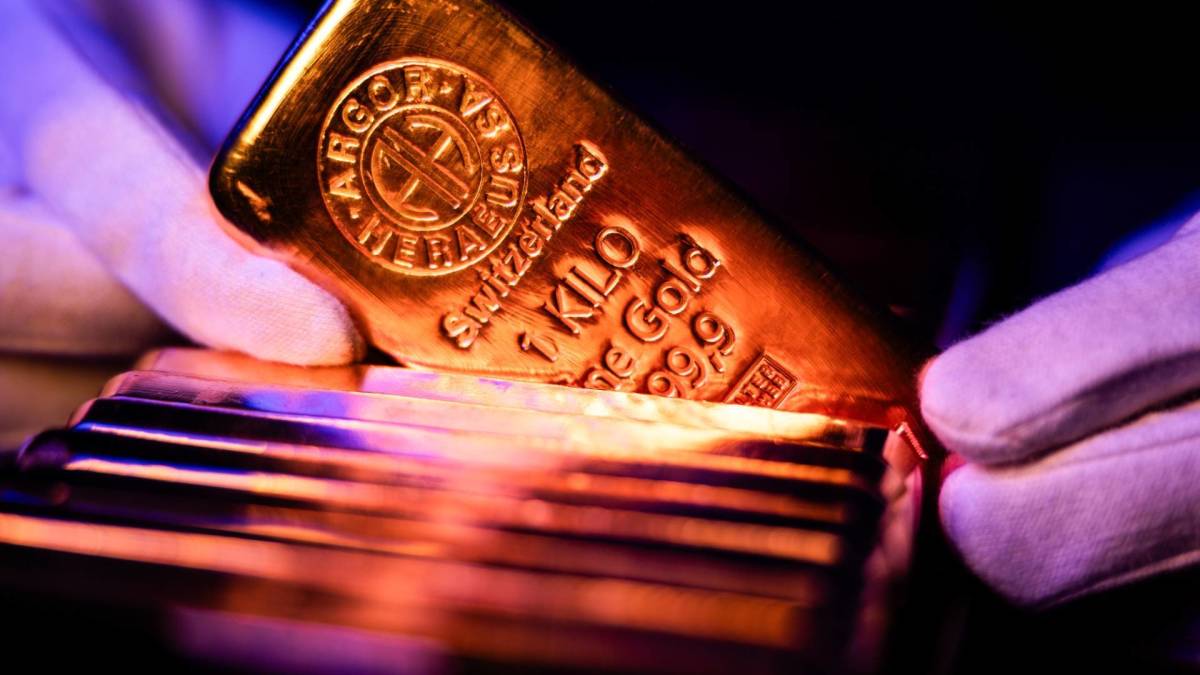 Gold has fallen more than 11% since the Iran war began on Feb. 28.
Stiller/Getty Images
Gold’s unusual response to this war
The counterintuitive decline is not a new phenomenon in this conflict. Gold rose briefly when Operation Epic Fury launched Feb. 28, climbing from $5,296 to $5,423. But it then sold off sharply, according to CNBC. It has broadly failed to hold gains through five weeks of escalation.
Part of the explanation is positioning. Gold had already risen more than 70% in the year before the war started. When a trade gets that crowded, shocks can trigger profit-taking rather than fresh buying.
Analyst Iain Barnes of Netwealth noted that gold’s price volatility has been running at twice its historical level in recent months due to increased participation from financial investors, per CNBC.
“International central banks seeking to diversify their reserves away from U.S. dollars may have started gold’s bull market in the past few years, but in the end the market ran out of new financial buyers and instead saw widespread profit-taking as wider uncertainty hit markets and the dollar rebounded,” Barnes told CNBC.
Goldman holds its target
Despite the continued pressure, Goldman Sachs has not moved off its $5,400 year-end target. The bank maintained its call after the March selloff and repeated it in the context of the ongoing conflict.
“We continue to forecast gold prices reaching $5,400 per ounce by end-2026, as central bank diversification continues, currently low speculative positioning normalizes, and the Fed delivers the 50 basis points of cuts our economists expect,” Goldman analysts Daan Struyven and Lina Thomas wrote, as CNBC reported.
They acknowledged the near-term risk but pointed to medium-term upside. If the Iran conflict accelerates diversification into gold and weighs on perceptions of Western fiscal sustainability, risks to the forecast are skewed to the upside over time, they said.
For now, the war’s near-term impact runs through oil, inflation, and the dollar, not through safe-haven flows. Until the Strait of Hormuz reopens or the Federal Reserve signals a clear path to rate cuts, that dynamic is unlikely to change.
Related: Gold’s price is falling fast: Here’s what comes next