
Even after gold got hammered last month, China continued buying.
The People’s Bank of China kept buying gold, continuing its streak to 17 straight months in March, according to Reuters. It grew its reserves, even as the metal posted its steepest monthly drop since 2008.
In a market that’s typically filled with a ton of fear, that sort of steady demand stands out.
To be fair, that isn’t the usual script for the shiny yellow metal.
Gold is almost always the asset investors gravitate towards when war risk rises, and the markets get nervous.
However, the Iran war scrambled the usual trade, reviving inflationary pressures, stoking growth fears, and ultimately compelling investors to rethink interest rate cuts.
Speaking of rate cuts, veteran economist Jeremy Siegel now believes rate hikes may be warranted, given the current economic backdrop.
That combination hit gold hard, dragging down the value of Beijing’s reserves, making its latest move all the more interesting.
Gold vs. silver returns
- Gold: 30 days: -6.35%, 6 months: +16.55%, 1 year: +48.01%, 5 years: +174.82%
- Silver: 30 days: -10.20%, 6 months: +47.08%, 1 year: +136.10%, 5 years: +201.89%, 20 years: +497.31% Source: GoldPrice.org
How has gold performed lately?
Gold entered 2026 on a tear.
It blasted out of the gates, setting new records as early as January, and was tracking up by nearly one-fifth early in the year after a monster 2025.
That tremendous rally was supercharged by safe-haven demand, de-dollarization, healthier ETF inflows, strong central-bank accumulation, and tariff worries.
More Gold:
- Gold just saw its biggest decline since 1983: what’s next
- Gold and silver bugs face grim reality check
- Gold’s price is falling fast: Here’s what comes next
However, when the Iran war hit, that easy narrative lost steam.
Higher energy prices stoked inflationary pressures, and traders were quick to price in fewer near-term interest rate cuts
Consequently, we saw a steep March sell-off (the biggest monthly drop in years), where the king metal slid from record highs back to the mid-$4,000s.
However, despite the pressures, gold hasn’t cracked.
With China still loading up, the dollar easing at times, and ceasefire headlines cooling off the relentless momentum in the commodity markets, gold has bounced back into the high-$4,700s.
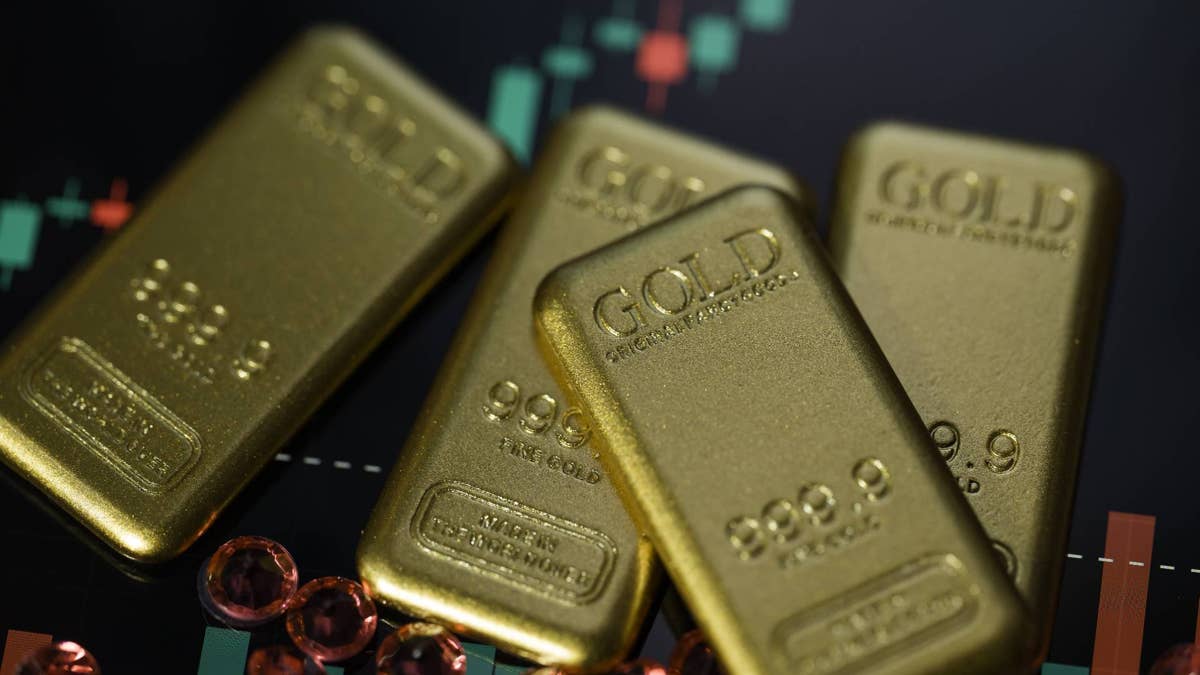 A major central bank added to gold reserves for the 17th straight month in March.
Why is China still buying gold?
The People’s Bank of China bumped its gold holdings to 74.38 million fine troy ounces at the end of March, up from 74.22 million in February.
That came at a point when the value of those holdings effectively dropped to $342.76 billion from $387.59 billion, the first monthly drop in reserve value since May 2025.
March was a rough month for the yellow precious metal, but China bought the dip.
Three forces could potentially explain the strategy:
- Gold acts like reserve insurance when war, inflation, and rate uncertainty hit markets.
- Central banks care much more about ounces accumulated than about short-term mark-to-market losses.
- Official buying helps stabilize prices efficiently when private investors tend to pull back.
China wasn’t alone, though.
According to the World Gold Council, Poland and Kazakhstan added 20 tonnes and 8 tonnes of gold, respectively, in February.
Meanwhile, Uzbekistan has added 16 tonnes so far this year, and Malaysia added 5 tonnes across January and February.
Why is gold a safe-haven asset in times of turmoil?
Gold is hailed as a safe-haven asset because when we see markets get all worked up, investors look for something that isn’t linked to a particular business, government, or earnings report.
Basically, it’s like a storm shelter, where you might need it every day, but when the weather gets funky, it becomes incredibly valuable.
During times of war, trade fights, and inflation scares, stocks tend to swing wildly, and fiat currencies come under immense pressure.
Gold benefits as it’s viewed as the top store of value that can hold up, even if confidence breaks down.
Central banks view it in the same way, but just on a far bigger scale.
It allows them to effectively diversify reserves, reduce their dependency on the dollar, and build confidence as the global backdrop gets messy.
Wall Street’s latest gold price targets
- J.P. Morgan: $6,300/oz.
- UBS: $6,200/oz.
- Deutsche Bank: $6,000/oz.
- Goldman Sachs: $5,400/oz.
- Bank of America: $5,000/oz.
- HSBC: $5,000/oz. Source: Reuters
What are gold’s next catalysts?
The next big tests for gold include the upcoming jobs report on May 8, CPI report on May 12, and Fed minutes on May 20.
That setup matters a lot because at this point, we’re seeing the shiny yellow metal trade a lot more like a rate story that’s gift-wrapped inside a geopolitical story.
Moreover, the latest CPI report showed prices shot up 0.9% month over month and 3.3% year over year in March, CNN noted. Still, core CPI came in at 0.2% on the month and 2.6% on the year, according to Barron’s.
That matters a ton for gold because hotter inflation keeps the Fed on its heels and real yields get elevated, pressuring non-yielding assets.
Additionally, the labor market has held up enough to keep the pressure alive.
March payrolls increased by 178,000, and unemployment dipped to 4.3%. Then we have the March 17-18 Fed minutes that showed that some officials were open to the idea of rate hikes.
Moreover, from a technical perspective, gold has repaired some of the damage, rebounding from around $4,655 to $4,790 in recent sessions.
So that leaves $4,800 as the first big test to clear, with mid-$4,800s after that. On the downside, the mid-$4,700s and then the mid-$4,600s appear to be key support zones.
SPDR Gold Shares (GLD) vs. SPDR S&P 500 ETF Trust (SPY) returns
- YTD: SPDR Gold Shares (GLD) +10.30% versus SPDR S&P 500 ETF Trust (SPY) -0.09%
- 2025: GLD +63.68% versus SPY +17.72%
- 2024: GLD +26.66% versus SPY +24.89%
- 2023: GLD +12.69% versus SPY +26.18%
- 2022: GLD -0.77% versus SPY -18.18%
- 2021: GLD -4.15% versus SPY +28.73%
- 2020: GLD +24.81% versus SPY +18.33% Source: TotalRealReturns annual total return data for GLD and SPY, with dividends reinvested
Related: ‘Big Short’ Michael Burry sends signal on Nvidia stock