
When it comes to the U.S. automotive industry, collectively known as the Big 3, Wall Street has a clear favorite: General Motors.
As recently as last week, analysts at Deutsche Bank raised their GM rating to buy from hold heading into next week’s print (GM is scheduled to report its first-quarter earnings before the opening bell on April 28). Meanwhile, analysts at Morgan Stanley named GM its top pick in the sector, citing “a strong execution track record of managing its business and delivering strong results through supply chain disruptions and volatile operating environments.”
But Ford has one major thing going for it that GM and Stellantis do not: the Blue Oval makes the overwhelming majority of its vehicles in the U.S. and since import costs add $5,000 to $8,900 per vehicle, original equipment manufacturers that produce domestically have a leg up on the competition.
Ford CEO Jim Farley recently said in an interview that Ford is doing well despite tariff costs because 83% of the vehicles it sells in America are assembled domestically.
GM imports more vehicles than even foreign competitors do
S&P Global has new data showing exactly how large the domestic production gap between Ford and its competitors is.
Of the 2.2 million new vehicles it sold in the U.S. last year, Ford imported 378,123 of them, the Detroit Free Press reported, citing S&P Global Data. Meanwhile, of the 2.85 million vehicles General Motors sold in the U.S. in 2025, 1.17 million were imported. Stellantis imported 514,000 of the 1.26 million vehicles it sold in the U.S. last year.
GM imported more vehicles than foreign competitors like Hyundai and Honda, and GM and Stellantis both imported more vehicles than Volkswagen, Nissan and BMW did last year.
Ford estimated a net tariff impact of $2 billion in 2025, about $1 billion higher than the company expected as recently as October. Meanwhile, GM says tariffs cost the company over $3.1 billion last year.
Despite the tariff headwinds, carmakers such as Ford played the change in the U.S. economic policy perfectly. Ford rode dealer incentives, combined with consumer anxiety about tariffs, to become the top-selling brand in the U.S. during the year’s first half. Ford said total sales in the second quarter rose at a rate seven times that of the overall auto industry.
It sold 1.1 million units in the first six months, a 6.6% year-over-year increase.
But Ford wasn’t the only beneficiary. GMincreased its U.S. market share above 17%, representing the most substantial presence in the U.S. since 2017, while other brands also saw sales rise.
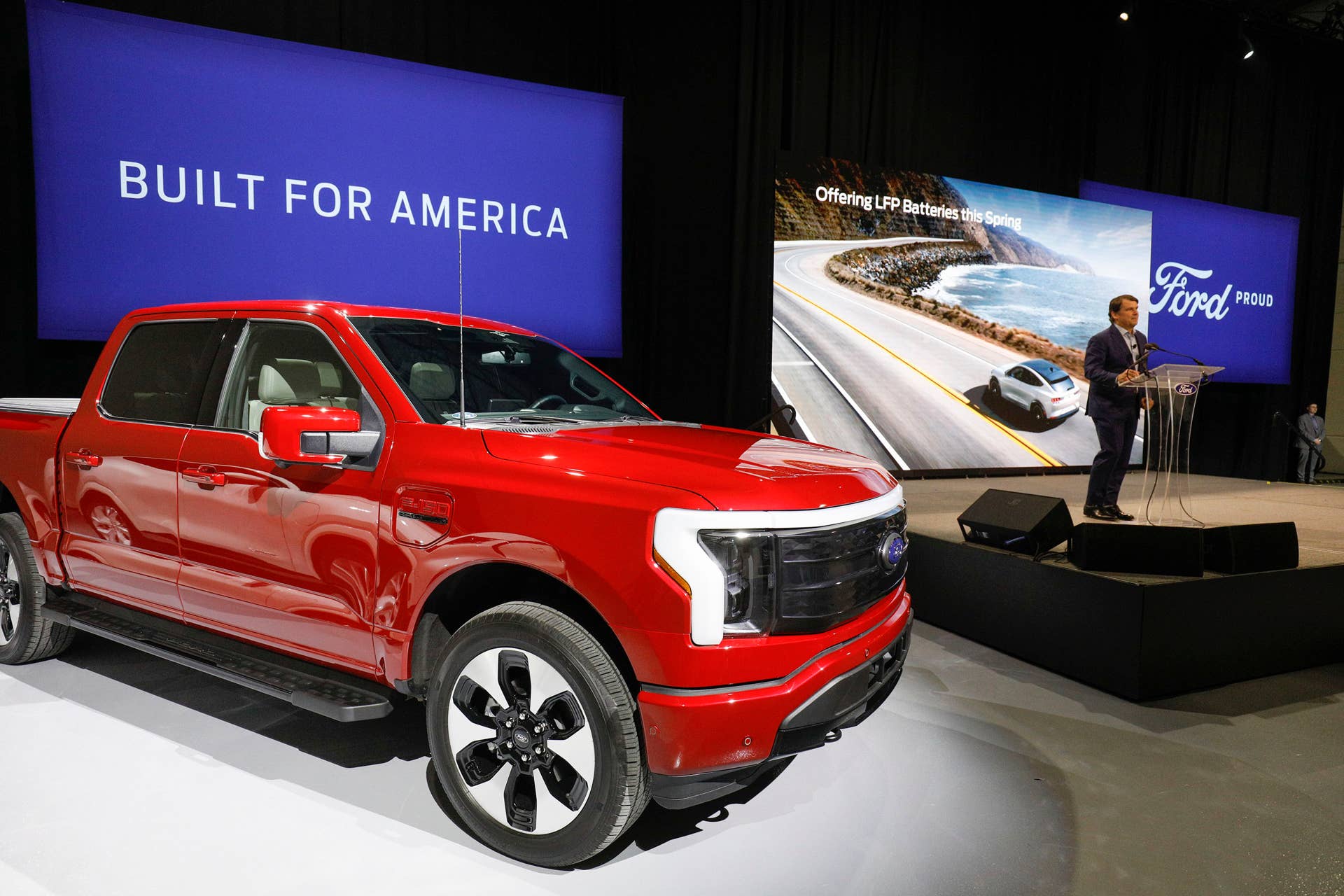 Ford builds most of its cars in the U.S.
Bill Pugliano / Getty Images
Morgan Stanley picks General Motors as its top auto pick amid higher gas prices
If the Iran War persists, Morgan Stanley expects heightened volatility, and if that happens, it has picked General Motors, ol’ faithful, as its top sector pick, maintaining an overweight rating on the stock.
“GM remains one of the top ideas across autos, particularly with the recent sell-off, with the stock now trading at just 5.5x our 2026 EPS and offering 30% upside to our $100 price target,” according to Morgan Stanley.
Related: Ford CEO Jim Farley has blunt message on Chinese EVs
Meanwhile, Morgan Stanley has an equal weight rating on Ford’s stock.
“The recent sell-off in the Ford shares also provides a 20% upside to our $14 price target. However, we caution around potential adverse effects to the extent the industry sees an unfavorable mix shift (i.e., away from trucks),” the firm says.
GM raised to buy from hold at Deutsche Bank
Analysts at Deutsche Bank have a mostly positive outlook on the company’s first quarter, but it won’t be without headwinds.
“Looking specifically at GM’s 1Q, we expect some deterioration in volume/mix relative to the prior year, though pricing should help to mitigate,” the Deutsche Bank note says.
While tariffs aren’t in the headlines in 2026 like they were last year, tariff expenses are expected to be the company’s biggest headwind, accounting for a negative $800 million hit in the quarter versus the company’s own expectations between $700 million and $1 billion.
Those expenses are expected to offset the tailwinds the company is expected to see in the quarter, including a $400 million improvement in EV losses, a $250 million improvement in warranty, and $200 million in emissions benefits.
Deutsche Bank expects GM to report a first-quarter EBIT of $2.91 billion, a slight increase from its previous expectation of $1.85 billion but below Wall Street’s consensus of $2.97 billion.
“The key question for the 1Q call is how GM will manage its full-year guidance, considering the volatile macro backdrop (e.g., raw materials, supply chain, consumer sentiment),” the note says. “When we look at the drivers of YoY walk, many of the factors are more within GM’s control, including improvement in EV losses from capacity reduction, cost benefits from warranty, and regulatory benefit mainly due to the elimination of emissions compliance credits.”
Related: GM gets key update from Deutsche Bank ahead of earnings