
Americans, especially those in lower-income brackets, are seeing their budgets stretched by the gas affordability crisis, but analysts at Bank of America say the increase in gas prices hasn’t yet reached the highs seen during the Covid pandemic.
In March, the median lower-income household spent 4.2% of its income on gasoline, up from 3.9% a year ago, but still below the levels reached in 2022.
In March, gasoline prices rose by more than $1 per gallon for regular unleaded. Americans turned to plastic to cover the increase, as gasoline card spending rose 16.5% month over month, according to the bank’s aggregated credit and debit card data.
The Iran war has pushed U.S. gas prices to $4.123 per gallon, according to the U.S. Energy Information Administration. Economists at the Stanford Institute of Economic Policy Research estimate that the war has pushed Americans’ average annual gasoline costs up $857 this year.
There was a 15.5% increase in U.S. gas station sales, according to the Census Bureau, the largest March increase since the government started tracking the stat in 1992. Service station receipts had only risen 1.3% in February.
The U.S. economy was relatively healthy before the start of the war on Feb. 28, Axios reported. Now that the war is underway, experts expect energy prices to be just one of the casualties, as disruptions to fertilizer supply threaten food prices (the Gulf region provides nearly half of the world’s seaborne urea and 30% of global ammonia).
Lower-income households hit hardest by rising gas prices
Unsurprisingly, people already financially struggling are suffering the most from higher gas prices that won’t be going down anytime soon, Politico noted.
While the median lower-income household in its survey paid 4.2% more for gas in March, higher-income households only paid 2.7% more. But Bank of America found that all income levels saw similar-sized increases compared with a year ago.
But while about 10% of lower-income households spent more than 10% of their March income on gasoline, only 6% of higher-income households did so.
Related: Surging gas prices will cost Americans $857 more in 2026
“Overall, then, it is households in the lowest income tercile who have generally been hit hardest by higher gasoline prices thus far, with some more exposed than others — likely depending upon how much they drive and potentially if they use their car for work,” Bank of America’s note stated.
Despite the recent spikes, gas spending as a portion of income is much lower than it has been for most of this century.
“Using annual data from the Bureau of Labor Statistics (BLS) Consumer Expenditure Survey, shows the share of annual consumer expenditure on gasoline reached as high as 5% in 2008, 2011, and 2012. While this data runs only through 2024, looking at gasoline spending as a share of income in Bank of America data for 2019-2026 indicates that it likely remains well off its historical highs,” Bank of America says.
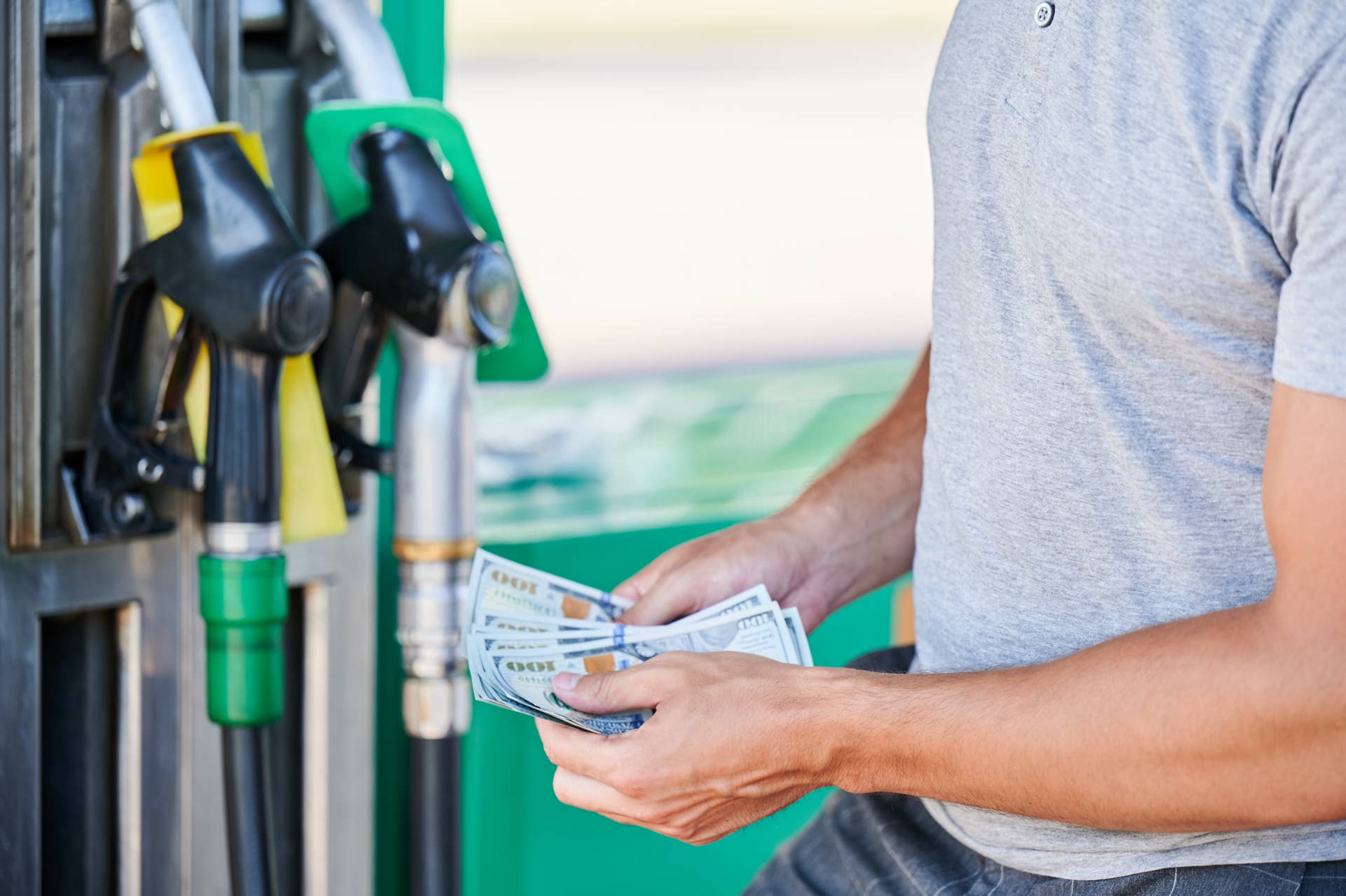 About 10% of lower-income households spent more than 10% of their March income on gasoline.
Bank of America gives advice on how to afford higher gas prices
Higher fuel prices could mean belt-tightening elsewhere for many households, but according to BofA, wealth inequality also plays a role.
Bank of America deposit data indicate that after-tax wages and salaries grew at a strong 5.6% year-over-year rate in March, compared with just 1% for lower-income households and 2% for middle-income households.
So what levers can U.S. consumers pull to support their new budgets?
“One is to finance more of their spending through credit. Federal Reserve Bank of New York data show that overall U.S. credit card balances relative to their limits in 4Q 2025 were broadly similar to where they were in the second half of the 2010s. This may suggest some room for households to increase borrowing relative to their limits,” Bank of America says.
But that isn’t the case for many households, and additional data suggest “that while utilization rates have declined since January 2026, lower-income households are more stretched relative to their limits than other cohorts — their utilization is the most above 2019 levels of all the income cohorts as of March 2026.”
Additionally, a higher portion of lower-income households make only the minimum payment on their credit card accounts. This means that “while there may be capacity for some to ‘ride out’ gasoline shock by relying more on credit card borrowing, this appears somewhat limited — particularly for lower-income households,” Bank of America’s note added.
The bank also suggests households could be using buy now, pay later for some of their spending.
“It’s worth noting that BNPL users in Bank of America data tend to have significantly higher credit card utilization rates (Exhibit 8). Indeed, lower-income households that are heavier BNPL users (making more transactions per month) tend to have the highest credit card utilization rates (Exhibit 9), so their overall credit availability may be fairly limited,” analysts said.
Related: Millennials spark BNPL revolution as inflation surges