
There is an old line I picked up early in covering Detroit: never bet against the American consumer’s love of trucks.
For the past three years, automakers tried anyway. They poured tens of billions of dollars into electric vehicle factories, lithium supply deals, and battery joint ventures, betting that a $7,500 federal tax credit and rising gas prices would finally push U.S. buyers off the showroom lot in a Tesla-shaped car.
That gospel held until last fall.
Then the federal tax credit expired, gas stayed cheap enough, and the people who were supposed to trade in their SUVs for battery-powered crossovers… mostly didn’t.
The math that worked on a spreadsheet in 2022 stopped working in showrooms in 2025. Auto executives who built capital plans around aggressive electric vehicle (EV) targets are now quietly walking them back, one factory announcement at a time.
Production lines that were tooled for batteries are being retooled for V6 engines. Ribbon cuttings that were supposed to celebrate America’s electric future are becoming press releases about “diverse powertrains.”
This week, one of the biggest reversals yet landed in the Deep South. Nissan (NSANY), the Japanese carmaker that helped pioneer the modern EV with the Leaf back in 2010, told dealers and parts suppliers Thursday it is canceling plans to build two fully electric SUVs at its Canton, Mississippi factory.
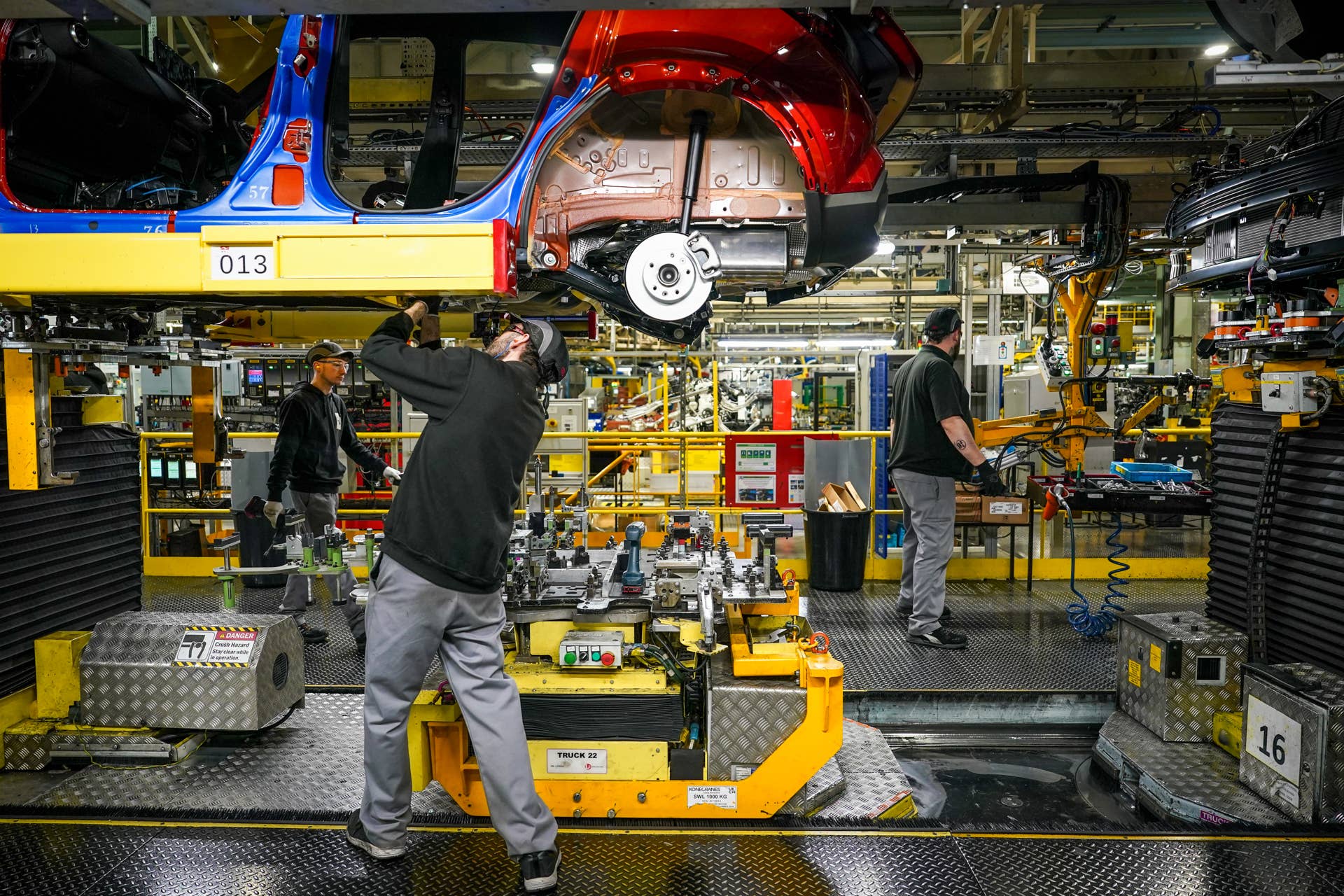 Nissan pulls the plug on ambitious U.S. EV plans
Photo by Bloomberg on Getty Images
What just happened at Nissan’s Canton plant
Nissan had previously frozen its EV production plans at the 4.7-million-square-foot Canton facility. Now it is killing them outright.
The decision, relayed to dealers and parts suppliers Thursday, comes “as part of a broader recalibration of its product strategy as the Japanese carmaker seeks to conserve cash,” according to Bloomberg.
Related: 5 popular SUVs to avoid, and 5 safer options, Consumer Reports says
Instead of the two electric SUVs, Canton will build a V6 engine-powered hybrid version of the Xterra SUV, plus other body-on-frame trucks and SUVs. The plant currently produces the Frontier pickup and the Altima sedan, and employs roughly 3,200 workers.
The reversal undoes a $500 million investment Nissan announced in 2022, which had been hailed as one of the largest EV manufacturing commitments in the South.
“To better align with market conditions, customer demand, and Nissan’s updated strategic direction, the company will not move forward with previously announced EV programs at its Canton, Mississippi facility,” Nissan spokesperson Jennifer Swanner said in a statement.
Ashli Bobo, a spokesperson for Nissan’s U.S. operations, was even blunter. “Canton does have a future that will include diverse powertrains, but it will not include EVs,” Bobo said in remarks reported by The Japan Times.
That sentence is the entire story of the U.S. EV market in 2026, condensed into one line from a corporate spokesperson.
More Automotive:
- Hyundai admits deadly defect caused more injuries than previously known
- Consumer Reports names 5 popular EVs with the best real-world range
- Uber targets 50,000 robotaxis in major Rivian, Nvidia deals
Why the EV market suddenly turned against automakers
This is not a one-off corporate flinch. The post-incentive U.S. EV market has been brutal across the board.
Americans bought just 212,600 new battery-electric vehicles in the first quarter of 2026, “a steep 28% decline from 296,304 units a year earlier,” according to Kelley Blue Book. EV market share fell to 5.8%, well below the 7.5% peak reached in Q3 2025 when buyers rushed to grab the credit before it expired.
The federal $7,500 EV tax credit sunset on September 30, 2025, under the One Big Beautiful Bill Act, and the impact has been immediate. New EV inventory has ballooned to 130 days’ supply versus just 89 days for combustion vehicles, “according to Cox Automotive data,” reported by Electrek.
When I ran the numbers across the post-credit period, one pattern jumped out. The further you get from a Tesla (TSLA) showroom, the worse the slowdown looks. Tesla controlled roughly 53.7% of EV registrations in January, while rivals like Hyundai (HYMTF) saw deliveries fall 23% year over year, according to Carscoops.
Karl Brauer, executive analyst at iSeeCars, summed up where this is going. “There’s going to be a shakeout to the new reality with no federal EV incentives, which was the carrot, and no greenhouse gas penalties, which was the stick,” Brauer said in remarks reported by Carscoops.
The damage is showing up on factory floors:
- Q1 2026 new EV sales fell 28% year over year, according to Kelley Blue Book.
- $19.9 billion in planned EV manufacturing investments have been canceled since 2025, per the World Resources Institute.
- Hybrid vehicle sales surged 57% year over year to 756,000 units in Q4 2025, per Cox Automotive data.
- Nissan booked a $4.5 billion loss in fiscal 2025 and projects another $4.2 billion loss for fiscal 2026, per company guidance reported by Mexico Business News.
What Nissan’s pivot says about your next car
For investors, the Canton reversal is the latest data point in a worrying trend.
NSANY shares trade around $4.50 on the U.S. over-the-counter market, with a consensus analyst rating of “Hold” and a 12-month average price target of $5.31, according to Investing.com data. The stock is down sharply from its January 2018 peak above $18.
For consumers, the message is more practical. The vehicles automakers are racing to put on dealer lots in 2026 are not pure EVs. They are gas trucks, hybrids, and “extended-range” electrics that come with a backup engine. If you have been waiting on a roomy, three-row electric SUV from a legacy carmaker priced under a Tesla Model Y, the wait got longer.
Nissan CEO Ivan Espinosa, who took over in 2025, has been candid about the pivot. “We needed to face the reality that we cannot grow our top line at the speed that we need to absorb the structure,” Espinosa said in an interview with Semafor about his “Re:Nissan” turnaround plan.
That plan calls for $3.7 billion in cost cuts, 20,000 layoffs, and the closure of seven factories worldwide.
What to watch next in the EV pullback
If you have been waiting on a new battery-electric SUV from a legacy automaker, my analysis of the pipeline says you are going to be waiting longer. The Canton story is unlikely to be the last one of its kind this year.
Patrick Manzi, chief economist at the National Automobile Dealers Association, expects the trend to continue. “I think by and large we’re going to see a lot fewer new EV announcements but a lot of the ones that are already baked in the pipeline are still going to come out,” Manzi said in remarks reported by Automotive Logistics.
The good news for buyers is that the used EV aisle has never been more interesting. Used EVs averaged $34,821 in Q1 2026, just $1,300 above the average used gas vehicle, per Cox Automotive. A wave of off-lease Teslas, Hyundais, and Chevrolets is hitting dealer lots through 2028.
The bad news for Mississippi is that thousands of promised electric-vehicle assembly jobs are not coming. The bad news for Nissan investors is that the EV pioneer that built the Leaf is now pivoting to hybrid Xterras to survive its own restructuring drama.
The real question for the rest of 2026 is which legacy automaker pulls the plug next, and whether the buyers ever come back.
Related: Ford maintains a big advantage over GM in one key area