
Deckers Outdoor (DECK) walked into its earnings night with everything a footwear company could want.
Record fiscal 2026 revenue, record EPS, a blockbuster $3.5 billion buyback authorization, and a fiscal 2027 outlook that came in above Wall Street‘s consensus.
Then, Bank of America trimmed its price target the next morning anyway, MarketScreener reports.
The new figure of $115, down from $120, with a Neutral rating maintained, sits roughly $11 below the Wall Street consensus of $126.62, per Stock Analysis. It’s not a panic call.
But it’s a quiet signal that the company many investors view as a “growth-at-any-price” story may be running into a more complicated chapter.
And the actual numbers, when you pull them apart, explain why.
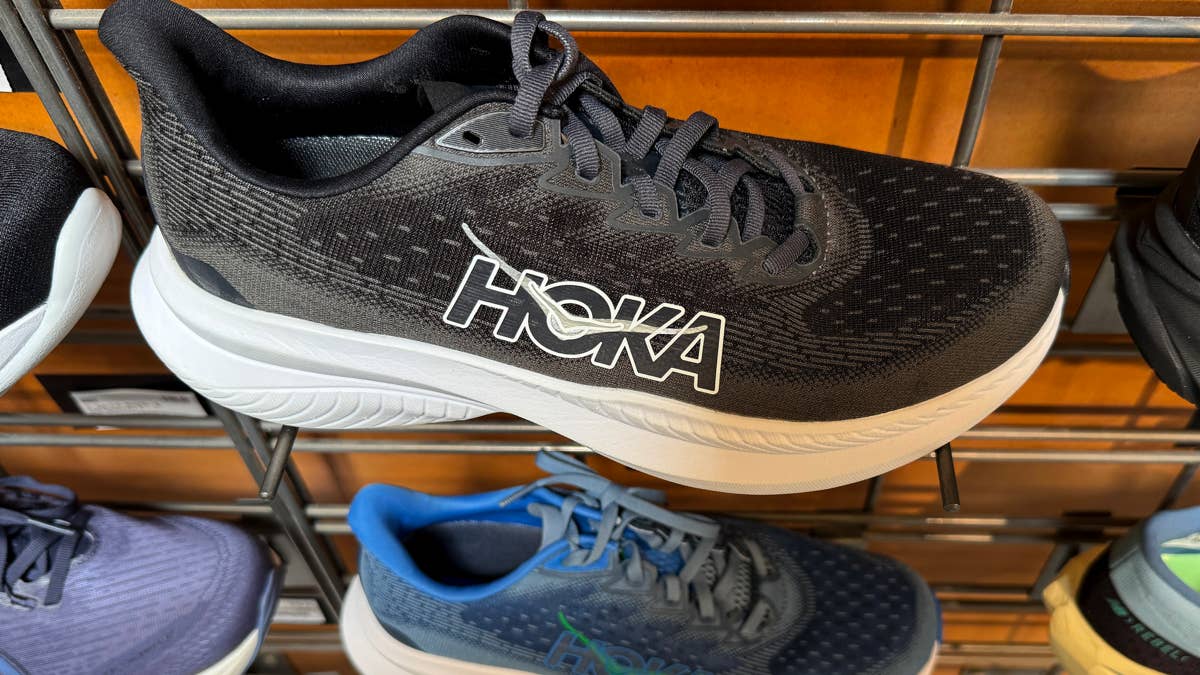 HOKA delivered its biggest quarter ever, but slowing U.S. demand and softer fiscal 2027 margin guidance prompted Bank of America to cut its Deckers price target to $115.
Justin Sullivan / Getty Images
What BofA saw in Deckers’ fiscal 2026 results that the headline missed
The fourth quarter print looked clean on the surface, as seen on Yahoo Finance. Revenue of $1.12 billion grew 9.6% year over year, and EPS of 96 cents beat the Zacks consensus of 81 cents by 18.5%.
But underneath, the engine isn’t firing on every cylinder.
More Retail Stocks:
- Bank of America revamps its Target stock price target ahead of earnings
- Morgan Stanley revisits Walmart stock price target pre-earnings
- Walmart earnings reveal concerning shift in customer behavior
HOKA and UGG carried the entire quarter. HOKA grew 14.5% to $671 million. UGG climbed 9.2% to $409 million. The “other brands” bucket, which houses Teva and the wind-down of Koolaburra and Sanuk, collapsed 35.6%, per Benzinga.
That’s the two-brand company problem in one line.
In terms of location-specific sales, international revenue surged 25.5% to $469.5 million. Domestic revenue rose just 0.3% to $649.8 million. The U.S., still Deckers’ largest market, has effectively stopped growing.
Why slowing U.S. footwear demand is the bigger story for DECK investors
The American consumer matters more than the headline numbers admit. And the broader footwear sector has been flashing yellow for months.
Wells Fargo downgraded Deckers to Underweight on May 8, per Investing.com, cutting its target to $90 from $115 in the same note that downgraded Nike (NKE) on a GLP-1 thesis.
The argument, led by analyst Ike Boruchow, is that the adoption of GLP-1 weight-loss drugs is rewiring how consumers spend on apparel.
Related: Birkenstock stock price slumps as luxury dream unravels
The data point that matters: 23% of U.S. households had at least one GLP-1 user as of September 2025, with 55% of active users already buying new clothing or footwear because their sizes changed, per Sporting Goods Intelligence reporting on Circana data.
The catch: that incremental spending is flowing into denim, casualwear, and intimates, not running shoes.
That’s the structural backdrop sitting underneath BofA’s $115 target.
What Deckers’ fiscal 2027 guidance is really telling Wall Street
Management guided fiscal 2027 revenue to $5.86 billion to $5.91 billion and EPS to $7.30 to $7.45, above the $5.82 billion and $7.29 EPS consensus.
But the deceleration is visible.
EPS growth is guided at roughly 4% to 6%, well below the 11% delivered in fiscal 2026. SG&A is projected to grow at roughly double the pace of revenue. Operating margin is expected to be around 21.5%, down from 23.1% last year, according to Deckers’ earnings call transcript, per The Motley Fool.
Here’s what BofA, Telsey ($113), and Truist ($125) appear to be pricing in:
Three pressure points sitting inside Deckers’ guidance
- Margin compression from $120 million in tariff costs and heavier marketing spend, with no tariff refund baked into guidance.
- First-quarter EPS guided to 82 to 87 cents, signaling growth won’t be linear.
- A two-brand portfolio carrying nearly 97% of revenue, with no obvious third growth engine after Teva’s contraction.
The buyback helps.
Deckers repurchased $1.075 billion of stock in fiscal 2026 and added $3.5 billion to its authorization, bringing the total to roughly $5 billion.
With $1.91 billion in cash and zero debt, the balance sheet can absorb plenty of share repurchases.
But buybacks support EPS arithmetic. They don’t solve a brand-concentration risk.
What practical investors should weigh before chasing DECK
The bull case is intact, but narrower than it was a year ago. International runway is real, HOKA is still the fastest-growingpremium running brand, and the cash machine keeps printing.
The bear case is also real. U.S. growth has flatlined, GLP-1 headwinds are now in the analyst conversation, and the FY27 EPS math leans heavily on buybacks rather than organic earnings power.
For long-term holders, the Deckers thesis hasn’t broken.
For new money, the gap between BofA’s $115 and the $126 consensus is the range to watch.
If Q1 fiscal 2027 confirms the deceleration, more targets are likely to converge toward BofA’s view. If HOKA reaccelerates in the U.S., the bears get squeezed.
The next earnings print is the tell.