
The reason buying a phone, paying for Netflix, or a car feels normal while buying a dozen eggs feels like a crunch is that digital tech and entertainment have become optimized utility bills. They are flat and predictable. The official Bureau of Labor Statistics (BLS) numbers help us better understand the irony and the crisis.
“Total annual household expenditures in the United States averaged $78,535 in 2024, equivalent to an average of $6,545 per month,” according to data from BLS. Housing and transportation consume a massive 50.4% of that total.
Because housing and transportation lock away a massive 50.4% of every single dollar before the month even begins, consumers cannot easily reduce these fixed costs. The grocery register, ironically, becomes the only place left to cut back and the one place where families feel the raw impact of inflation in real-time.
Per BLS reports, spending on food accounted for 12.9% of household budgets, forcing families to rethink their habits. What’s more, consumers are no longer just trading down to cheaper private-label brands, they are trading down on the retailer itself.
Twenty-seven percent of shoppers are keeping their brands but switching to a less expensive store, up from 16% last fall, according to a report from Alvarez & Marsal,
Traditional, mid-tier grocers are feeling the immediate impact of this shift. When you pair this loss of foot traffic with rising lease and labor expenses, it becomes clear why another grocery giant like Albertsons is aggressively closing stores.
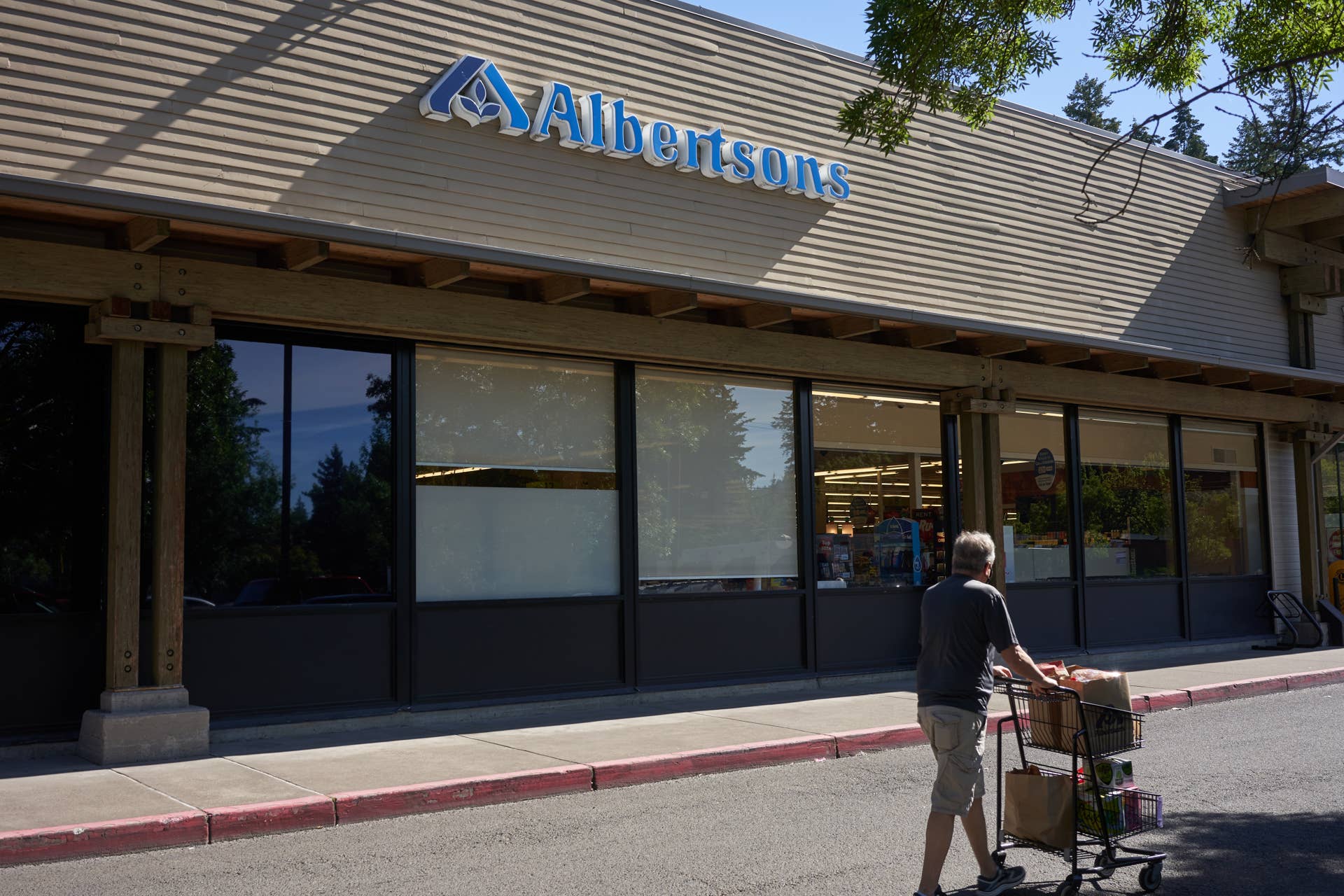 Albertsons has closed 12 locations in recent months.
Albertsons has closed 12 locations in recent months
Major supermarket chain Albertsons is closing more stores in 2026, after closing around 30 locations in 2025.
The company behind many popular brands, including Albertsons, Safeway, Pavilions, and Vons, tried to merge with Kroger in 2022, but the deal fell apart on antitrust concerns in 2024, according to the Associated Press.
The merger would have created one of the largest grocery chains in the U.S., which the Federal Trade Commission (FTC) said would have eliminated competition and increased prices for millions of Americans.
Instead of merging into a much larger operation, Albertsons has been making moves to improve its business, including closing down certain locations.
Earlier this year, TheStreet’s Fernanda Tronco reported about Albertsons closures from the prior year.
Albertsons 2025 closures included:
- 12 Safeway locations, according to prior reporting by TheStreet.
- One Carrs store in Anchorage Alaska, according to Alaska News Source.
- One Albertsons store in Southwest Portland, Oregon, in July, according to KGW8.
- One United Supermarkets store in Kingfisher, Oklahoma, in July, according to Kingfisher Press.
- 15 stores across multiple banners, according to Albertsons Companies’ latest earnings report.
The new report from Fast Company reveals more closures spanning seven states.
Albertsons 2026 closures:
- Acme
455 NJ-23, Sussex, NJ 07461
481 River Rd, Edgewater, NJ 07020 (closing in August)
- Albertsons
1260 E Ontario Ave, Corona, CA 92881
6700 West Fwy, Fort Worth, TX 76116
1155 N Main St, Euless, TX 76039
1300 E Flamingo Rd, Las Vegas, NV 89119
- Balducci’s 1385 Post Rd E, Westport, CT 06880
- Randalls 5161 San Felipe St, Houston, TX 77056
- Safeway
1601 Maryland Ave NE, Washington, DC 20002
231 W Jackson St, Hayward, CA 94544
- Vons
2345 E Valley Pkwy, Escondido, CA 92027
522 Orange St, Redlands, CA 92374
Source: Fast Company
The outlet reported that 11 of the 12 locations listed above have closed in recent months, with one location set to close in August 2026. More importantly, the list may not be complete.
Why has Albertsons been closing stores
Albertsons’ closures are one of the key moves under its broader cost-reducing plan in an effort to improve margins and offset rising operations costs. Back in early 2025, the company revealed plans to cut $1.5 billion in expenses by 2027, focusing heavily on selling, general, and administrative costs (SG&A), according to the company’s third quarter 2024 earnings call.
Under the initiative, Albertsons eliminated hundreds of corporate roles, including 225 jobs at an office in Phoenix, Arizona, and 156 at two offices in Pleasanton, California, according to BoiseDev.
More recently, during the April 2026 earnings call discussing the fourth quarter of 2025 results, the company’s CEO Susan Morris discussed the moves.
“We’re taking a disciplined market-by-market approach to banner optimization, store modernization, market densification, where we have the right to win, and store rationalization where the economics are structurally challenged,” she said.
Morris said the company is not working towards growth for growth’s sake, but rather it is “optimizing return on investment, elevating the customer-centric experience and ensuring that every store plays a clear role in winning in its local market,” according to an earnings call transcript provided by Insider Monkey.
It is important to highlight that Albertsons has not only been closing underperforming locations, it has also opened new stores in places with potentially higher foot traffic and profit.
“[Our network positioning] includes opening new stores in areas with strong demand and long-term opportunity, while also making the difficult decision to close some locations. In these cases, we work to place as many associates as possible in other stores,” Albertsons said in an emailed statement to Fast Company.
While the retailer didn’t reveal how many locations it expects to close in 2026 in total, it confirmed it anticipates a net increase in locations for its current fiscal year (ending in February 2027).
Related: 104-year-old beauty chain closes 50 more locations
What Albertsons closures mean for consumers
While occasional store closures for retail giants such as Albertsons, which operates 2,244 retail stores according to its official press release, might not impact the business as much, especially as the company opens new stores, local communities are feeling the impact hard.
I recently reported on the discount chain Family Dollar shutting 350 stores; however, losing access to cheap household essentials is not the same as losing a full-scale supermarket chain like Albertsons.
While both closures impact the local communities the most, and confirm the consumers’ shifting habits and economic pressures on retailers from high rent and labor expenses, the closures of Albertsons stores is often felt harder by the community.
Earlier this month, U.S. Senators Kirsten Gillibrand, Maria Cantwell, Ron Wyden, and Cory Booker explicitly called out Albertsons’ historical real estate tactics that have exacerbated community hunger:
“On the West Coast, the 2016 closure of an Albertsons grocery store created a food desert in the Birchwood neighborhood of Bellingham, Washington. Yet when Albertsons later sold the property in 2018, it included a deed restriction that would have prevented a grocery store from operating in the space until 2038,” the senators wrote in a press release.
While Albertsons ultimately removed the deed restriction after an open investigation into whether it had violated Washington’s antitrust laws, the lawmakers further focused on the impact of grocery store closures in general.
“When grocers leave a community, anti-competitive restrictive covenants further cement the harm caused by the initial loss of the store, leaving consumers without ready access to food or more exposed to high food prices with fewer choices to seek better deals.”
The senators also pointed out that these closures often lead to losing a neighborhood pharmacy and, further, to pharmacy deserts.
Additionally, a recently released U.S. Grocery Outlook 2026 by the leading provider of global consumer data-driven insights, Consumer Edge, confirmed that shoppers are changing where they buy groceries, with “specialty retailers gaining market share and traditional supermarkets losing ground.”
“Traditional supermarkets, including names like Publix and Safeway are seeing pullbacks from every income group, with the sharpest declines among lower-income shoppers,” reads the report.
The broader shift away from traditional supermarkets suggests Albertsons may face continued pressure to close underperforming stores, particularly in lower-margin markets, which could deepen food-access challenges in communities already losing affordable grocery options.
Related: Major cannabis cultivation supply chain provider closes 12 stores