
If you’re a gold fan, these are trying times.
At least in the short run. Just ask Ed Yardeni, who has been a gold fan for years, not to mention a prominent stock-market bull.
As May ended, Yardeni’s firm Yardeni Research put out a QuickTakes Note noting there’s support for gold at about $4,580 an ounce. That was the good news.
A surprising and maybe short-lived cut
The bad news was that Yardeni cut his year-end price target for gold to $5,500 an ounce. That’s off from his original target of $6,000.
The reasons for the target cut:
- Gold hit an all-time high of $5,626.80 on Jan. 29, amid a manic speculative fever that also saw silver hit new highs. Then, the prices for both metals broke. (Silver is down more than 35% since.)
- The U.S.-Israeli war on Iran erupted on Feb. 28. That boosted oil prices to four-year highs. Interest rates moved higher, along with the value of the U.S. dollar, and gold fell back under the market and economic weight.
Gold was down about 20% from its January peak as of June 1 when it fell nearly 2% to $4,506.30. Moreover, the trend line from the January through into June remains intact: lower.
Gold has lately moved in the opposite direction to oil prices. On June 1, oil prices were higher after Iran suspended talks with the United States Monday after Israel intensified attacks in Lebanon. And gold fell in response
But what’s happening underneath the surface numbers is what gives Yardeni hope. People who watch charts closely look to see if falling prices hit levels and start to bounce higher. Two hits off a low is a critical sign. Three bounces is real confirmation.
Since peaking in January, gold has hit $4,400 an ounce twice and bounced up.
(If you want to see a monumental bottom, look to the 2008-2009 crash. As clear a bottom was one could ask for came on March 9, 2009. The S&P rose 300% over the next 10 years.)
More Gold & Silver
- Bank of America has stark message for Silver investors
- State Street declares gold must-hold asset
- How much gold you should hold in your retirement portfolio
A bull for the long run
Yardeni has not changed his end-of-decade target for gold: $10,000 an ounce. He believes that level will be reached because:
- The Iran war will be ended.
- The end of the war will ease recent upward pressure on the U.S. dollar.
- Inflation pressures will ease.
There’s a sort of poetic symmetry here: Yardeni’s S&P 500 target for the end of the decade is also 10,000.
Yardeni is not alone in adjusting a year-end gold target.
Morgan Stanley adjusted its target to $5,200 an ounce from $5,700. The investment bank‘s worry is that the Federal Reserve will be more hawkish than expected. And a stronger U.S. dollar could also weigh on gold.
J.P. Morgan cut its average 2026 price for gold to $5,243 but will sees gold topping $6,000 at the end of 2026.
However, Goldman Sachs and Bank of America are sticking with their current targets of $5,400 an ounce and $6,000 respectively.
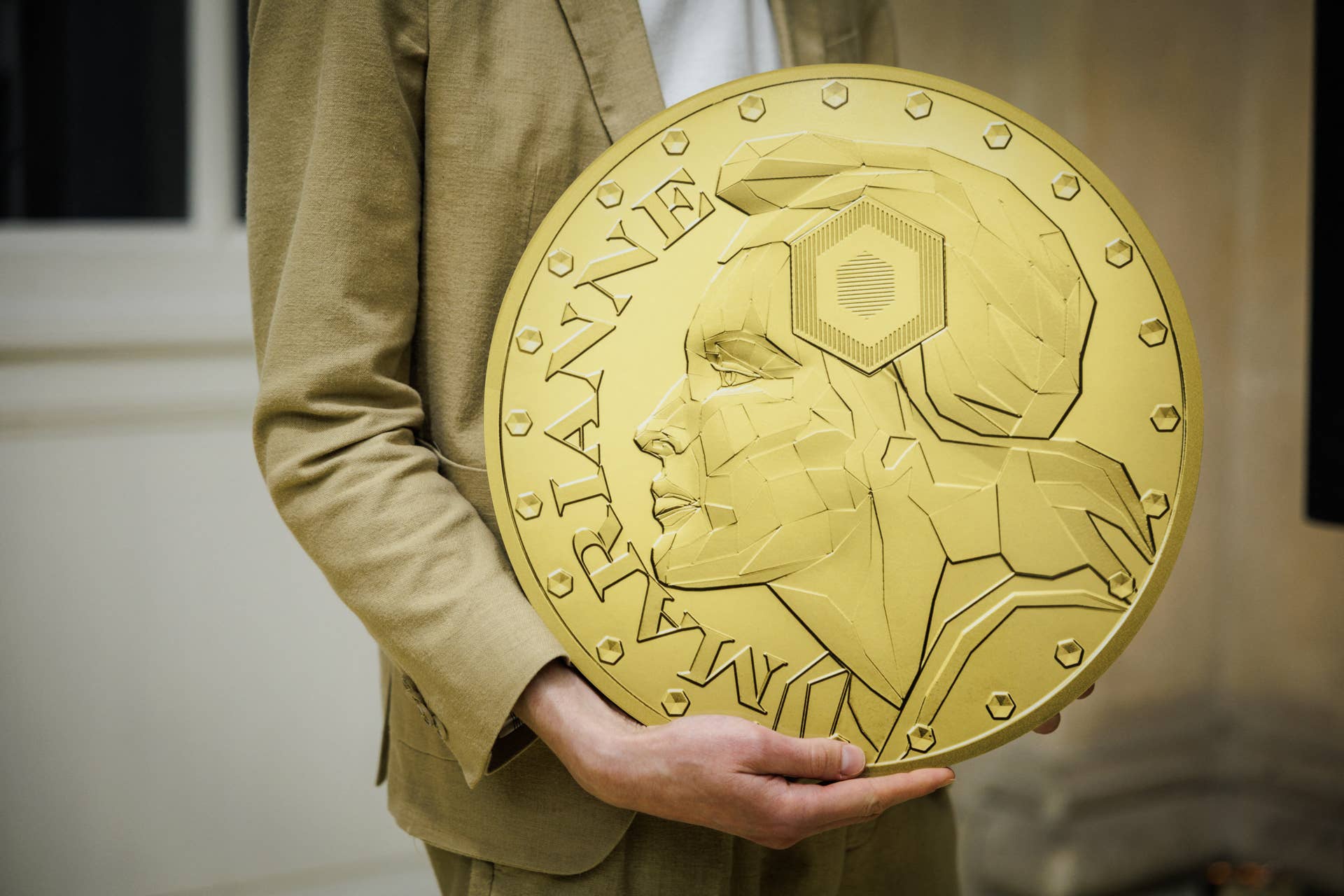 A worker holds a Marianne-Or gold coin bullion replica in Paris.
Simon Wolhlfajrt / AFP / Getty Images
More gold coming to market
Interest in gold has sparked a new interest in selling gold coins to the public. A new entrant into this market will be France.
The French government expects to start selling four sizes of its Marianne gold coins starting June 16: a tenth of a troy ounce, a quarter of a troy ounce, a half an ounce and a full troy ounce.
France hasn’t sold gold to the public since the 1920s.
A troy ounce is heavier than a standard ounce, weighing approximately 31.103 grams compared to the 28.35 grams of a standard “avoirdupois” ounce.