
Gold hit $5,595 an ounce in January 2026, its highest level on record, then spent the next several months doing something that confused investors expecting it to keep climbing.
It started falling every time the Iran conflict escalated and rising every time tensions eased. For a metal whose entire reputation is built on being a safe haven during geopolitical stress, that was the wrong way around.
One of Europe’s most closely watched commodity analysts just published his explanation for why, and revised his gold targets around it.
What Commerzbank’s Carsten Fritsch said and what changed in his forecast
Commerzbank commodity analyst Carsten Fritsch lowered the bank’s end-2026 gold price forecast to $4,800 per ounce from $5,000, while keeping the end-2027 target unchanged at $5,200, according to Invezz.
The cut is driven by a single factor: oil. The Iran conflict has created an oil price shock that is feeding directly into US inflation expectations, which in turn has pushed interest rate expectations sharply higher.
More Gold & Silver
- Bank of America has stark message for Silver investors
- State Street declares gold must-hold asset
- How much gold you should hold in your retirement portfolio
That is gold’s problem right now. Gold tends to rise when real rates are falling and the dollar is weakening. The oil shock has reversed both of those conditions simultaneously.
Gold fell to a two-month low of less than $4,400 last week, triggered by doubts that the US and Iran were moving toward a deal despite earlier signals from President Trump.
The drop was the latest expression of a pattern persisting since the conflict began: gold underperforms when the conflict escalates and outperforms when it eases.
Why oil is behaving like gold’s biggest headwind right now
Before the Iran conflict began more than three months ago, markets were pricing in approximately 50 basis points of Federal Reserve rate cuts for 2026.
The oil shock has flipped that outlook. Fed Funds futures now imply a US key interest rate of approximately 3.8% at year-end, with markets beginning to price in a 25-basis-point rate hike by spring 2027, according to TradingView.
Commerzbank’s economists have adjusted their own Fed forecast accordingly. They no longer expect a rate cut in 2026 but do not anticipate a hike either. Rate cuts are now expected only from mid-2027, driven by political pressure rather than the inflation dynamics that would normally trigger them.
That is the direct mechanism linking oil to gold. Higher oil prices raise inflation expectations, pushing the Fed toward tighter policy. Tighter policy raises real rates, reducing the appeal of holding a non-yielding asset like gold.
The oil shock has not destroyed the gold bull case. It has delayed it by pushing the rate-cut timeline further out.
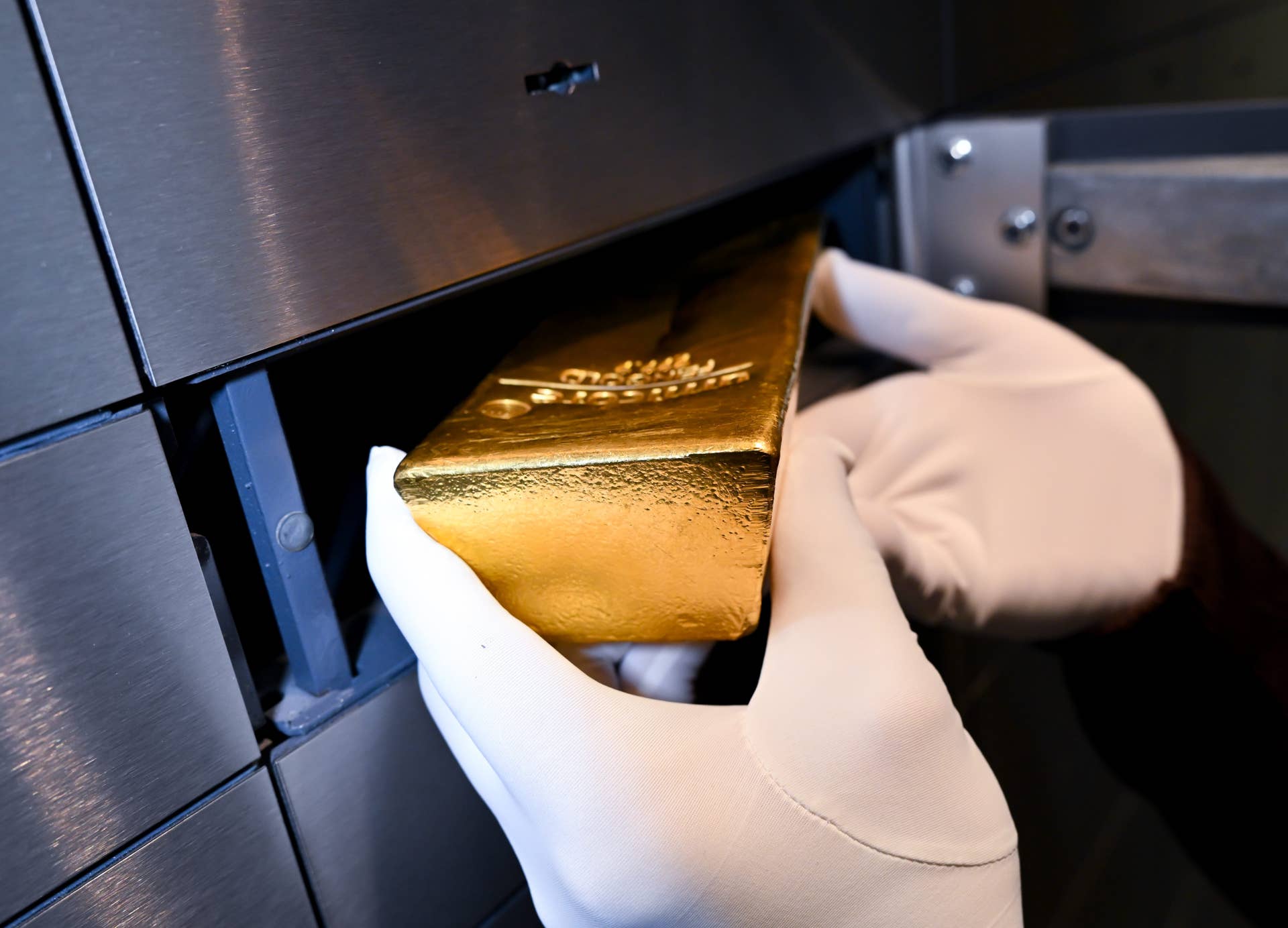 Central banks are still buying gold at elevated rates
Hoppe/Getty Images
Why Fritsch kept the 2027 gold target at $5,200
The more important part of the Commerzbank note is what Fritsch did not change. The 2027 target of $5,200 remains intact because the structural drivers of the gold bull market are unchanged.
Central banks are still buying gold at elevated rates. Government debt levels globally remain high and rising. Confidence in the US dollar as the sole reserve currency continues to erode at the margins.
Fritsch’s base-case scenario assumes a two-month transition period followed by the reopening of the Strait of Hormuz, which should ease oil prices, reverse current rate-hike expectations, and create space for a gold recovery toward the unchanged 2027 target. The 2026 cut is a timing adjustment, not a structural reversal.
That distinction matters for investors assessing the note. Commerzbank is not saying gold’s bull market is over. It is saying gold needs the oil shock to resolve before the next leg higher can begin, and that the timeline for that resolution is measured in months rather than years, according to Invezz.
Where Commerzbank’s gold targets sit relative to other major bank forecasts:
- JPMorgan targets gold at $5,055 to $6,300 for 2026-2027, with a Q4 2027 average of $5,400; Goldman Sachs targets $4,900 to $5,400 for the same period; UBS has a $5,900 target, according to MEXC
- Bank of America flagged an extreme bull scenario , accelerated de-dollarization, further Fed easing, and rising institutional gold allocations , that could push gold to $8,000 by 2027, though it describes this as a tail risk rather than a base case, according to GoldSilver.com
- ING expects gold to climb steadily from $5,100 in Q2 2026 to $5,450 by Q4; Westpac expects a peak at $5,000 in Q1 2027 followed by consolidation; Reuters poll of 31 analysts puts the 2026 median forecast at $4,916, according to XS.com
- HSBC remains the contrarian voice: analyst James Steel maintains a wide 2026 trading range rather than a point target, arguing that any meaningful easing of geopolitical tensions or fiscal tightening could remove a significant portion of the current risk premium, according to GoldSilver.com
- Commerzbank previously raised its 2026 gold target twice this year: from $4,400 to $5,000 in March, citing the sharp decline in prices as unsustainable; the June 4 cut to $4,800 is the first downward revision Fritsch has made in 2026, and it is explicitly tied to the oil-driven rate shock rather than any change in the structural bull thesis, according to Invezz
What the Commerzbank gold forecast means for investors watching the metal
The current gold setup is unusual because the metal is trading against its own fundamental logic. Gold’s core identity as a safe haven should make it the obvious beneficiary of a Middle East war.
Instead, it is being suppressed by the second-order effect of that war on oil prices and rate expectations. Understanding that mechanism is essential for anyone trying to position around gold right now.
Fritsch’s note essentially argues that the trade is a waiting game. The oil shock is temporary. The Strait of Hormuz will eventually reopen.
When it does, oil prices should ease, inflation expectations should moderate, and the Fed should return to a cutting bias. Gold should then be free to resume the structural bull market the January 2026 record high was expressing before the Iran conflict complicated the picture.
The risk is that the Hormuz reopening takes longer than the two-month transition Fritsch assumes, or that a US-Iran deal collapses and oil stays elevated through the rest of 2026.
In that case, the $4,800 year-end target could prove optimistic and the 2027 path to $5,200 would require compression into a shorter window. For investors, the key variable to watch is not gold itself. It is oil.