
Money has a way of feeling infinite right up until the moment someone asks you to count it.
For three years, the story investors told themselves about artificial intelligence had no ceiling. Demand was bottomless, the spending was visionary, and the only real risk was sitting on the sidelines while the future got built without you. Every quarter brought a bigger number, and every bigger number got cheered.
That confidence has a hidden assumption baked into it. It assumes the cash to pay for all of this is just sitting there, waiting, in some account no one ever has to drain. Companies do not raise money out of thin air. They raise it from the same pool that holds your index funds, your pension, and the retirement account you check more often than you admit.
Which brings us to the question Jim Cramer keeps asking, the one most of Wall Street would rather skip. With Anthropic, OpenAI and SpaceX all racing toward the public markets at once, where exactly is the half-trillion dollars supposed to come from? The CNBC host has been hammering that point for weeks. And yet, buried inside his own warning, Cramer sees one piece of evidence that the panic may be overdone.
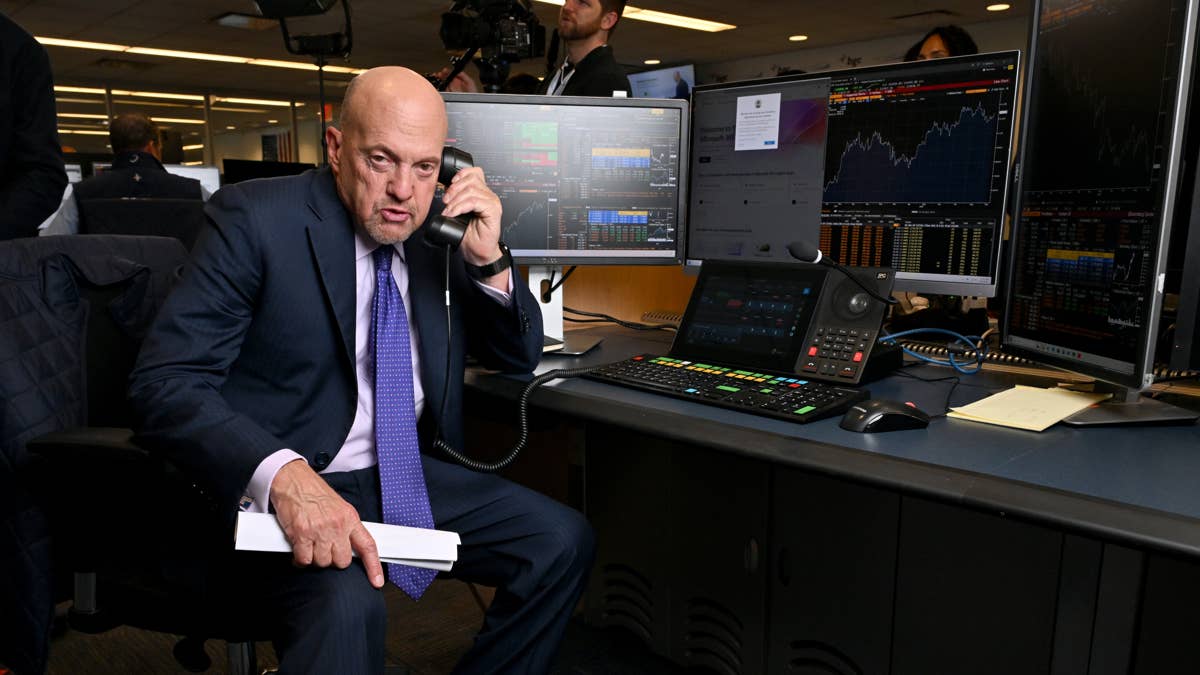 Jim Cramer has spent weeks warning that the crunch will pull cash out of stocks.
Slaven Vlasic / Getty Images
Why Cramer keeps doing the math on AI
Cramer’s worry is not complicated, which is part of why it sticks. Three of the most valuable private companies on earth are heading public within months of one another, each one needing a fortune to get out the door.
More AI:
- Micron sits at the center of a red-hot chip rally
- IBM CEO sends blunt message on AI and quantum computing
- Anthropic CEO makes shocking admission about AI
He counted roughly $80 billion for Alphabet, then about $100 billion each for Anthropic, OpenAI, SpaceX and Amazon, and asked whether the market really holds $500 billion in “spare change” to absorb the lot, he wrote in a June 2 post on X. That is the same arithmetic he laid out when he did the math on five mega-IPOs and concluded the numbers do not add up, as seen in my TheStreet report.
The reason the bill keeps climbing is simple. Building AI is brutally expensive, and the money goes out the door long before the revenue comes in.
Here is the scale of what investors are being asked to swallow this year.
- Alphabet (GOOGL) plans to sell roughly $80 billion of stock to fund its AI buildout, including $10 billion in shares set aside for Warren Buffett‘s Berkshire Hathaway (BRK.B), according to Yahoo Finance.
- Anthropic last raised $65 billion at a valuation near $965 billion before its confidential filing to go public, according to Benzinga.
- The four largest cloud companies, Alphabet, Microsoft (MSFT), Meta Platforms (META) and Amazon (AMZN), are on track to spend more than $700 billion combined on data centers and chips this year, according to CNBC.
Put that next to the warning Cramer keeps repeating. To make room for $500 billion in fresh stock, somebody has to sell $500 billion of something else first. When I lined that logic up against the deals that have actually cleared, though, the picture got more interesting than the headline fear suggests.
Related: Jim Cramer sends blunt message on Micron, Nvidia, Amazon
The Alphabet deal that caught his eye
The bright spot Cramer keeps circling back to is the one mega-deal that already worked.
Goldman Sachs (GS) was named the private placement agent for Alphabet’s roughly $80 billion stock sale, and the deal went off without a hitch. It was “the largest follow-on equity raise ever,” Goldman chief executive David Solomon said of the Alphabet sale, according to Yahoo Finance.
That matters because it is real-world proof, not a forecast. The single biggest test of investor appetite this cycle got placed cleanly, and the stock kept trading well after the shares hit the market.
Solomon sees more greed than fear in the market right now, and he is not shy about why. “There’s plenty of liquidity in the system,” as long as investors stay optimistic, he said, according to Banking Dive.
His point cuts against the doom narrative. The wall of money Cramer worries about is also a wall of money that, so far, keeps showing up when the deals are good. The fear assumes buyers vanish. The Alphabet placement says they did not.
What the Broadcom and CrowdStrike selloff actually shows
The second piece of evidence landed the hard way, on an earnings day that looked ugly on the surface.
Broadcom (AVGO) reported after the close on June 3 and slid about 11% the next session because it declined to raise its AI semiconductor sales forecast for 2026, dragging chip names like Micron (MU) and Advanced Micro Devices (AMD) down with it. CrowdStrike (CRWD) fell nearly 10% in the same window, even though its quarter was strong.
That second drop is the one Cramer flagged as misplaced. CrowdStrike’s “beat-and-raise quarter was actually great despite a nearly 10% stock drop,” he wrote, according to CNBC, pointing to a full-year guide of 27.7% growth in net new annual recurring revenue (ARR), a jump of more than five percentage points over the company’s prior outlook.
In other words, the company delivered, and the stock fell anyway. Cramer’s read is that the selloff would have happened no matter what the numbers said, because the stock had run up too far, too fast into the print.
What caught my attention in his June 4 note was not the alarm. It was the footnote. The same man warning that the funding crunch will take the market down was busy telling investors that the day’s scariest looking selloff was a buyer’s overreaction, not a verdict on the business.
Where the AI cash crunch leaves your money
Strip away the trillion-dollar headlines and the funding crunch becomes a plumbing problem, and plumbing problems can be fixed.
If the market has to find $500 billion to fund the IPO wave, the money comes from selling, and the most liquid thing to sell is whatever everyone already owns. That includes the broad index funds sitting inside most 401(k) accounts. A few weeks of that kind of rotation can feel like the sky is falling even when nothing is fundamentally broken.
The Alphabet deal and the CrowdStrike snapback hint at the other side of that trade. When the supply is priced right and the business is sound, the buyers are still there, and the panic tends to burn off faster than the headlines suggest.
That does not make the risk imaginary. Wedbush analyst Dan Ives called the IPO rush “an opening of the floodgates for the IPO market,” according to Benzinga, and floodgates can swing both ways. A glut of new stock chasing the same dollars is exactly the setup that produces a sharp, scary air pocket.
For now, the lesson Cramer is quietly handing retail investors is the least glamorous one on Wall Street. Watch what gets funded and what bounces, not what gets shouted. The next leg of this market will be decided by whether the deals keep clearing as cleanly as Alphabet’s did, and the first real test arrives the moment OpenAI files.
Related: Jim Cramer does the math on 5 mega-IPOs, and it doesn’t add up