
The most expensive habit a company can have is paying someone else for the thing it sells.
For three years, Microsoft (MSFT) looked like the firm that had outsourced its way to the front of the artificial intelligence race. It poured more than $13 billion into OpenAI, wired ChatGPT’s models into Windows and Office, and later spent billions more to put Anthropic’s Claude on its Azure cloud.
The strategy worked. It gave Microsoft an early lead and made the stock look untouchable.
It also created a quiet dependency. The smartest features in Microsoft’s products ran on intelligence the company rented from partners it did not control, and every query carried a bill. As usage exploded, so did the cost of leaning on other people’s models.
Microsoft has moved to change that arithmetic. At its Build developer conference in San Francisco on June 2, the company’s AI Superintelligence Team unveiled seven homegrown models and a plan to lean on its outside suppliers far less.
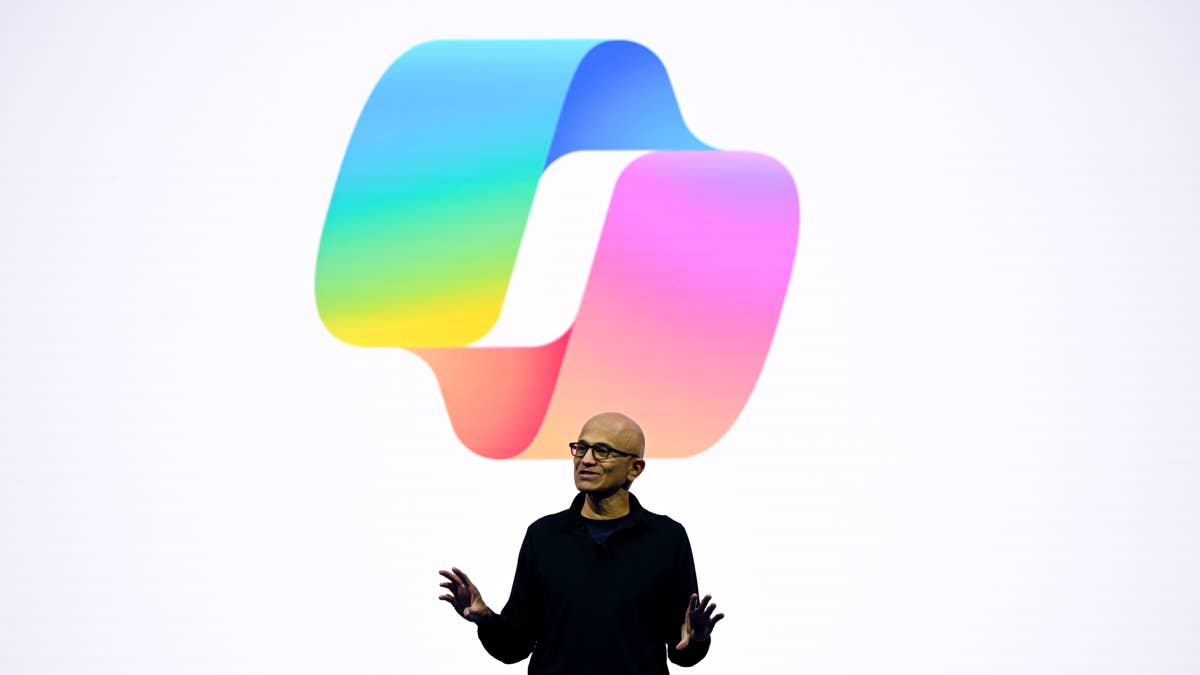 Microsoft builds its own AI to stop renting brains.
picture alliance / Getty Images
What Microsoft actually showed
Microsoft did not just demo a chatbot. It showed the plumbing.
The flagship is MAI-Thinking-1, a reasoning model Microsoft says it trained from the ground up without copying from rival systems.
Around it sits a coding tool called MAI-Code-1-Flash that turns plain-language descriptions into working software, plus new image, speech and transcription models, according to CNBC.
The selling point is a lower cost for every request a developer sends.
More AI:
- Micron sits at the center of a red-hot chip rally
- IBM CEO sends blunt message on AI and quantum computing
- Anthropic CEO makes shocking admission about AI
The coding model is already rolling out inside GitHub Copilot and Visual Studio Code, the tools millions of developers use every day, which hands Microsoft a built-in audience the moment it stops paying outside vendors for that work.
CEO Satya Nadella framed the launch as a shift from buying frontier intelligence to building it, and that framing matters more than any single demo. Owning its models lets Microsoft stop paying a toll on work it could do in-house.
At Microsoft’s scale, trimming the cost of every query is the difference between thin margins and fat ones.
Related: Microsoft reveals strange new plan for users
Why investors sold Microsoft on the news
Wall Street did not throw a party after Microsoft’s announcement.
Microsoft stock fell about four percent on June 2 as traders took profits and moved money around big tech, with much of the attention swinging to Anthropic’s fresh filing to go public, according to Benzinga.
The drop says less about the models than about timing.
Owning artificial intelligence means paying for it up front, and Microsoft is already carrying heavy bills for data centers and chips.
Bank of America has pegged Microsoft’s capital spending near $140 billion for fiscal 2026, most of it aimed at the hardware that trains and runs these models, according to TheStreet.
Against a bill that size, a four percent dip reads like impatience rather than doubt.
The partner Microsoft wants to stop paying
The OpenAI story took the headlines. The sharper edge points somewhere else.
Suleyman, who runs Microsoft AI, told the Financial Times the team is “less concerned” about the consumer-focused work at Google (GOOGL), Meta (META) and OpenAI, and more focused on the enterprise and coding work that Anthropic has made its own, according to Benzinga.
With Bloomberg he was blunt about money. Microsoft pays heavily for Anthropic’s models and wants to “reduce and ultimately eliminate that cost,” Suleyman said, according to The Next Web.
That is the quiet target. Microsoft has put $5 billion into Anthropic and signed a $35 billion cloud agreement with it, so every task its own models can absorb is margin Microsoft keeps instead of sending out the door.
The company is also pushing its own Maia inference chips as a cheaper option than Nvidia (NVDA) hardware for running these models, another way to squeeze cost out of each query, according to Benzinga.
Microsoft says its new reasoning model already draws even with Anthropic’s Claude Sonnet 4.6 in blind testing and matches the stronger Claude Opus 4.6 on a coding benchmark, according to GeekWire. I would treat any vendor’s own benchmark with caution, but the direction of travel is hard to miss.
What Microsoft’s AI numbers say
The Microsoft AI bet at a glance
- Microsoft unveiled seven in-house models, led by MAI-Thinking-1, at Build on June 2, according to CNBC.
- The renegotiated OpenAI agreement caps what OpenAI pays Microsoft at $38 billion through 2030, while Microsoft keeps a 27 percent stake and access to OpenAI’s models until 2032, according to CNBC.
- Jefferies analyst Brent Thill holds a 675 dollar price target, while Stifel sits near $415 on worries about heavy spending, according to stockanalysis.com.
That gap between $675 and $415 is the entire debate, and in my analysis it turns on a single question. Bulls see rented intelligence becoming an owned, high-margin engine. Bears see a fortune spent with the return still on paper.
What makes this moment different from past Microsoft AI news is that the company is no longer just an investor and a landlord for other people’s models. It now sells its own, at every layer of the stack from coding to images to voice.
The broader analyst crowd still leans bullish, with a consensus target near $560, according to stockanalysis.com, even after the June 2 dip left the stock near $422.
Suleyman himself did not claim victory. He said Microsoft is only now reaching the frontier and acknowledged that Anthropic stays ahead by several months, according to Benzinga.
What Microsoft’s AI bet means for your money
You may never open a Microsoft app on purpose. You almost certainly own the stock anyway.
Microsoft anchors the S&P 500, which anchors most index funds and target-date retirement accounts. When a company that size tries to make its core product cheaper to run, the savings flow to earnings, and earnings are what your fund is really buying.
Put it in dollars. If owning models shaves even a few cents off the cost of every Copilot query, then across billions of queries that lands as real profit, and profit is what lifts the funds in your retirement account. If it does not, the same spending becomes a weight on those funds.
The timing is not random. Anthropic filed confidentially to go public on June 1, and OpenAI is widely expected to follow, according to CNBC. Both partners are sprinting toward the market as independent companies, which is exactly why Microsoft wants intelligence it owns before its suppliers start answering to public shareholders with pricing power of their own.
Here is the risk worth watching. Training models is expensive, and if MAI-Thinking-1 and its siblings fall short in real use, Microsoft will have taken on cost for intelligence it could have kept renting at a known price.
The showy phase of these partnerships is ending. The financial phase, where building beats buying or quietly turns into a drag, is the one that will show up in your next statement.
Related: Microsoft and Copilot just hit a jackpot in healthcare