
Rivian (RIVN) is finally moving into the part of the electric vehicle market that could determine its future.
The electric vehicle business is delivering its new R2 SUV, a more compact, affordable car that many investors view as Rivian’s greatest hope for breaking out of its niche as a builder of premium electric trucks and SUVs.
That makes the R2 more than just another product rollout.
This is Rivian’s biggest challenge yet.
The EV firm has built a loyal following with its R1T pickup and R1S SUV, although both vehicles are in higher-priced areas of the market. The R2 aims to attract a wider demographic and allow Rivian to compete in the segment of the EV market where volume counts most.
The timing is notable.
Tesla’s Model Y remains one of the popular electric cars in America, and numerous competitors have spent years attempting to take it on with similar crossovers and similar techniques.
Rivian CEO RJ Scaringe thinks that could be a mistake.
As deliveries begin, he’s arguing that Rivian’s future hinges on doing something that many competitors have struggled with: offering buyers a true alternative to Tesla, not just another version of Tesla.
“If you want to buy a Tesla Model Y, you don’t want XYZ company’s version of a Model Y. You’ll just get the Model Y.”
Rivian’s R2 gives the company its biggest growth opportunity
The R2 will play an important role in Rivian’s lineup.
Rivian’s previous automobiles made the brand, but the price points are steep, limiting the ability to appeal to a wide customer base. The R2 is supposed to change that equation.
The business says the new SUV will eventually start at $44,990 for the Standard variant, with higher-end Premium and Performance versions commanding higher prices.
That price tag puts Rivian considerably more in the middle of the EV market.
For investors, the vehicle is much more crucial.
Scaringe has previously characterized the R2 as an inflection point for Rivian. In many ways, this is the company’s first real attempt at becoming a mainstream automaker rather than a premium EV brand.
Related: AT&T lands Rivian win as Wall Street sees growing threat
The problem is evident.
Tesla is still the 800-pound gorilla in the EV space, and there have been plenty of competitors trying to take a piece out of that lead.
Some looked for lesser pricing.
Others were about technology.
Many just released cars that looked and felt a lot like Tesla’s best-selling models.
Scaringe seems to believe that strategy doesn’t often work.
According to him, the U.S. EV market doesn’t suffer from too much choice. It suffers from too little.
He recently called the inexpensive EV segment being underserved, saying that there is a large number of buyers who want something that is not Tesla designs and experiences.
That conviction formed the basis of the R2’s development.
Rather than imitate Tesla’s playbook, Rivian leaned on the rugged styling and outdoor-oriented character that made the brand stand out in the first place.
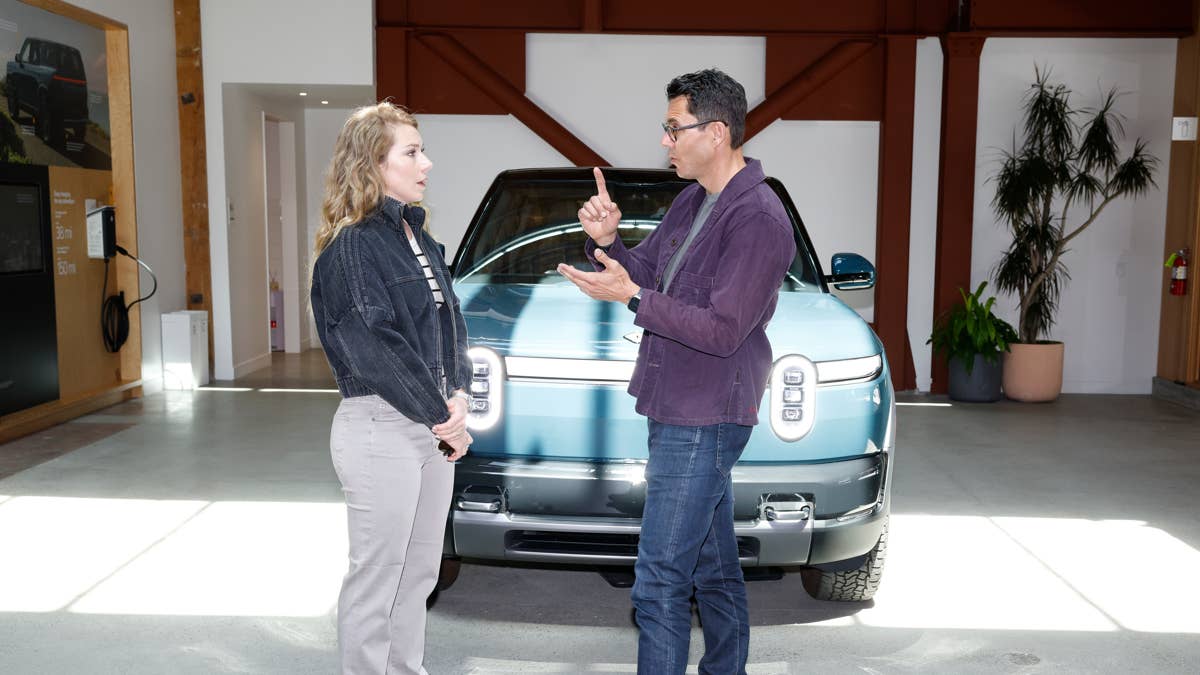 RJ Scaringe (R), founder and CEO of Rivian, has a clear-cut take on competing against Tesla.
Kimberly White / Getty Images
Rivian CEO says Tesla copycats are missing the point
Scaringe’s statements are indicative of a broader approach to competition in the EV sector.
Rivian wants to focus on its strengths, rather than chase Tesla’s.
Many automakers have tried to compete with “Model Y copies,” as the CEO termed them. The problem, he says, is that if buyers want a Tesla experience, they can buy a Tesla.
That doesn’t leave much room for knock-offs.
Instead, Rivian is wagering that purchasers want choices.
Not all people desire the same design language, the same driving experience, or the same brand identity.
The company’s approach hinges on the belief that EV adoption will continue to expand and that there will be room for numerous winners, not just one dominant winner.
More Automotive:
- Ford, GM likely scratching heads over latest White House message
- Ford begins testing tech that will change Americans’ minds about EVs
- Honda’s million-vehicle recall hits core SUVs and trucks
That sounds like a logical technique, but it is not without risk.
Differentiation is only important if people care enough to actually pick your product.
Rivian still needs to show it can build the R2 cost-effectively and keep demand and production going without compromising profitability.
These are obstacles that have sunk many EV ventures in the past.
Rivian’s anti-Tesla strategy faces a real-world test
The real test of Rivian’s strategy will be the success of the R2.
The business is entering a sector that has grown more competitive as carmakers fight for EV buyers and consumers are more choosy about big purchases.
Rivian R2 key takeaways
- Rivian has begun delivering its new R2 SUV.
- The R2 is widely viewed as Rivian’s most important growth vehicle.
- CEO RJ Scaringe says many EV makers made a mistake by copying Tesla.
- Rivian intentionally designed the R2 to stand apart from the Tesla Model Y.
- The Standard R2 is expected to start at $44,990.
- Rivian believes EV buyers want more choice rather than more Tesla alternatives.
Tesla still enjoys big advantages in scale, brand recognition and manufacturing capacity.
Rivian isn’t trying to compete with those advantages directly. It’s trying to convince customers they don’t need another Tesla choice. They require something else.
It may seem like a fine distinction, but it is crucial to Rivian’s long-term plan.
If buyers buy into the R2, Rivian could be one of the only EV companies with a clear identity outside of Tesla.
If they don’t, worries about the company’s prospects for growth will undoubtedly get louder.
Right now, Scaringe seems to believe that being unique is a better strategy than copying others.
The launch of the R2 will be the first significant test of whether that belief is right.
Related: Rivian defies expectations despite rough EV environment