
Discount retailers are in a difficult position.
Many shoppers are still looking for low prices and quick deals, but that does not mean every discount chain is winning.
Dollar Tree’s long struggle since its acquisition of Family Dollar has shown how difficult the sector has become.
The company had to close hundreds of Family Dollar stores before selling it for far less than it had paid after years of pressure from weak demand, high costs, and a difficult turnaround.
This matters because discount chains can no longer rely only on low prices. They also have to make shopping easier, keep expanding variety, and make products feel worth the money.
All this while protecting the value message that brought customers in the first place.
Five Below is now trying to manage that balance inside its own stores.
The retailer, known for low-priced toys, beauty items, candy, room decor, tech accessories, and trend-driven products, has spent the past several years expanding beyond its original $5-and-under identity.
Some items now sell for more than $5, giving the company room to offer larger, trendier, or more gift-able products.
Traditionally, these items were kept in a separate section called Five Beyond, at the back of the store.
But as demand and customer interest increase, the retailer is changing that strategy.
Discount chain removes familiar store section
Five Below is removing its dedicated Five Beyond section and moving those products into regular store departments.
That means shoppers may still find items priced above the chain’s traditional $5-and-under range, and now they won’t be in a separate area anymore.
Five Below Chief Executive Winnifred Park said on the company’s first-quarter earnings call that the retailer has largely finished moving Five Beyond products into the appropriate merchandise “worlds” across stores.
More Retail:
- Struggling women’s clothing retailer shutters 171 stores
- Retail giant launches first new home brand in 5 years
- Discount retail giant wins as shoppers change how they spend
Park said the company, “abolished the Five Beyond section, moved that product in line.”
Further noting that they saw “product perform better because it’s basically merchandized the way the customer wants to shop the product.”
Park gave the example of a $35 gilt floor mirror. Instead of putting that item in a separate Five Beyond area toward the back of the store, the retailer now places it in the room section with other home and decor products.
That is a meaningful shift for Five Below because Five Beyond had served as a separate place for higher-priced merchandise. Now, the company is trying to make those products feel like part of the regular shopping trip.
It also reflects the company’s broader shift toward expanding product ranges and price options, a move that is not away from its deals and discounts but rather suggests ways to increase revenue.
Park said more than 80% of the company’s assortment is priced at $5 or less. But she also said customers have responded well to prices above $5 when the product delivers strong value.
This will be a key test for the retailer.
Five Below wants the flexibility to sell larger, trendier, or more giftable products, but it cannot make customers feel the chain is moving too far from its core bargain identity.
TheStreet previously covered Five Below’s stock jump and the customer challenge emerging as the chain pushes beyond its original price point.
This latest move shows how the company is trying to address that challenge in-store.
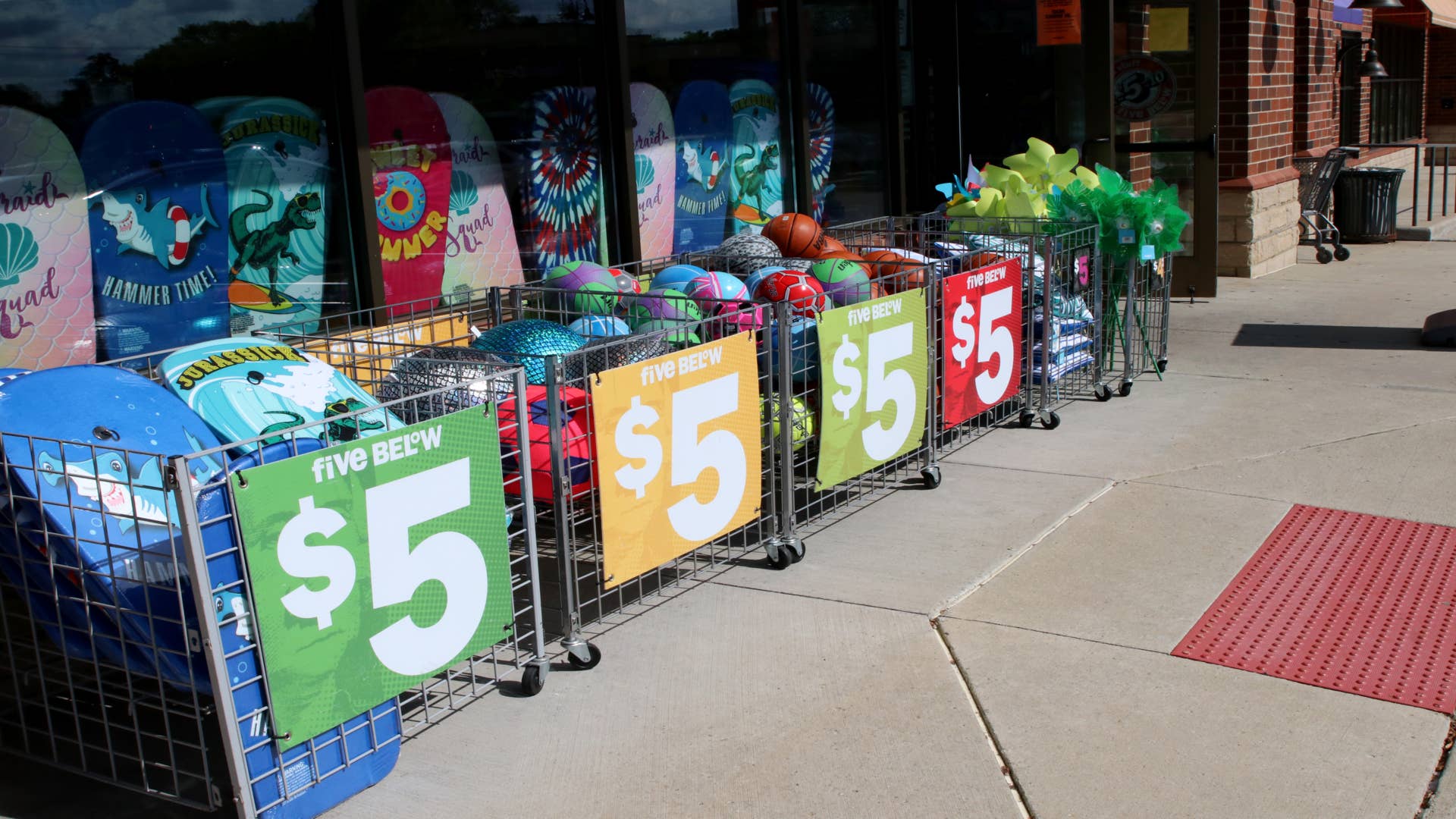 Five Below gets rid of the Five Beyond section.
Shutterstock
Five Below sales surge in first quarter
Five Below’s store change follows a strong first quarter.
For its first-quarter 2026, the company said net sales rose 32.5% to $1.29 billion, up from $970.5 million a year earlier. Comparable sales increased 22.7%.
The retailer opened 49 net new stores during the quarter and ended the quarter with 1,970 stores in 46 states.
Net income rose to $123.1 million from $41.1 million in the same quarter last year. Adjusted diluted earnings per share were $2.22, compared with 86 cents a year earlier.
The quarter was not driven only by higher prices.
Five Below said transactions increased 18.5%, while average transaction value rose 3.5%. That means more shoppers were coming into stores and not just spending more per trip.
Park said growth was broad-based, with 15 of the company’s 18 merchandise departments posting positive comparable sales.
Games and toys were especially strong, helped by collectibles and the broader squishy toy trend.
Five Below also leaned into candy, beauty, fitness, Pilates, and Pokémon-related products.
The retailer has been using social media and creator content to identify and amplify trends that can bring shoppers into stores.
Park said the Squishy Dumpling trend was supported through social listening, creator engagement, and in-store execution.
That strategy can drive traffic, especially with younger shoppers and parents. But it also creates a new challenge.
Once customers come in for a viral item, Five Below needs the rest of the store to be easy enough to shop that they keep adding to the basket.
That is where the Five Beyond change matters.
By placing higher-priced products in the right departments, Five Below aims to make them easier to discover during the same shopping trip.
Five Below will open 150 new stores
Five Below raised its full-year fiscal 2026 outlook after the strong quarter.
The company now expects full-year net sales of $5.40 billion to $5.48 billion, and expects comparable sales to increase 6% to 8% for the year.
This outlook is partly based on Five Below opening about 150 net new stores, showing that the company is still expanding even as it reworks part of its in-store experience.
While optimistic, the company is not seeing the year as risk-free.
Chief Financial Officer Daniel Sullivan said Five Below is watching the world its customers are living in, including higher fuel costs, sticky inflation, and a somewhat soft labor market.
He also said shoppers may have received some first-quarter help from higher tax refunds, which he said could be a reason for the company’s solid earnings.
Five Below’s outlook includes the expected impact of the tariffs currently in place through July 24 and assumes tariffs will return to the rates in place at the start of the fiscal year.
The company said its forecast excludes any impact from potential tariff refunds.
That caution makes the store change more important.
Five Below is trying to prove that products above $5 can still work without hurting the value image that draws shoppers to the chain.
For customers, the change means Five Beyond will no longer be a store section. They are being moved to where Five Below thinks shoppers are more likely to find them.