
Tesla FSD has been touted as one of the industry’s best advanced driver assistance systems.
The total fleet of FSD-equipped vehicles has driven over 10 billion miles using the semi-autonomous driving technology that allows the driver to take their hands off the wheel, but still requires drivers to keep their eyes and attention on the road.
Tesla has been expanding access to Full Self-Driving (Supervised) rapidly overseas lately as the company looks to have the technology approved across the European Union soon.
But back home, there are questions about just how safe the technology is based on the data collection done by Tesla. Now, two U.S. Senators are seeking answers about FSD safety statistics that they say are creating “urgent safety problem.”
U.S. Senators question Tesla FSD safety data
Last month, Reuters reported that Tesla was exaggerating its safety claims for FSD and that it is using a team of “data labelers” to help the AI that powers FSD be better.
This revelation suggests that Elon Musk‘s declaration that FSD is already up to 10 times safer than human drivers and ready for more widespread adoption is hollow.
So Senators Edward Markey (D-MA) and Richard Blumenthal (D-CT) sent a letter to the National Highway Traffic Administration saying the Reuters report exposes “dangerous gaps” in its autonomous vehicle data collection.
“Tesla has repeatedly told investors, consumers, and the public that FSD is far safer than human driving, but the data analysis justifying those claims is weak and misleading. These representations are not merely marketing claims; they may shape how drivers use Tesla’s FSD, how the public understands the risks of the technology, and how regulators evaluate potential safety defects,” the letter stated.
According to the letter, Tesla’s data to come up with the “10 times safer” is flawed for several reasons, including:
- Comparing unlike crash incomes that made Tesla look better
- Comparing newer Tesla vehicles to the entire U.S. vehicle fleet
- Counting FSD involved crashes only if it is active at the time of crash or within five seconds. The NHTSA uses a 30-second time threshold for all ADAS systems.
- Relying on incomplete automated telemetry.
Tesla is cooking the books, according to the Senators and the NHTSA has not been able to get the real data it needs, which makes the whole situation more dangerous for drivers.
“The push to allow more autonomous vehicles on public roads depends heavily on the claim that these driving systems are safer than human drivers,” the letter stated.
“To the extent that Tesla or other vehicle manufacturers are misleading the public about their safety data, however, consumers may choose to purchase or ride in an AV based on the unproven expectation that they are safer than non-autonomous vehicles. This type of information asymmetry is a classic market failure, which will likely result in more AVs on the road — and potentially more traffic injuries and fatalities if those systems are not in fact as safe as they claimed.”
Currently, the NHTSA does not require vehicle manufacturers to submit data on the number of vehicles they operate, the distances they travel, and other data that could help contextualize crash rates.
They say that is the type of data that “would help prove or disprove Tesla’s safety claims.”
So the Senators are asking the agency to “significantly expand autonomous vehicle data reporting requirements.”
But while Tesla have one of the most popular ADAS platforms, it is far from the only one.
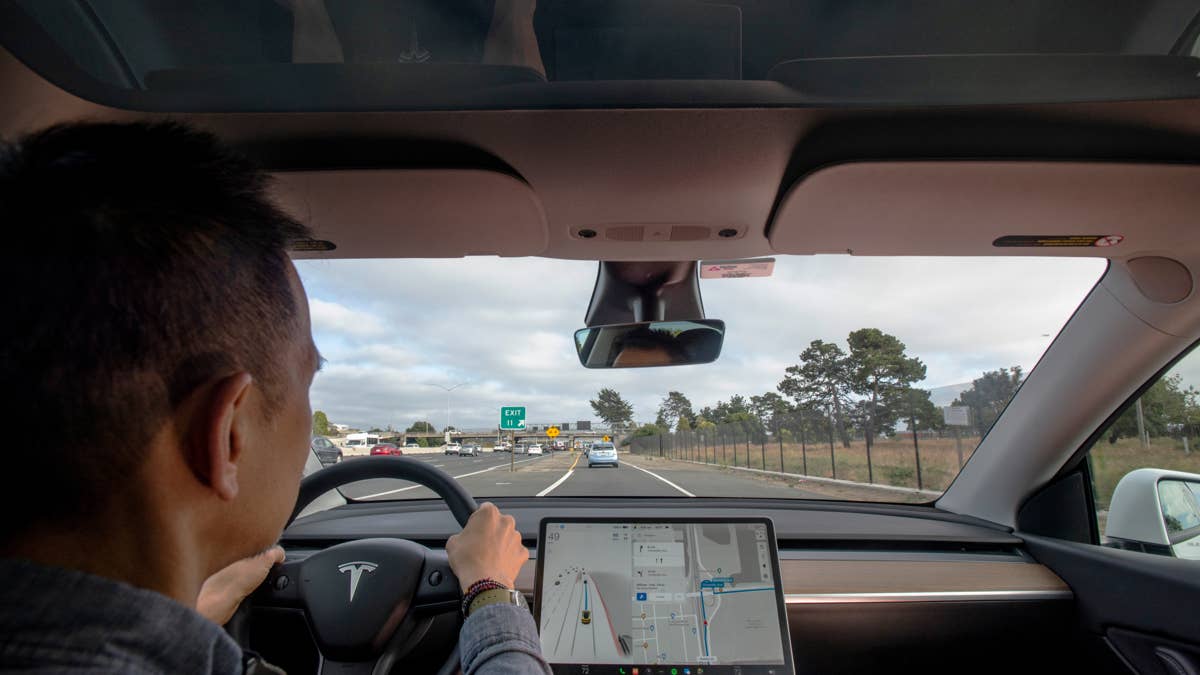 Tesla FSD data is not sufficient, according to two U.S. Senators.
The Washington Post / Getty Images
Autonomous driving data is incomplete across the board
Tesla isn’t the only company with autonomous driving data that isn’t as transparent as possible.
Waymo, which is the most active of the U.S robotaxi options, says that compared to those with human drivers, its autonomous vehicles have been involved in 90% fewer crashes resulting in serious injuries.
Auto insurance companies have a lot at stake with this new technology. Autonomous vehicles could change insurance pricing at the most minute level. The question is: will it raise rates or lower them?
Right now, the industry is in a wait-and-see pattern.
“I don’t think they have the data yet to make that kind of assessment,” David Kidd, vice president for vehicle research at the Insurance Institute of Highway Safety, told Bloomberg when asked which drivers are more likely to crash: autonomous or human. “Most insurers are extremely conservative, and they rely on historical data to assess risk accurately. There just isn’t enough information available yet.”
Trent Victor, Waymo’s director of safety research and best practices, recently gave an interview saying much of the same, acknowledging that, “there is not yet sufficient mileage to make statistical conclusions about fatal crashes alone,” adding that “as we accumulate more mileage, it will become possible to make statistically significant conclusions on other subsets of data, including fatal crashes as its own category.”
In recent months, two videos of a Waymo robotaxi driving through an active police standoff in two different cities have circulated online.
While most drivers would be able to navigate those scenarios fairly easily, Waymo has not been able to. And one professor says he know why.
“In like 95% of situations where a disengagement or accident happens with autonomous vehicles, it’s a very regular, routine situation for humans,” Henry Liu, professor of engineering at the University of Michigan, said recently. “These are not challenging situations whatsoever.”
“We have seen many reports from autonomous vehicle developers, and it looks like the numbers are very good and promising,” Liu said. “But I haven’t seen any unbiased, transparent analysis on autonomous vehicle safety. We don’t have the raw data.”
Related: Former Tesla AI data trainers deliver crucial message on robotaxis
Even the way Waymo collects the data is disingenuous, according to Liu.
Waymo vehicles primarily drive on urban streets with a speed limit of 35 miles per hour or less. “It’s not really fair to compare that with human driving,” according to Liu.
Former Tesla AI trainers reveal skepticism about FSD viability
Reuters recently interviewed nine former Tesla “data labelers” from the company’s Utah office, where hundreds of employees scrutinize and label video from the eight external cameras on each Tesla.
The workers train Tesla’s AI by labeling traffic incidents as good or bad, identifying items the computer can’t recognize, and pinpointing potential trouble spots where the tech needs improvement.
But the problem, according to them, is that FSD is still struggling to execute basic maneuvers, like stopping at a railroad crossing or for school buses, or traveling in the left lane. And despite these consistent issues, Tesla is still publicly touting the tech’s prowess while doing big public displays like the Robotaxi launch in Austin last summer.
While FSD and Robotaxi aren’t exactly the same technology, according to Tesla, there is apparently a lot of overlap in the work employees are doing to ensure both platforms are safe.
“Inside Tesla, as these events (Robotaxi rollout) approached, staffers worked long hours mapping routes and training the software on specific hazards to make the company’s self-driving technology appear more capable than it really is,” Reuters reported, citing four former employees.
But the problem is that those fixes the human workers were doing are “impossible to deploy on a broad scale,” like the scale Musk has envisioned, where there are millions of autonomous Teslas on the road.