
Federal Reserve Chairman Kevin Warsh did not make a definitive policy statement on artificial intelligence during his June 17 press conference.
He achieved something quieter and perhaps more crucial for Wall Street.
Warsh said AI could be integrated into a bigger effort to revamp how the Fed gathers data, analyzes productivity and evaluates the economy in real time. That’s different from suggesting AI will influence interest-rate policy right away.
The distinction is important because AI is already showing up in the economy in data centers, power usage, business spending and infrastructure investment. The tougher question is whether the technology will produce sufficient productivity growth to counter those challenges.
For now, Warsh’s answer isn’t a rate move.
It is a task force.
The Fed chief created five task teams on communications, balance-sheet policy, data, productivity and jobs and inflation frameworks. One will examine the Fed’s use of data. Another will study productivity and jobs in an age of transformation, including AI.
The question for investors is not whether the Fed has already reached a conclusion on AI.
It hasn’t.
The larger question is whether Warsh is positioning the Fed to employ AI and other new data tools to make sense of an economy that may be changing faster than old models can capture.
“It will really depend on the outcome of the task force which will no doubt be stacked with AI experts and savants. Warsh has been a vocal proponent of introducing AI into Fed models and measures to update data collection systems. This is his soft launch into doing exactly that,” TheStreet’s resident Fed expert Mary Helen Gillespie said.
Warsh’s Fed task force puts AI inside the modeling debate
Warsh presented the new task forces as a product of a wider examination of the way the central bank carries out monetary policy.
Inflation was substantially above the Fed’s 2% aim, said Warsh, but the Fed left the federal funds rate in a target range of 3.5% to 3.75% during the June meeting. The most forward-looking signal, however, came following the rate decision when he spelled out the structure of the task force.
The data task force could be particularly crucial.
The panel would look at new sources of information and changes in methodology that would provide policymakers with more accurate, relevant, up-to-date and actionable information about the economy, Warsh said.
That’s where AI transitions from market buzzword to potential Fed infrastructure.
The Fed has traditionally looked to basic economic statistics like surveys, inflation data, labor market measures, and national accounts. These tools are still crucial to policy, but they often arrive late and with amendments.
Warsh said the Fed needs to look carefully about whether previous data methods are sufficient for the economy policymakers are attempting to comprehend now.
Related: Fed’s Warsh leaves markets guessing on rate hikes
He was careful not to overdo the exertions. Asked if he planned to fully revamp the system of national accounts, Warsh said, “In a word, no.”
But he also said the Fed would look at government statistics, private-sector best practices and analytical tools enabled by AI to generate better real-time information for policymakers.
More Fed:
- Warsh’s first Fed meeting resets interest rate-cut bets
- Hot May CPI sticks a pin in Fed rate-cut bets
- Goldman Sachs sends strong message on next Fed rate cut
That’s the safer and stronger tack.
Warsh is not arguing that monetary policy has already changed because of AI. He’s leveraging AI to update the Fed’s approach to data and modeling.
AI demand is easy to count, but productivity is harder to prove
The big economic debate is whether AI is more about growing demand or supply.
That question came up directly during the press conference when Wall Street Journal reporter Nick Timiraos asked whether the AI buildout, including capital expenditures, data centers and power demand, was adding more to demand than supply.
Warsh’s answer explained the importance of the task force.
He said central bankers spend much of their time counting demand because it is easier to see, count, check and revise. Supply, by contrast, often has to be inferred.
That distinction is the crux of the Fed’s AI conundrum.
On the demand side, we have measures already. Companies are spending on chips, servers, data centers, and electricity and related infrastructure. That investment can raise gross domestic product, bolster business earnings and propel the larger AI trade.
Key takeaways from Warsh’s AI task force
- June 17: Warsh announces five task forces, including groups focused on data, productivity and jobs, and inflation frameworks.
- AI focus: The productivity-and-jobs task force will study new general-purpose technologies, including AI.
- Near-term issue: AI demand is already visible through data centers, power needs and infrastructure spending.
- Harder question: The productivity payoff is less certain and may take longer to measure.
- Investor relevance: Better Fed measurement could eventually affect inflation forecasts, rate expectations and market valuations.
There is less confidence on the supply side.
If AI makes labor more productive, corporations could produce more without raising prices as much. That might allow the economy to grow faster, without creating quite so much inflationary pressure.
But the trick is time.
Warsh said AI data centers and related infrastructure are showing up in GDP numbers, but the timing and size of the supply-side lift are less clear. He called it a “race between supply and demand” and said the task committee will investigate exactly the policy consequences.
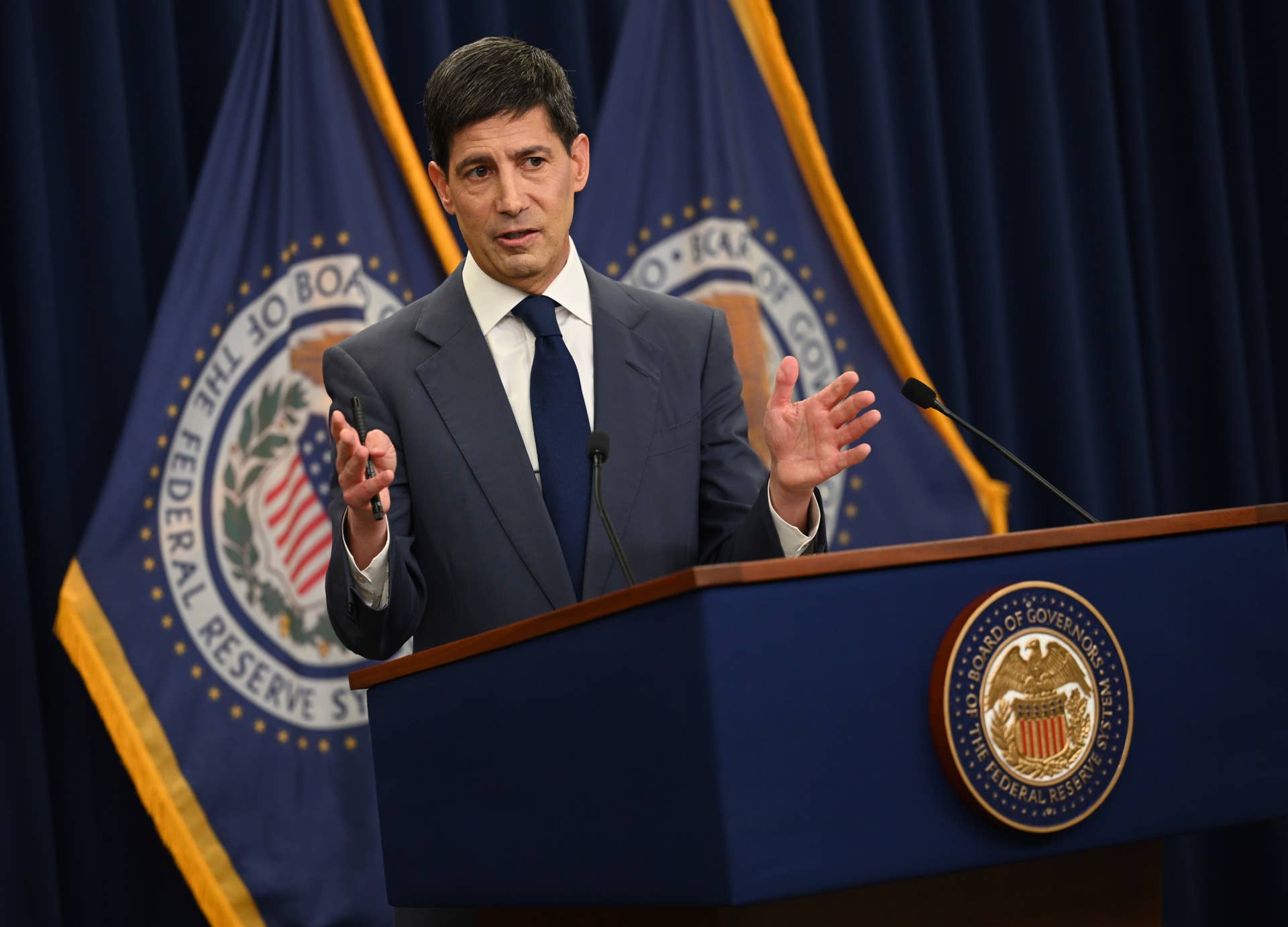 A quiet Warsh move could remake the Fed’s economic models.
China News Service / Getty Images
Wall Street gets a new Fed variable
The message to markets right now is that the Fed has not reached a conclusion on AI.
That is the point.
The bottom line is that Warsh appears to view AI as critical enough to shift the Fed’s internal conversation about data, productivity, jobs and inflation.
It might matter for rate expectations, bond yields, Big Tech valuations and the larger AI trade.
If the Fed finally becomes more convinced that AI is boosting supply-side capacity, policymakers may have greater space to tolerate faster growth without presuming inflation will be accelerating.
That would be a big deal for investors who have spent years discussing whether the economy can grow faster without pushing the Fed to keep policy tighter longer.
But if demand for AI continues to grow faster than productivity gains, the situation may change.
More data centers, semiconductors, power infrastructure and labor demand can be a boon to growth, but they can also cause bottlenecks in sections of the economy where supply is constrained.
Warsh said he’s still recruiting and finalizing the task groups, with work scheduled to begin in the coming weeks and early framing possibly in the fall.
So the names are going to matter on the task force.
If the committee is populated with AI experts, economists and data specialists, it could be the first serious indication of how aggressively Warsh wants to integrate AI into the Fed’s measurement process.
For the present, Warsh is retaining a cautious official policy stance.
But he’s giving AI a seat at the table.
That may be the bigger story for Wall Street, not a quick Fed pivot, but the beginning of a fresh attempt to upgrade the tools the central bank employs to evaluate inflation, productivity and growth.
