
I have watched plenty of Wall Street veterans hedge their commentary on big corporate breakups. We have had too many qualifiers, too much “time will tell.” This time, I like that Roger Altman did not do that.
The Evercore founder, senior chairman, and American investment banker who has advised on some of the largest deals in Wall Street history, joined CNBC’s “Squawk Box” Monday morning, June 29, hours after Comcast (CMCSA) announced it would split into two independent public companies.
His verdict was immediate and unhedged. “It does,” Altman said when asked if the split made sense.
It’s the right move.
CMCSA closed up 4.53% to $24.22 on June 29 after the news. The stock is still down 11.51% year-to-date and 23.63% over the past year, according to Yahoo Finance. Yes, that’s a brutal stretch that, in Altman’s framing, is partly why this breakup is finally happening now rather than sooner.
Also Read: Comcast Corporation Latest News and Stories
Here is what Comcast actually announced
Comcast confirmed Monday, June 29, that it will separate into two independent publicly traded companies through a tax-free spin-off of NBCUniversal and Sky, according to the Comcast announcement.
Shareholders will receive shares in both the standalone Comcast and the new NBCUniversal entity once the separation is complete, expected in approximately one year.
The resulting Comcast will be a pure-play connectivity and technology company, anchored by its broadband and wireless platforms, reaching more than 65 million homes and businesses, alongside its business services division.
More Telecommunications:
- SpaceX just put every US carrier on notice
- Qualcomm’s massive AI expansion already has 2 Mag 7 giants on board
- Cramer turns bullish after surprise comeback in legacy tech stock
NBCUniversal — combined with Sky, Comcast’s European media business — becomes a standalone global media and entertainment company built around theme parks, the Universal film and television studios, NBC, Telemundo, Peacock, and Bravo.
Leadership changes accompany the split. Mike Cavanagh will run NBCUniversal as CEO. Former Comcast CFO Michael Angelakis returns as Comcast’s CEO, joining initially as a strategic advisor.
Brian Roberts remains actively involved across both companies. Comcast plans to retain up to a 19.9% stake in NBCUniversal for up to one year post-spin, intending to monetize that position in a tax-efficient manner over time.
Why Altman thinks the timing should have come sooner
Actually, what stood out most to me in Altman’s commentary was not just his endorsement. It was his candor about the delay.
“Comcast’s share price obviously in recent months has done very poorly,” Altman said on CNBC’s Squawk Box.
“I commend Brian and Mike and the others for taking it, and I think it gives them now a lot of optionality once they complete the split on both sides of the company in terms of additional combinations and other things. So it’s the right move. You could debate the timing of it. Maybe they should have done it a year or two ago, but it’s the right move.”
Related: Comcast launches new service to win back internet customers
My read of that comment is that Altman is pointing to a familiar pattern in conglomerate breakups: the stock has to get cheap enough, and the pressure has to build long enough, before management acts.
Yahoo Finance CMCSA’s three-year return of negative 30.89% and five-year return of negative 46.70%, against an S&P 500 that gained 69.24% and 73.36% over those same periods, is exactly the kind of underperformance that forces a board’s hand.
The “optionality” language Altman used is significant to an investment banker. A standalone connectivity company and a standalone media company each become cleaner acquisition targets, partnership candidates, or consolidators in their own right — deal flexibility that gets buried inside a conglomerate structure.
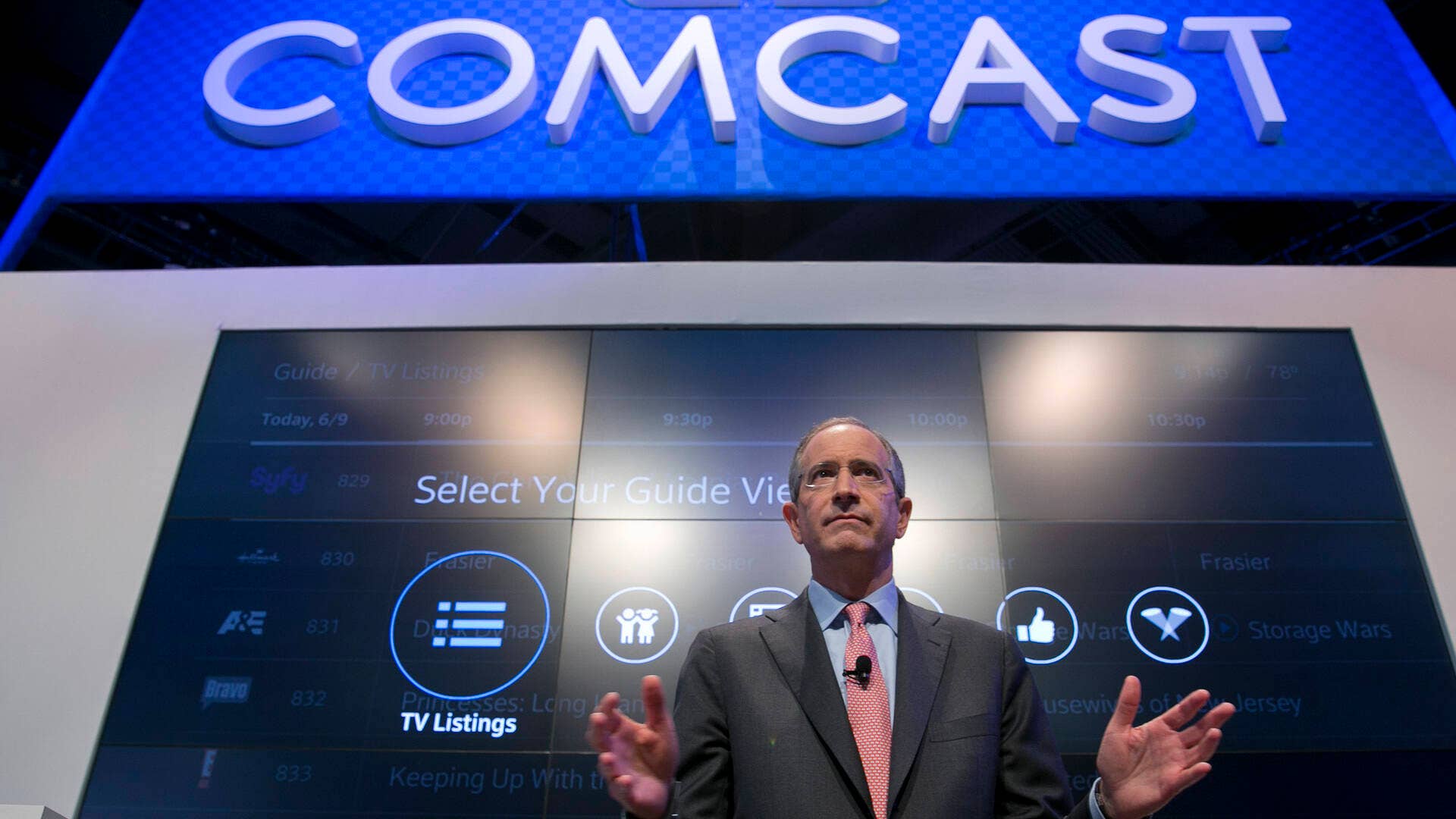 Comcast Domestic wireless customer line net additions reached 435,000, the best quarterly result in company history.
The underlying businesses that Altman believes justify the split
Comcast’s Q1 fiscal 2026 results, reported April 23, illustrate why splitting these two businesses may unlock value that the combined structure has obscured, according to the Comcast earnings release.
On the Connectivity & Platforms side
- Domestic wireless customer line net additions reached 435,000, the best quarterly result in company history.
- Total wireless lines increased to 9.7 million.
- Business services connectivity revenue grew 5.8% year over year to $2.6 billion.
- Business services connectivity posted an EBITDA margin of 55.9%.
- Domestic broadband customer net losses improved by 117,000 year over year.
- Total Residential Connectivity & Platforms customer relationships increased by 10,000 to 47.9 million.
On the media side:
- Peacock paid subscribers grew 12% year over year to 46 million.
- Peacock revenue surged 71% year over year to more than $2 billion for the first time.
- Theme parks’ EBITDA rose 33% to $551 million, driven by the May 2025 opening of Epic Universe.
- The Milan Cortina Olympics and Super Bowl LX became NBCUniversal’s most-watched events in company history.
“2026 is an important year of execution, and we’re seeing tangible early signs our pivot is taking hold,” said Brian L. Roberts and Mike Cavanagh, co-CEOs of Comcast Corporation, in the Q1 fiscal 2026 earnings report.
Both businesses are performing well individually. The market, evidently, has not been valuing them as such combined.
Altman’s framing, that this should have happened sooner, but is unquestionably the right move now, captures exactly what a 4.53% single-day stock pop is telling investors. Separation may finally let each business get credit for what it is actually worth.
Related: Comcast’s NBCUniversal spinoff just transformed streaming wars