
I have been following the Strait of Hormuz crisis since February 28, when the conflict first began rerouting the global oil trade in ways most investors underestimated. It’s been 139 days.
I covered Chevron CEO Mike Wirth’s warning in May, when he said oil price pressure was building and buffers were being drawn down. Now, Chevron is not just warning about the risk. It is building around it.
Bloomberg reports that the company expects to sign non-binding accords with Iraq on July 17, covering two major oil fields and, critically, a pipeline that would allow Iraqi crude to reach the Mediterranean without passing through the Strait of Hormuz at all, according to a senior Chevron executive speaking on July 16.
Chevron (CVX) closed July 16 at $183.86, up 1.24% on the session, according to Yahoo Finance. This is a strategic move years in the making that the current geopolitical crisis has suddenly made urgent.
And for CVX investors watching the July 31 2Q26 earnings report, understanding what Chevron is building in Iraq is important context for how the company is positioning itself for whatever comes next in the Middle East.
Also Read: History of Chevron: Company timeline & facts
Why the Strait of Hormuz is the risk Chevron is engineering around
The Strait of Hormuz carries approximately 20% of the world’s oil supply. Since the U.S.-Iran conflict began in February, it has been intermittently blocked, causing what the International Energy Agency has called the biggest energy supply disruption in history.
Fresh U.S. and Iranian strikes in the past week, ending July 11, have again mostly closed the strait to shipping, according to Bloomberg reporting.The IEA Oil Market Report for May showed that global oil supply declined by a further 1.8 mb/d in April to 95.1 mb/d, taking total losses since February to 12.8 mb/d.
More Oil & Gas:
- Drivers face an unpleasant surprise at the gas pump
- U.S. blocks Strait of Hormuz: Here’s what’s next for oil prices
- A big shift in the U.S. energy market is about to happen
For Iraq, the consequences have been severe. Iraq Business News reports that Iraq’s crude exports plummeted from 99.8 million barrels in February to just 18.6 million barrels in March, resulting in nearly $4 billion in lost revenue in a single month.
Reuters report noted that Iraq was forced to slash oil production by roughly 70% to just 1.3 million barrels per day, from a pre-crisis peak of around 4.3 million barrels per day, because its export vessels could not exit the Persian Gulf.
That collapse forced Iraq’s Prime Minister Ali Al-Zaidi to Washington this week, starting July 12, where he met with President Trump at the White House before traveling to Houston to meet directly with Chevron executives.
Trump described “massive” new oil partnerships being announced in the coming days. Chevron’s Friday accord is the first concrete step toward that promise.
What Chevron is actually committing to
The July 17 accords are non-binding, and the senior Chevron executive was careful to note that technical studies remain incomplete and commercial terms are “a way from the finish line.” But the strategic direction is clear, and the assets involved are substantial.
West Qurna-2 is a super-giant oil field with an estimated 13 -14 billion barrels in recoverable reserves. Bloomberg reports that it currently produces about 460,000 barrels per day, representing about 9% of Iraq’s total oil output, according to Oil & Gas Middle East.
Also Read: Chevron Corporation Latest News and Stories
The field became available to American investors after Russia’s Lukoil was sanctioned by the U.S. in 2025, transferring its interest to Iraqi state entities. Now, Iraq hopes Chevron can nearly double production to 750,000 to 800,000 barrels per day over time.
Nasiriyah is a smaller field with significant exploration upside, alongside four exploration blocks in Iraq’s Dhi Qar province being reviewed by Chevron.
Related: Chevron surprises investors with eye-catching disclosure
Chevron is part of a consortium that includes TI Capital and UCC Holding exploring the revival of the Kirkuk-Baniyas pipeline, a 500-mile conduit running from northern Iraq through Syria to the Mediterranean port of Baniyas, according to Bloomberg reporting.
Alternative route studies also include a Basra-to-Haditha line branching toward Ceyhan, Turkey, or Baniyas, Syria. Either route achieves Iraqi oil reaching the Mediterranean and the Suez Canal without ever transiting the Persian Gulf.
“Chevron wants to make sure it has access to moving cargoes out to the Mediterranean,” the senior company executive said.
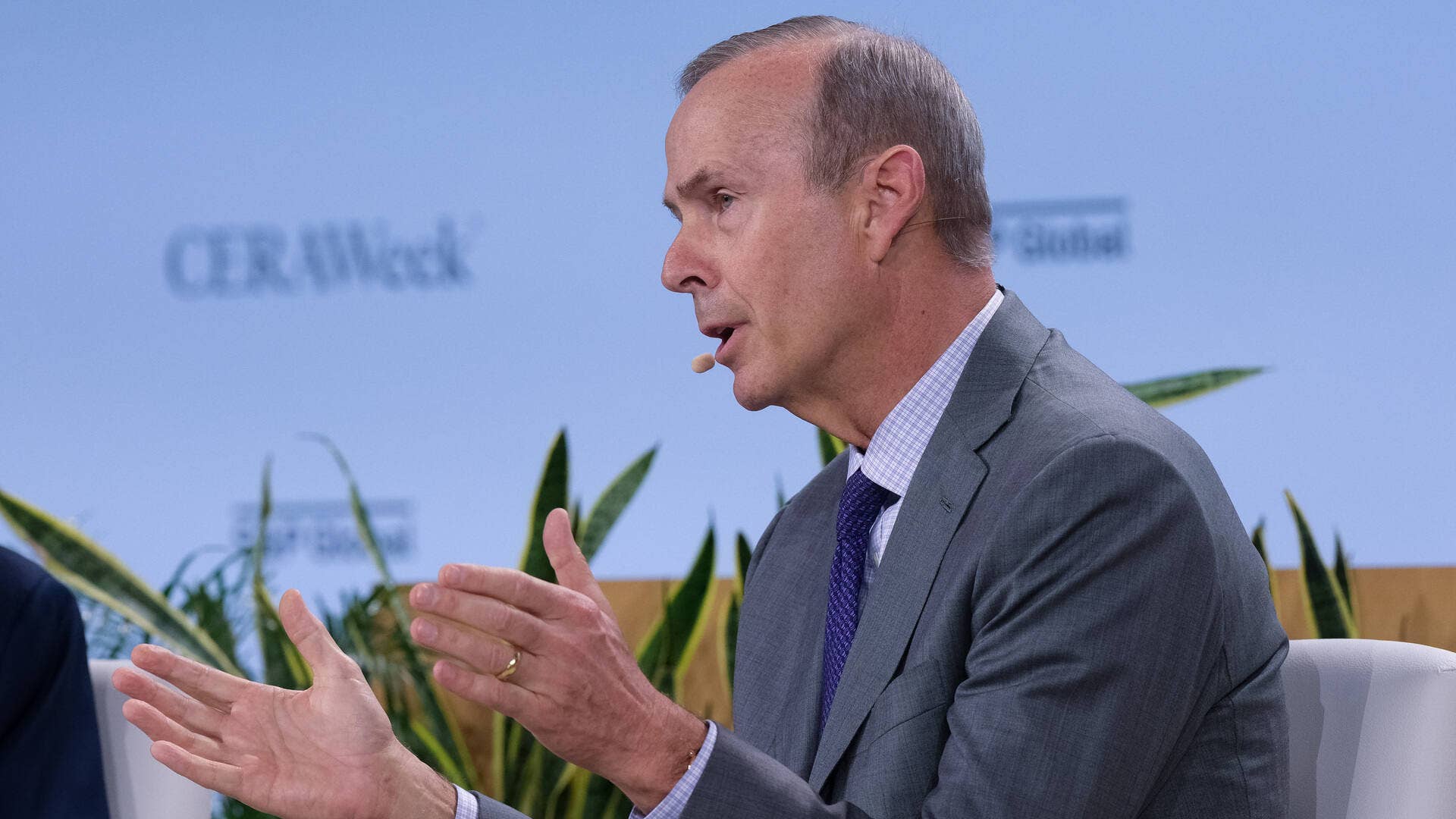 Chevron’s U.S. refinery crude throughput set a record in March 2026, maintaining over 1 million barrels per day for the fifth consecutive quarter.
F. Carter Smith/Bloomberg via Getty Images
How the MOU fits Chevron’s broader strategy under Mike Wirth
The move is consistent with what Wirth has been articulating all year. In the Q1 2026 earnings release, he described Chevron as a fundamentally stronger company, positioned for exactly this kind of geopolitical disruption.
- Adjusted earnings came in at $2.8 billion, or $1.41 per share diluted
- Reported earnings of $2.2 billion were lower year over year, primarily due to unfavorable timing effects from derivative mark-to-market, not operational weakness.
- U.S. production exceeded 2 million oil-equivalent barrels per day for the third consecutive quarter.
- U.S. refinery crude throughput set a record in March 2026, maintaining over 1 million barrels per day for the fifth consecutive quarter.
Wirth noted in the Q1 release that the “unpredictable external environment reinforces the importance of disciplined investment to ensure reliable energy supply and global energy security.” The Iraq accords are that disciplined investment made concrete.
CVX is up 22.93% year-to-date against the S&P 500‘s 10.05% gain, with a one-year return of 27.78%, according to Yahoo Finance. Q2 earnings are due July 31.
Related: Chevron CFO reveals why gas prices are stuck
The Iraq move, depending on how quickly technical studies conclude and commercial terms are negotiated, is a long-dated growth option layered onto a giant already generating strong returns from its U.S. and Gulf of America production growth.
My read of the strategic deal is that Chevron is doing what the world’s best energy companies do during periods of maximum supply disruption — securing access to the next generation of reserves.
The Hormuz bypass pipeline, if built, would not just solve Iraq’s export problem. It would give Chevron a route to market that no future Strait closure, from any conflict, could shut down.