
If you’re in the oil business, whether producing it or financing deals or speculating on price, Aug. 3 has been a day to drive you crazy.
President Trump announced on late on Aug. 2 the United States would engage in talks with Iran. A day earlier, he had posted on Truth Social that “perimeters of a deal” had been hammered out.
And that was a big change from July 31, when the President was threatening major attacks on oil infrastructure in Iran and maybe more attacks on bridges, the country’s power grid and the like.
For a brief instant, hope for peace
But the Aug. 1 and Aug. 2 posts were enough for traders. Along with reports that Saudi Arabia and others had asked the Trump Administration to hold off on the big attack.
Oil prices started plunging as futures trading opened on Aug. 2. On Aug. 3, prices were down more than 5%. Light sweet crude actually dropped below $80 a barrel for the first time since July 17 in the early afternoon.
But, alas, if you were filling up a gas tank for your vehicle, gasoline prices did not fall much, if at all.
GasBuddy.com said its U.S. national average was at $4.061 a gallon in the late afternoon, up nearly a cent from Aug. 2, although down 0.9% from its July 31 average of $4.092. (And the price is still up nearly 44% this year. )
Related: Middle East turmoil leaves gas prices exposed
AAA’s price was at $4.095 a gallon, unchanged from Aug. 2 and also up 44% on the year.
Whether anyone is talking peace in the Middle East really wasn’t clear. Iran denied they were talking to U.S. officials.
At best, Iranian envoys were talking to Oman officials about the terms of reopening the Strait of Hormuz, with the assumption Iran would be able to charge tolls to pass through the Strait.
That’s the 104-mile-long body of the water linking the Persian Gulf to the Indian Ocean. It is one of the key waterways of the world: Before the war between Israel, the United States and Iran erupted on Feb.28, about 20% of the world’s crude oil would pass through it every day.
Pakistani government sources have told Turkish news agency AA that intermediaries were yet to confirm a date or venue for the resumption of stalled negotiations between the US and Iran, the Guardian newspaper reported.
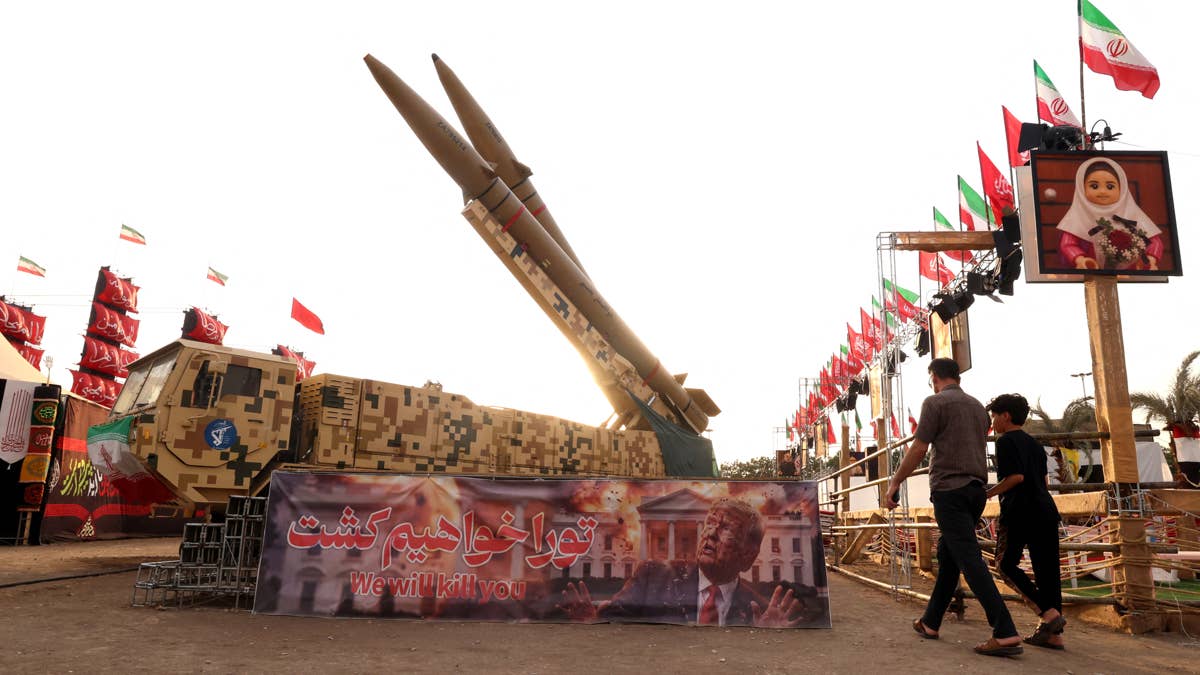 Iranian-made Zolfaghar missiles are displayed in Tehran, Iran, on Aug. 2.
Atta Kenare / AFP / Getty Images
The toll question in the Strait is the critical point. Iran wants it. The United States says no. And, perhaps inevitably, in a Truth Social post late on Aug. 3, Trump erupted, Iran is “unbelievably duplicitous.”
Later on, he said he was going to give Iran a last chance at a peace deal or “risk decapitation.”
A more nuanced view came from economist Tracy Shuchart of Ninjatrader:
“It’s the same problem that we keep coming up with,” she told The Wall Street Journal. “Iran says they want to have control of the strait, and charge some kind of toll with the U.S. administration saying that’s not going to happen.”
More Oil & Gas:
- Drivers face an unpleasant surprise at the gas pump
- U.S. blocks Strait of Hormuz: Here’s what’s next for oil prices
- A big shift in the U.S. energy market is about to happen
So, light sweet crude settled at $80.34, down 5.1%, after falling to as low as $78.43.
Brent, which fell to as low as $81.55, jumped back to $83.77 at the close but still down 4.7%.
Not surprisingly, energy stocks were lower as well. The State Street Energy Select Sector SPDR ETF (XLE) was down 1.3% at $58.79. Chevron (CVX) fell 1.9% to $193.18. ExxonMobil (XOM) dropped slightly to $155.06.
And the tension in the Middle East will be the canker sore that keeps on giving.
Related: Mark Zuckerberg’s data center: Bigger risk than your house