
Gold hit $5,589 an ounce on Jan. 28, 2026. That was the all-time high.
Since then, it has pulled back to around $4,031, Reuters confirmed, giving up roughly 28% from the peak in a correction that spooked some investors and prompted genuine questions about whether the two-year bull run that began in August 2024 was running out of steam.
Deutsche Bank just put out a note saying it isn’t. And the way the bank makes that case is worth understanding, because it goes further than a simple price target.
What Deutsche Bank’s gold note actually says
Michael Hsueh and Bryant Xu wrote the note. They didn’t lead with a price target. They led with history. Going back to 1975, gold has only entered what Deutsche Bank calls an “explosive phase” four other times. The current one started in August 2024 and is still going.
That’s the lens the bank is using to evaluate whether the recent pullback represents the end of something or just a pause inside it, according to CNBC.
More Gold & Silver:
- Robert Kiyosaki has a bold call on gold and silver
- Peter Schiff sees something big in gold and silver
- BofA sees lost year taking shape for gold
The bank uses a statistical measure called BSADF to track these episodes. It peaked at 3.3 earlier this year and has since moderated to 1.3. But it’s still above the 95% critical value, which in Deutsche Bank’s framework means the explosive phase is ongoing, not over.
The correction has been real. The underlying trend, in the bank’s view, has not broken.
“A statistical measure indicates that the current episode of explosive gold price behaviour began from August 2024 and is ongoing,” the analysts wrote in the note, according to Yahoo Finance. “This provides a useful frame of reference for today’s gold market.”
Deutsche Bank’s $4,700 fair value: what it means against the $4,600 target
The headline figure from the note is a fair value estimate of $4,700 an ounce by year-end, above Deutsche Bank’s official Q4 2026 price target of $4,600. That gap is intentional.
The $4,700 is a model-derived estimate of where gold should trade, given current macro and flow conditions. The $4,600 is a more conservative base-case projection the bank has kept unchanged despite recent volatility.
With spot gold trading around $4,031, the $4,700 fair value implies roughly 17% upside from current levels by year-end. The $4,600 Q4 target implies about 14%. Both are meaningful numbers for a market that has been shaken by the recent correction.
The fair value model builds on gold’s historical sensitivities to real interest rates, the U.S. dollar, equity market performance, and measures of financial stress. Even after adjusting for the slowdown in central bank gold purchases, the model still points toward $4,700.
That tells you something about how much structural support the bank sees underneath the current price, as FXStreet reported.
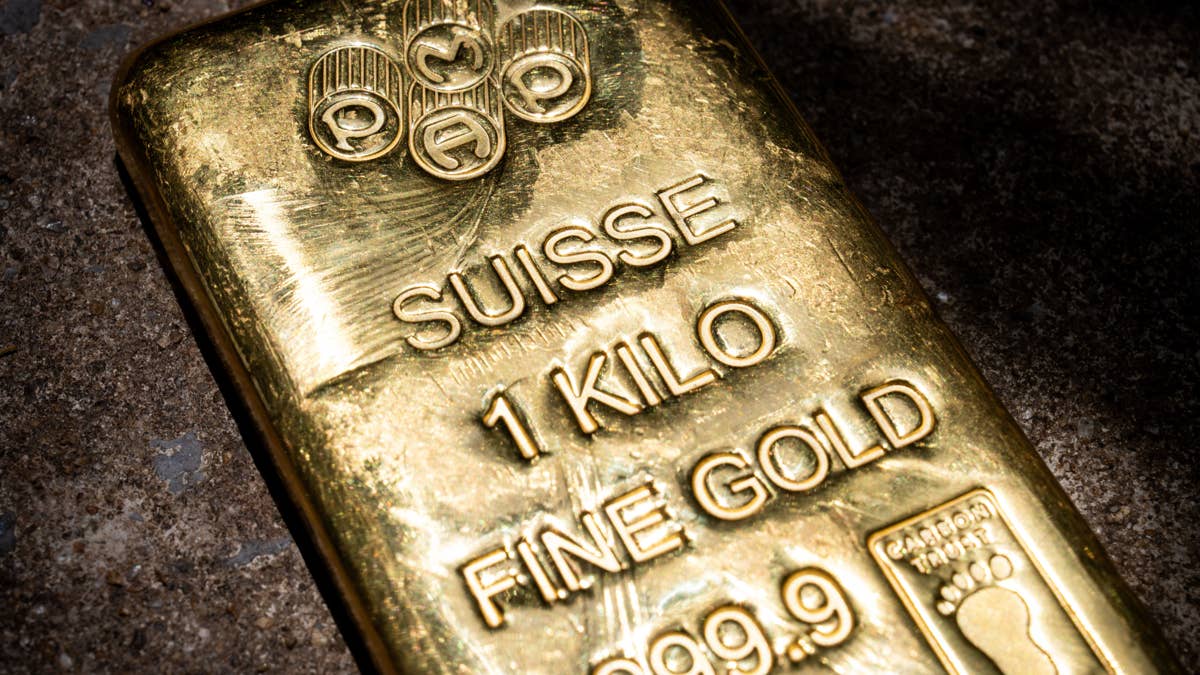 The fair value model builds on gold’s historical sensitivities to real interest rates, the U.S. dollar, equity market performance, and measures of financial stress.
Matt/Getty Images
Why the floor is $3,900 and not $2,600
The bear case exists, and Deutsche Bank doesn’t ignore it. Some valuation models that lean heavily on real interest rates and the dollar spit out a number as low as $2,600 if conditions turn against gold sharply.
The bank looked at those models. It doesn’t buy them right now.
The bank ran its own regression analysis on what the BSADF test statistic suggests about the correction’s depth. The result was a floor closer to $3,700.
But Deutsche Bank thinks the actual bottom is higher than that, around $3,900, because the correction has been “muted compared to prior explosive phases.” In other words, gold has pulled back less severely than historical analogs would predict, which the bank reads as a sign of underlying demand supporting the price, according to Investing.com.
Central bank buying and the macro case for gold
The biggest thing the $2,600 models miss is central banks. China and other emerging market governments have been buying gold consistently to reduce dependence on the U.S. dollar.
The pace has come down from its peak but is still running well above what was normal before 2022. Deutsche Bank built that into its fair value model. The simpler frameworks that get to $2,600 largely didn’t.
The macro picture that drove gold to $5,589 in January is still mostly intact. Governments are still running big deficits. More countries are still moving reserves away from the dollar. The Fed hasn’t cut rates yet but the market still expects it to eventually, and when it does, gold tends to benefit. None of that changed during the correction.
Deutsche Bank cut its Q3 2026 gold price target from $6,000 to $4,300 in June, acknowledging that the pace of the rally had outrun short-term fundamentals. But the bank’s message in the latest note is that the longer-term structural case remains intact.
The $4,600 Q4 target has been maintained. The $4,700 fair value sits above it. For gold investors watching the correction and wondering whether the bull market is over, Deutsche Bank’s answer is no.
Related: Bank of America’s latest gold outlook sends a different signal