
Anyone who has bought a fast new laptop only to watch it freeze while a file loads knows the frustration.
The processor is not the problem. It is waiting on memory that cannot feed it fast enough, and that same bottleneck now sits between AI companies and faster models.
Samsung Electronics says it has an answer. On Tuesday, Aug. 4, at the Future of Memory and Storage conference in Santa Clara, the company unveiled zHBM, a new way of stacking memory chips directly on top of AI processors instead of beside them, according to a Samsung press release.
The timing was pointed. Two of Samsung’s biggest rivals used the same event to unveil a completely different fix for the same problem.
Conventional high-bandwidth memory sits next to the AI chip on the same package, and data still has to travel sideways before reaching the processor.
zHBM stacks memory vertically above the chip instead, cutting that distance. A next-generation interface built around the design is expected to deliver about eight times the performance of today’s HBM5, Reuters reported.
Samsung said the same architecture could pack in more than 10 times the memory density of HBM5 while cutting energy use by two-thirds and thermal resistance by more than half, according to the company.
For chipmakers such as Nvidia, that matters because memory bandwidth, not raw processing power, has become the limiting factor in how fast a data center can train and run AI models.
Samsung also introduced V10 BV-NAND, a storage chip built with a new wafer-bonding technique that packs more than 400 layers into a single piece of silicon, according to the company.
That design lifts storage density by about 58% over Samsung’s previous generation, the V9, while improving read and write speeds, Reuters reported.
The bottleneck has moved from chips to memory
AI workloads have expanded beyond training large language models into generating responses for millions of daily users, pushing NAND demand sharply higher.
Samsung disclosed last week that long-term supply agreements could soon account for 60% to 70% of its total memory sales, a sign that customers are locking in chips years before they need them.
Related: Two chipmakers, one demo, and a signal for AI’s next phase
That is the real subtext behind the Aug. 4 showcase.
Samsung is not just demonstrating engineering. It is trying to convince Nvidia and every hyperscaler that its memory will not be the reason their systems fall behind.
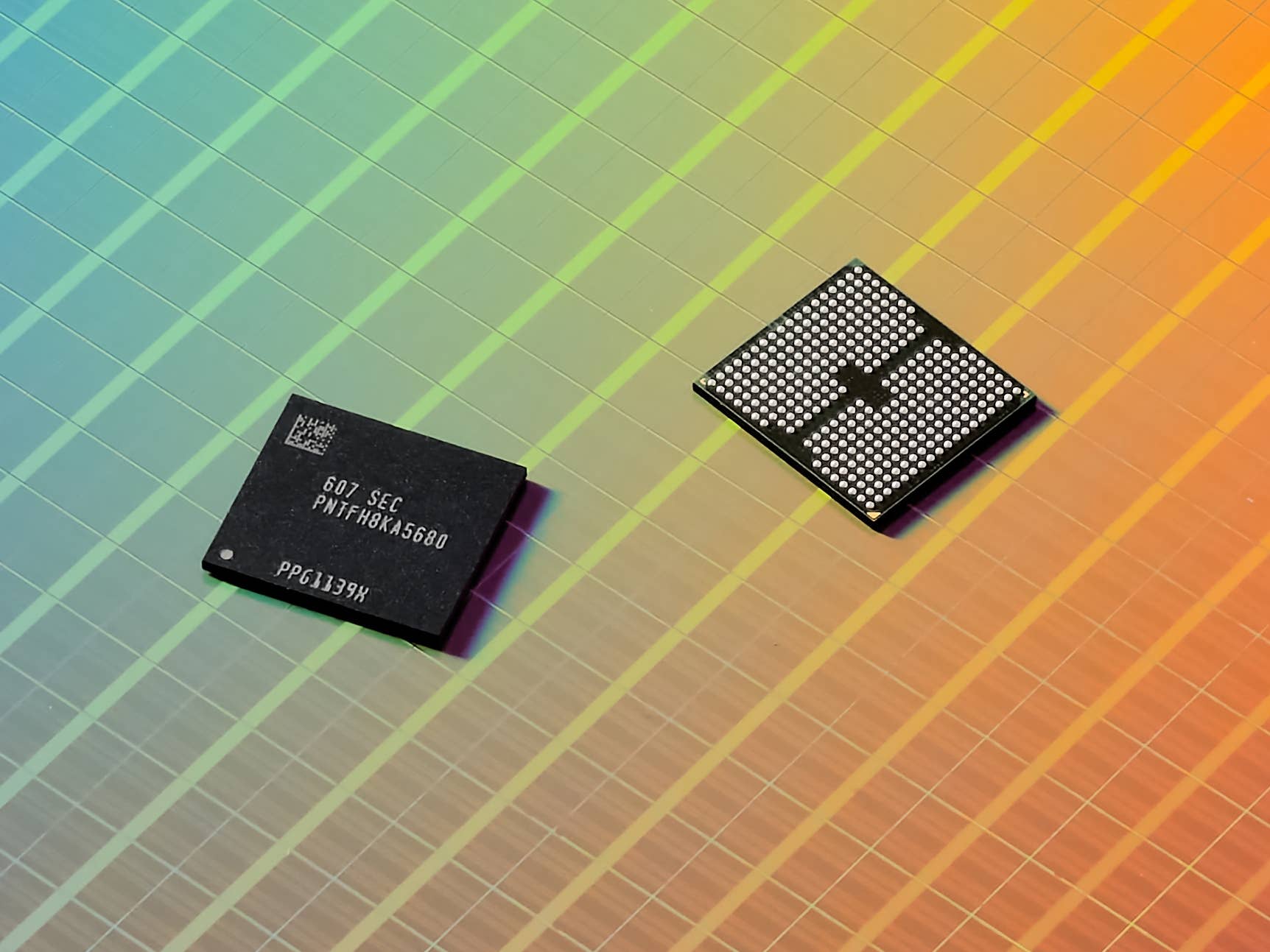 Samsung’s zHBM stacks memory directly above AI chips, promising up to 8 times HBM5 performance as global memory supply sells out through 2027.
SK Hynix and Sandisk are betting on a different memory fix
SK Hynix and Sandisk used the same conference to release the first open-standard specification for High Bandwidth Flash, a technology built through the Open Compute Project with backing from Google and Tenstorrent, according to a Sandisk press release.
Instead of racing to make memory faster, HBF adds a new layer of NAND-based capacity between HBM and SSDs, letting AI models too large for HBM alone stay closer to the processor.
The two strategies playing out at the same event capture how differently the top three memory makers are approaching the same shortage:
- Vertical stacking directly above the AI chip is Samsung’s proprietary bet, aimed at squeezing more bandwidth out of a shorter physical path between memory and processor.
- An open standard called High Bandwidth Flash is SK Hynix and Sandisk’s alternative, adding NAND-based capacity so that AI models too large for HBM can still run near the chip.
- Gaining ground through existing DRAM production, not new architecture, is Micron’s near-term approach, and it is working.
Micron is closing the gap while supply runs dry
Micron lifted its global DRAM market share to 25% in the second quarter of 2026, up from 22%, closing in on SK Hynix’s 26%, while Samsung held the top spot at 39%, GuruFocus reported.
Micron (MU) shares jumped nearly 6% on the news, one of several recent sharp swings in memory stocks as investors price in who benefits most from the shortage.
More AI:
- Nvidia just made a move Wall Street wasn’t ready for
- Microsoft just took sides in AI policy fight
- OpenAI just disclosed something genuinely alarming
Innovation cannot fix what capacity cannot supply
None of this changes a more basic constraint. Samsung, SK Hynix, and Micron have already sold out their entire 2027 DRAM and HBM production capacity, with customers receiving only 60% to 70% of the volumes they originally requested, according to a Seeking Alpha report citing industry sources.
New architecture does not add a single wafer of supply. It only decides who gets more value out of the wafers that already exist.
That is the part other coverage of the Aug. 4 announcement has mostly missed. Samsung, SK Hynix, and Sandisk are not competing on speed anymore. They are competing to become the default design inside a market that will not grow until new fabs finish construction in 2027 and 2028.
Whoever wins that bet locks in pricing power for years, not just a headline at a trade show.
For Nvidia and the hyperscalers relying on these components, the message is clear. The AI race is no longer just about who designs the smartest processors, but who can secure the memory to actually run them.
Investors should watch closely to see whose architecture becomes the industry standard, as that company will quietly dictate the pace of the AI boom through the end of the decade.
Related: Samsung’s foldable preorder surge comes with a retail catch