
Every alliance eventually asks for something.
For most of the postwar era, the ask was legible. Buy our weapons, host our bases, vote with us at the United Nations, and the security guarantee holds.
Trade was the part countries got to keep flexible. You could sell soybeans to one superpower and buy machine tools from the other, and nobody in Washington or Beijing called it betrayal.
That flexibility has been thinning for a decade, first through tariffs, then through export controls on advanced semiconductors. Now the scarce resource has changed shape. It is compute, the chips that produce it, and the minerals sitting underneath the chips.
Governments figured out the smart play fast. Sign everything. Join the American initiative for investment access, join the Chinese one for cheap models and infrastructure money, and let the two giants compete for your signature.
I have watched that hedge hold for roughly three years. It is about to break.
The United States is preparing to tell dozens of governments they must pick a side in the artificial intelligence race with China or be locked out of a U.S.-led coalition, according to Reuters, which reviewed an internal State Department draft and spoke with a U.S. official.
What the leaked AI letter actually says
The draft is addressed to the 35 signatories of an AI Opportunity Statement the U.S. organized in June, a roster that overlaps heavily with a separate American framework called Pax Silica.
Countries that also sign on with Beijing’s competing organization would be shut out. “To be part of everything is to be part of nothing,” the letter says, urging governments to “choose deliberately” on AI, according to Reuters.
Related: AI agents are quietly rewriting how the internet works
The State Department declined to discuss what it called purportedly leaked internal documents. Reuters could not determine when the letter will be sent, or whether it survives internal review intact. The draft carried no date.
One country is the reason this document exists.
Kazakhstan signed the Pax Silica Declaration in June and is also a founding member of China’s new AI body, making it the only government known to belong to both. That matters far more than the size of its economy suggests, because Kazakhstan sits on significant reserves of the critical minerals that feed advanced chipmaking.
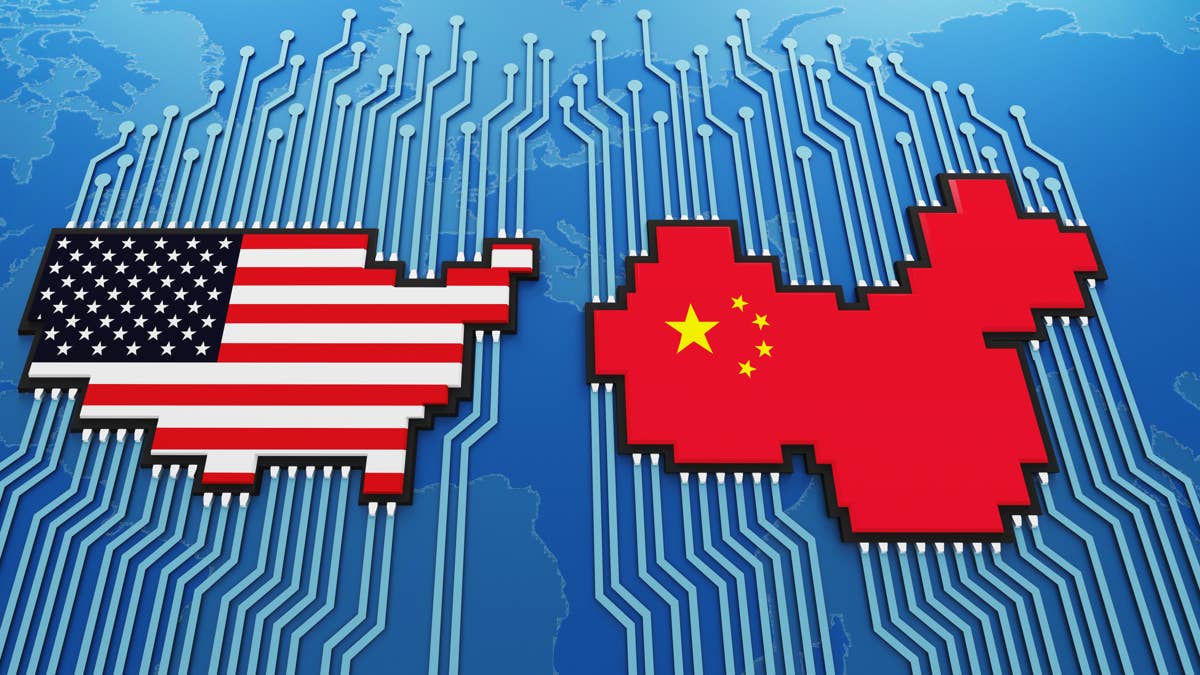 A leaked letter warns 35 partner countries they cannot hold membership in the U.S. and China.
kritsapong jieantaratip / Getty Images
How Pax Silica and China’s AI bloc took shape
Pax Silica opened in December 2025 with seven signatories. By August 2026 the declaration had 25, while the separate AI Opportunity Statement had drawn 35, according to the Information Technology and Innovation Foundation.
The framework covers minerals, energy inputs, manufacturing, semiconductors and AI infrastructure, and its architects are not subtle about the stakes. The 21st century “runs on compute and the minerals that feed it,” according to Under Secretary for Economic Affairs Jacob Helberg at the State Department.
Beijing answered in July. Twenty-nine countries signed the founding agreement for the World Artificial Intelligence Cooperation Organization, or WAICO, on July 16, creating a Shanghai-headquartered body with no major Western democracy among its founders, reported Al Jazeera. Xi Jinping used his keynote the next day to sell open-weight models to developing nations as a “historic opportunity.”
The two blocs, side by side:
- Pax Silica Declaration: 25 signatories as of August 2026, launched December 2025, per ITIF.
- AI Opportunity Statement: 35 signatories, signed June 2026, per the State Department.
- WAICO: 29 founding countries, agreement signed July 16, 2026, per Al Jazeera.
- Known overlap: Kazakhstan, the only government in both, according to Reuters.
What an AI loyalty test means for chip stocks
This is where it stops being a foreign-policy story and starts being a portfolio one.
Selling compute to governments is a real business now, not a rounding error. Nvidia (NVDA) posted record first-quarter fiscal 2027 revenue of $81.6 billion, with data center revenue of $75.2 billion split close to evenly between hyperscale customers and a newer category covering AI clouds, industrial, enterprise and sovereign deployments, according to Nvidia.
More Artificial Intelligence:
- David Tepper cuts AI stock, yet value hits $1.1 billion
- SpaceX, Google, Meta position themselves as the best of AI’s rest
- Jim Cramer reveals 6 AI stocks to watch in 2026
When I ran that against the bloc math, the exposure looked far less abstract than the diplomatic language suggests. The addressable market for sovereign AI is not “the world.” It is whichever list of countries a vendor is diplomatically cleared to sell into, and Washington is now drafting that list in writing.
A country that chooses Shanghai does not stop building AI. It builds on Chinese silicon and Chinese open-weight models, and every rack it installs is a rack that American vendors never quote.
Rivals see the same opening.
The pressure runs the other direction too. Chinese open-weight models have closed much of the gap on proprietary systems from U.S. developers including OpenAI and Anthropic, reported Reuters. When the free option is nearly as good, a coalition membership card is a harder sell.
Where the AI race goes from here
Nvidia guided to roughly $91 billion for its second quarter without assuming any China data center compute revenue at all, according to Nvidia. That report lands later this month, and the sovereign line inside it is now a geopolitical readout as much as a sales number.
Watch three things. Whether the letter goes out unchanged. Whether Kazakhstan drops one membership. And whether any of the 35 signatories decides the American terms are worth refusing.
Because the quiet assumption holding up a lot of AI valuations is that the technology sells to everyone. Some large investors have already started backing away from that math.
A loyalty test is what you administer when you are no longer certain of the answer. The countries getting this letter will notice that too.
Related: Nvidia, Micron just got hit by an AI model from Beijing