
Shoe Carnival differentiates from traditional shoe stores thanks to its upbeat music, open-stock layout, spin-to-win discount wheels and in-store announcer who manages time-sensitive flash sales.
Until recently, the brand mainly focused on moderate-income, value-conscious family shoppers looking for name-brand products (such as Nike, Skechers, Crocs, Adidas) at discounted prices.
That’s why it predominantly located its stores across strip shopping centers, benefiting from lower occupancy costs and maximizing exposure to value oriented customers, according to the company’s official documents.
However, over the recent years, the brand changed its strategy, affecting some of its most loyal customers. Amid other structural and banner changes, Shoe Carnival made changes to its merchandise offering, prioritizing higher priced footwear.
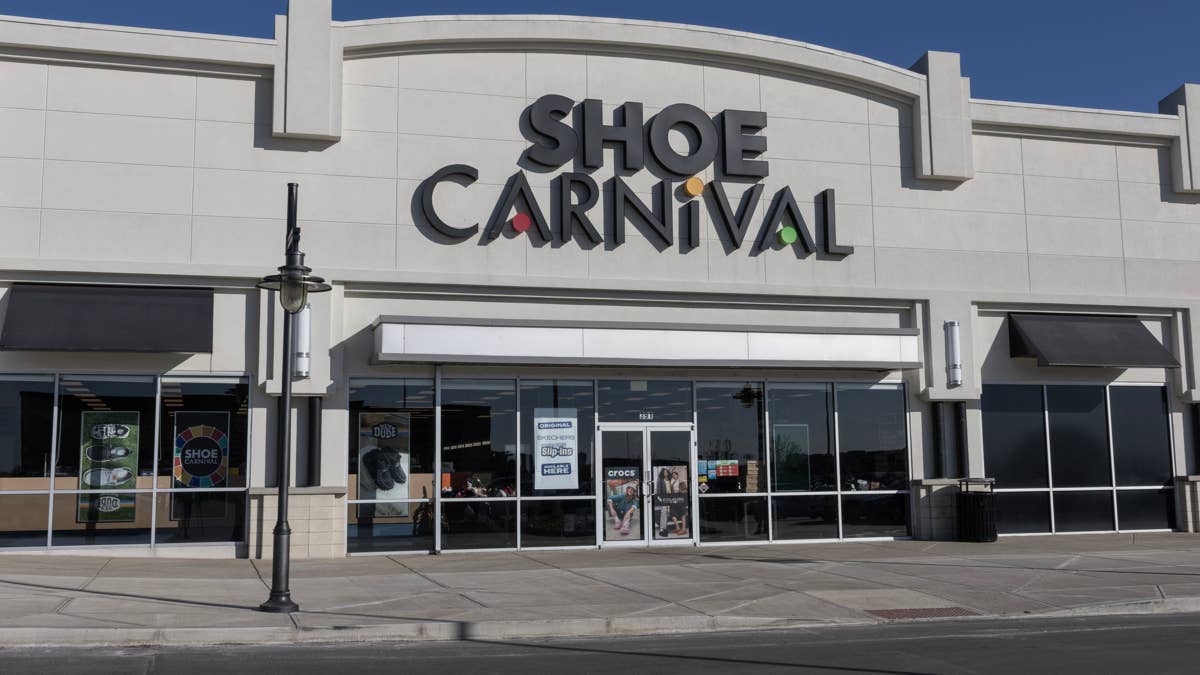 Shoe Carnival to permanently close around 24 underperforming stores.
jetcityimage / Getty Images
Shoe Carnival CEO admits underserving value-focused families
During Shoe Carnival’s first quarter 2026 earnings conference call, Interim President, CEO & Vice Chairman, Clifton E. Sifford explained that the company shifted strategy toward higher price merchandise in 2025, and is now aiming to change that.
“We have also begun the effort to reengage the value-focused families and a more fast-fashion-forward customer, both of whom we underserved in fiscal 2025, when our merchandising drifted toward higher price points and assortments that did not reflect what those customers historically came to Shoe Carnival to find,” stated Clifton E. Sifford Interim President, CEO & Vice Chairman.
For the full fiscal 2025, Shoe Carnival reported net income of $52.3 million, down from $73.8 million it reported in fiscal 2024, according to the company’s Form 10-K with Securities and Exchange Commission (SEC).
Shoe Carnival attributed net income decline partly to its rebanner-related investments.
In 2025, the footwear retailer’s net sales declined 5.6% year over year, “as we maintained pricing discipline despite pressure on lower-income consumers and reduced promotional marketing,” the company stated.
The problem Shoe Carnival encountered reflects a broader challenge for footwear retailers. Consumers have become increasingly selective as shoe prices rise. Circana footwear analyst Beth Goldstein said that “rising prices will pressure demand, and consumers will still prioritize products that deliver comfort or wellness benefits, as well as fashion.”
“To succeed in 2026, footwear brands will need meaningful storytelling, well-defined distribution strategies and tight coordination across digital and physical touchpoints,” Goldstein added.
On the other hand, Shoe Carnival highlighted that its Shoe Station banner actually experienced net sales growth in fiscal 2025, driven by rebanner strategy, including omnichannel growth.
“Therefore, our Shoe Station banner’s net sales growth in Fiscal 2025 compared to Fiscal 2024 outperformed Shoe Carnival’s net sales decline by 10.4 percentage points.”
Its comparable stores net sales also declined 5.6%.
Shoe Carnival to permanently close around 24 underperforming stores
During the company’s first-quarter of 2026 earnings call, the management announced new store closures.
“Our store fleet includes underperforming locations that do not have a path to acceptable economics with or without banner conversion. We expect to close 12 to 14 such stores during fiscal 2026 and a further 6 to 10 stores during fiscal 2027,” stated Sifford.
Closing 12-14 stores a year is not a typical store optimization move for Shoe Carnival. TheStreet’s analysis of the company’s 10-K filings over the last couple of years shows that the company ended fiscal 2025 with 426 stores or four stores fewer than in 2024.
At the end of fiscal 2024, the company operated 430 stores, up from 400 a year earlier. The increase was largely driven by its acquisition of 28 Rogan’s stores, along with four new Shoe Station locations, partly offset by two store closures. All 28 Rogan’s stores were eventually rebannered to Shoe Station during fiscal 2025.
The company also confirms it contemplates opening around 3 to 5 new stores in fiscal 2027 and 8 to 10 in fiscal 2028.
Shoe Carnival and Shoe Station serve different consumers
In December 2021, Shoe Carnival acquired privately-held, family-owned Shoe Station for $67 million.
“We are excited to welcome Shoe Station to the Shoe Carnival team. Coming on the heels of our best quarter of our best year in our 43-year history, this deal accelerates our journey toward becoming a multi-billion dollar retailer in the years ahead,” stated Mark Worden, Shoe Carnival’s then President and Chief Executive Officer.
In March 2025, the company announced that it plans to rebanner its 175 legacy stores to Shoe Station, resulting in more than half of its fleet being operated under the Shoe Station banner, reported SGB Media.
However, the retailer has since backed out of that plan, determining that both brands actually serve as distinct consumers, claiming it is “best positioned to operate both banners as permanent independent components of our portfolio. We are not pursuing a single banner strategy,” Sifford said.
Will Auchincloss, EY-Parthenon’s Americas retail sector leader, recently highlighted the challenges retailers are facing, explaining that “demand remains intact but increasingly selective, making value, affordability and clear differentiation more important than ever.”
Related: 42-year-old iconic mall retailer quietly closes 219 stores
Shoe Carnival looks to win back value shoppers as consumers continue trading down
Sifford highlighted that gaining back customers will be a difficult task.
“Reengaging those customers will take longer than a single quarter, but our back-to-school product offering and supporting promotions would demonstrate a clear return to the traditional Shoe Carnival proposition,” the interim CEO said.
This aligns with the industry trends dominating over the last few years. In 2024, 72% of consumers reported being concerned about rising everyday product prices, and 67% said they were willing to switch to cheaper brands, according to Deloitte’s Retail 2026 analysis.
Moreover, seven in 10 retail executives agree that consumer behaviors “such as trading down , shopping value channels, or swapping convenience for savings represent a structural change, not a temporary response to inflation,” as per Deloitte’s 2026 Global Retail Industry Outlook.
Related: Outdoor retail giant permanently closes stores, and it’s working
