
Most technology gets cheaper the longer it stays on sale. That is the bargain buyers have come to expect. Wait a generation or two, and the gadget that cost a fortune at launch turns up at half the price with twice the storage.
Folding phones never honored that bargain.
Seven years after the first one reached store shelves, a folding handset still costs roughly double what a conventional flagship costs. The hinge is still the part owners worry about. The crease is still visible on most models. The category still accounts for a sliver of global shipments rather than the replacement wave the industry kept promising.
Buyers noticed. Survey after survey has found that most people do not want a phone that folds, mostly because they cannot see what the second screen buys them for the extra thousand dollars.
So a research note arguing that folding phones are about to turn into a real growth engine would usually be easy to skip.
This one is harder to skip, because of whose folding phone it involves.
Apple (AAPL) has stayed out of the category longer than any of its rivals, and a firm that had been sitting on the sidelines of the stock just decided that silence is worth paying up for.
Why the foldable phone market never went mainstream
The first mass-market folding phone arrived in 2019 from Samsung, and the pitch has barely changed since. You get a tablet-sized screen that fits in a pocket, and you pay a premium of roughly $1,000 over a standard flagship for the privilege.
Seven generations later, the mechanical problems have mostly been solved and the demand problem has not. Rivals including Google, Huawei, and Motorola all sell folding models. None of them has turned the form factor into a mainstream upgrade.
The volume numbers explain why. Samsung’s flagship folding model sells roughly three million units a year, a figure Jefferies flagged when it questioned the size of the market for a $2,000 phone, TheStreet reported on Oct. 3, 2025.
Set that against the 257 million conventional iPhones Rothschild uses in its own fiscal 2027 model, and the gap between a niche product and a mainstream one gets easy to see.
Related: Apple’s first foldable could reshape its entire iPhone launch
The resistance shows up in the survey data. A 2023 CNET survey found that 64% of consumers did not want a foldable handset, though a more recent Forbes survey found that 61% would gain immediate confidence in the category if one specific company entered it, according to Investing.com.
That second number is the entire bull case in one line.
The argument is not that folding phones are good. The argument is that the category has been waiting on a validator, and the case for a $2,000 foldable has always depended on who ships it rather than what it does.
What Rothschild sees in a $2,199 foldable iPhone
Rothschild & Co Redburn analyst Timm Schulze-Melander upgraded Apple to buy from neutral and raised his price target to $400 from $260 on Aug. 17, implying 31% upside from the prior Aug. 14’s close, according to CNBC.
The strength of the product roadmap and the move into folding handsets “appears underappreciated by the market,” he wrote to clients.
Apple has never confirmed a folding phone. The note assumes one lands next month, alongside the rest of the fall lineup, and that it carries a name most of the supply chain has already settled on: iPhone Ultra.
Here is what the forecast actually contains:
- Sales of 14 million iPhone Ultra units in fiscal 2027, with four million of those treated as cannibalized sales from the 257 million traditional iPhones, according to CNBC.
- A $2,199 price, an 83% premium to the iPhone 17 Pro Max, according to Invezz.
- iPhone sales growing at a 12% annual rate through fiscal 2030, up to 14% above consensus, according to TipRanks.
- A possible starting price of $2,325, above Redburn’s estimate, according to AppleInsider.
I ran the top-line math on those units, and the scale is smaller than the headline number suggests. Fourteen million units at $2,199 works out to roughly $31 billion in revenue spread across a fiscal year, against the $54.25 billion the iPhone line generated in a single recent quarter.
The foldable is not the story on volume. It is the story on price.
Redburn expects the device to lift average selling prices across the whole iPhone lineup by 11% by June 2027, according to CNBC, and that is the line that moves earnings.
The assumption I keep circling back to is the cannibalization figure. Four million out of 257 million works out to a 2% hit, which means Redburn is modeling a foldable that adds buyers instead of shuffling them.
Apple has pulled that off before with AirPods and Apple Watch. It has also never asked anyone to pay $2,199 for a phone.
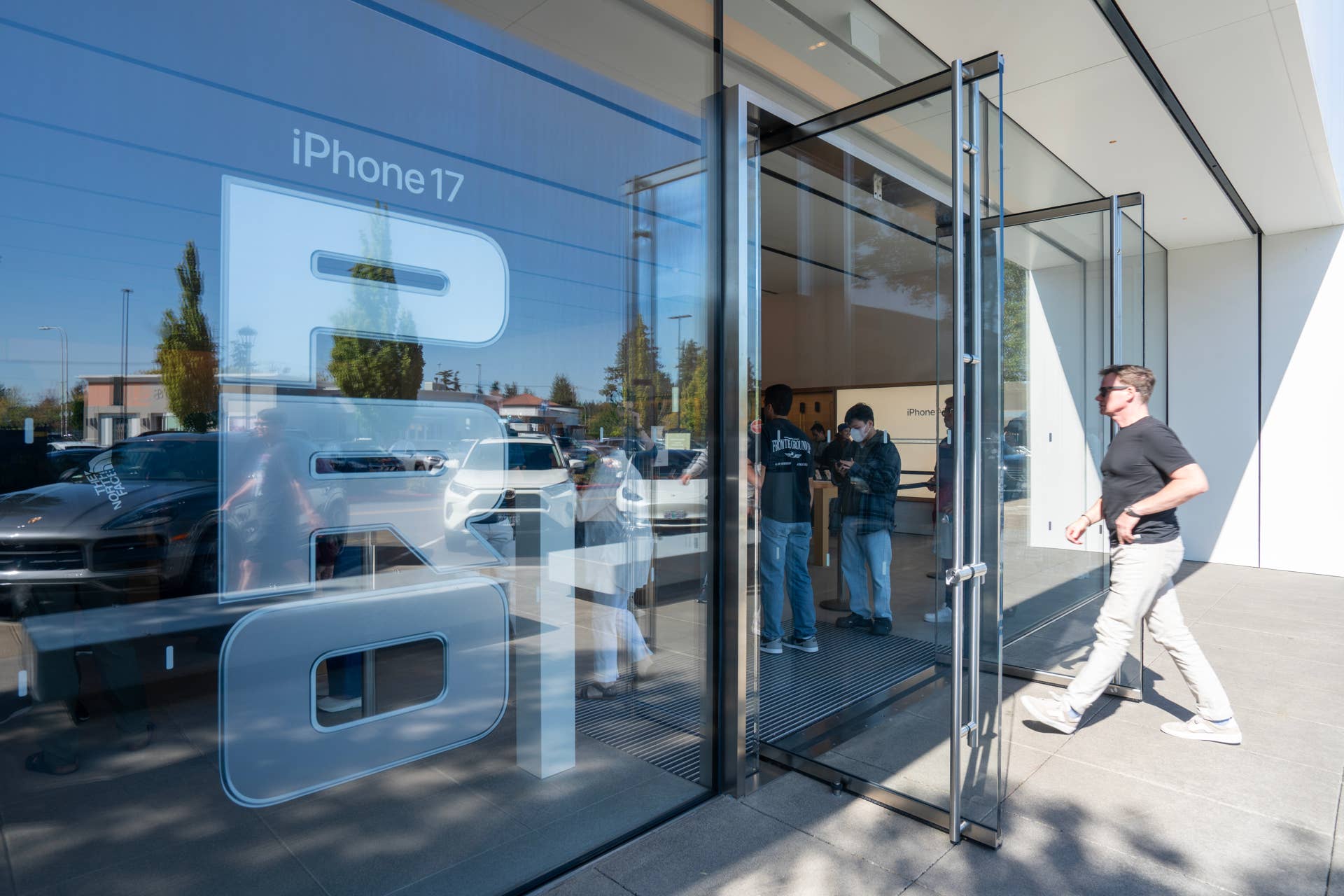 Rothschild sets Wall Street’s highest Apple target at $400, betting iPhone Ultra boosts prices 11% by 2027.
The Apple Intelligence problem behind the price target
The second half of the upgrade has nothing to do with hardware. Apple Intelligence, the company’s artificial intelligence (AI) platform, has disappointed since launch, and some of its marquee features run on a customized version of Google’s Gemini model.
Apple pays Google roughly $1 billion a year for that access while collecting about $27.5 billion a year from Google for search placement across its devices, according to Investing.com.
Redburn’s view is that Apple could cut its dependence by moving to open-source models, possibly with Nvidia (NVDA), an approach the analysts labeled “Fast Follower 2.0.”
More Apple News:
- Apple’s $54 billion iPhone machine may be about to break its biggest ritual
- Apple’s cheap-chip plan just hit a wall in Washington
- Apple’s next iPhone battle just got more complicated
Those two figures are worth sitting with. The company is paying about one dollar for every 27 it collects from the same partner, which is a comfortable position to occupy right up until the search payments come under legal or competitive pressure.
That framing matters because it reprices the AI discount. Apple has spent two years being marked down for showing up late to AI, which is roughly the same criticism it absorbed for showing up late to folding phones, large-screen phones, and streaming.
Late has historically been where the company makes its money.
What the foldable iPhone bet means for Apple investors
The risk list is not short. The device could slip, and Nikkei Asia reported engineering setbacks earlier this year before Bloomberg reported that the September timeline still held. Memory and component costs are rising. And a $2,199 phone has never been tested at scale.
The rest of Wall Street is nowhere near this target. The average analyst price target on Apple sits at $338.99, according to TipRanks, which puts Redburn about 18% above the crowd.
Shares closed at $305.59 on Aug. 17, up roughly 13% year to date and down about 8% over the past month, according to CNBC. The stock is cheap relative to the bull case and expensive relative to a company whose next growth engine is still unannounced.
For anyone holding Apple into September, the number to watch is not the price target. It is the mix.
If the folding model sells 14 million units and pulls buyers up the price ladder rather than sideways, the earnings math works and the stock follows. If it sells 14 million units to people who would have bought a Pro Max anyway, Apple gets a very expensive halo product and a flat quarter.
There is a version of this where the skeptics are right and a folding iPhone turns into a $2,199 status object that a few million people buy once. There is another version where it does what the Apple Watch did, which is create a category that did not commercially exist and then own most of it.
The event is next month. The answer starts arriving in the December quarter.
More on Apple & its stock:
- History of Apple: Company timeline and facts
- Who owns Apple? Institutional holdings & executives’ shares
- Does Apple pay dividends? A history of rewarding shareholders
- Apple’s stock split history: Everything you need to know
- How many employees does Apple have? A deeper look at the tech giant’s workforce