
Back in May, I covered Bank of America analyst Tal Liani’s initial Buy call on ServiceNow (NOW) with a $130 price target.
His core argument was that Artificial Intelligence (AI) is the strongest tailwind ServiceNow has ever seen, not an existential threat to its business. The stock hit that target. Liani came back with a higher one.
On Aug. 19, Liani raised his price target to $150 from $130 while maintaining his Buy rating, according to a note shared with TheStreet.
His reasoning this time centers on three things:
- Broad-based software multiple expansion;
- Improving growth at select infrastructure names;
- Easing concerns that AI would disrupt enterprise software businesses.
Crucially, his fundamental estimates on ServiceNow itself haven’t changed. The re-rating is about sentiment catching up to reality.
That’s an important distinction. Liani isn’t saying the business got better. He’s simply saying the market was wrong to penalize it as much as it did, and is beginning to correct that mistake.
Also Read: ServiceNow Inc. Latest News and Stories
Why the AI disruption fear around ServiceNow was always overstated
The narrative that weighed on enterprise software stocks earlier in 2026 went something like this: if AI agents can automate workflows, why would companies pay for platforms like ServiceNow to manage those workflows?
It’s a surface-level argument that sounds plausible until you look at what ServiceNow actually reported in Q2 2026.
More Bank of America:
- BofA’s $1.18T cloud forecast puts 3 chip stocks in focus
- BofA sees more upside in Seagate’s AI storage trade
- Bank of America spots ServiceNow’s overlooked AI advantage
ServiceNow’s AI annual contract value (ACV) crossed $1 billion during the quarter, according to its Q2 fiscal 2026 earnings statement. Agentic deployments of ServiceNow AI increased ninefold in just nine months, CEO Bill McDermott said in the same statement.
The $29 billion in remaining performance obligations (RPO) grew 21% year-over-year, reflecting longer customer commitments and expanding partner demand.
Related: ServiceNow’s quiet $1B cybersecurity boom
My read is consistent with what I wrote back in May. ServiceNow isn’t being disrupted by AI. It’s becoming the governance layer that makes AI deployable at enterprise scale.
The AI Control Tower, the partnerships with Nvidia, Microsoft, Anthropic, and AWS — these aren’t defensive moves. This is clear evidence that the biggest AI spenders are running their deployments through ServiceNow’s platform.
McDermott’s framing was simple in the company statement, too.
With our AI Control Tower as the market standard, agentic deployments of ServiceNow AI increased ninefold in just nine months.
ServiceNow Q2 numbers that validate Liani’s original thesis
ServiceNow reported Q2 2026 results on July 22 that beat Wall Street expectations across every meaningful metric.
Key ServiceNow Q2 highlights:
- Subscription revenues of $3.877 billion, up 24.5% year-over-year (YoY)
- Total revenues of $3.987 billion, up 24% YoY
- EPS of $0.90, above estimates of $0.86, MarketBeat reports
- RPO of $29.0 billion, up 21% YoY
- Current RPO of $13.20 billion, representing near-term contracted revenue
The company raised its full-year 2026 subscription revenue guidance to $15.76-$15.78 billion, implying approximately 21% constant-currency growth, according to the same statement.
Non-GAAP operating margin is projected at 31.5% for the full year, with non-GAAP subscription gross margin at 81%.
I’ve previously reported that ServiceNow‘s management targets approximately 100 basis points of operating margin and free cash flow margin expansion in 2027, with free cash flow margins projected between 35% and 37%.
Those numbers don’t scream business under AI-disruption pressure. In fact, they describe a business compounding efficiently while growing its AI revenue to scale.
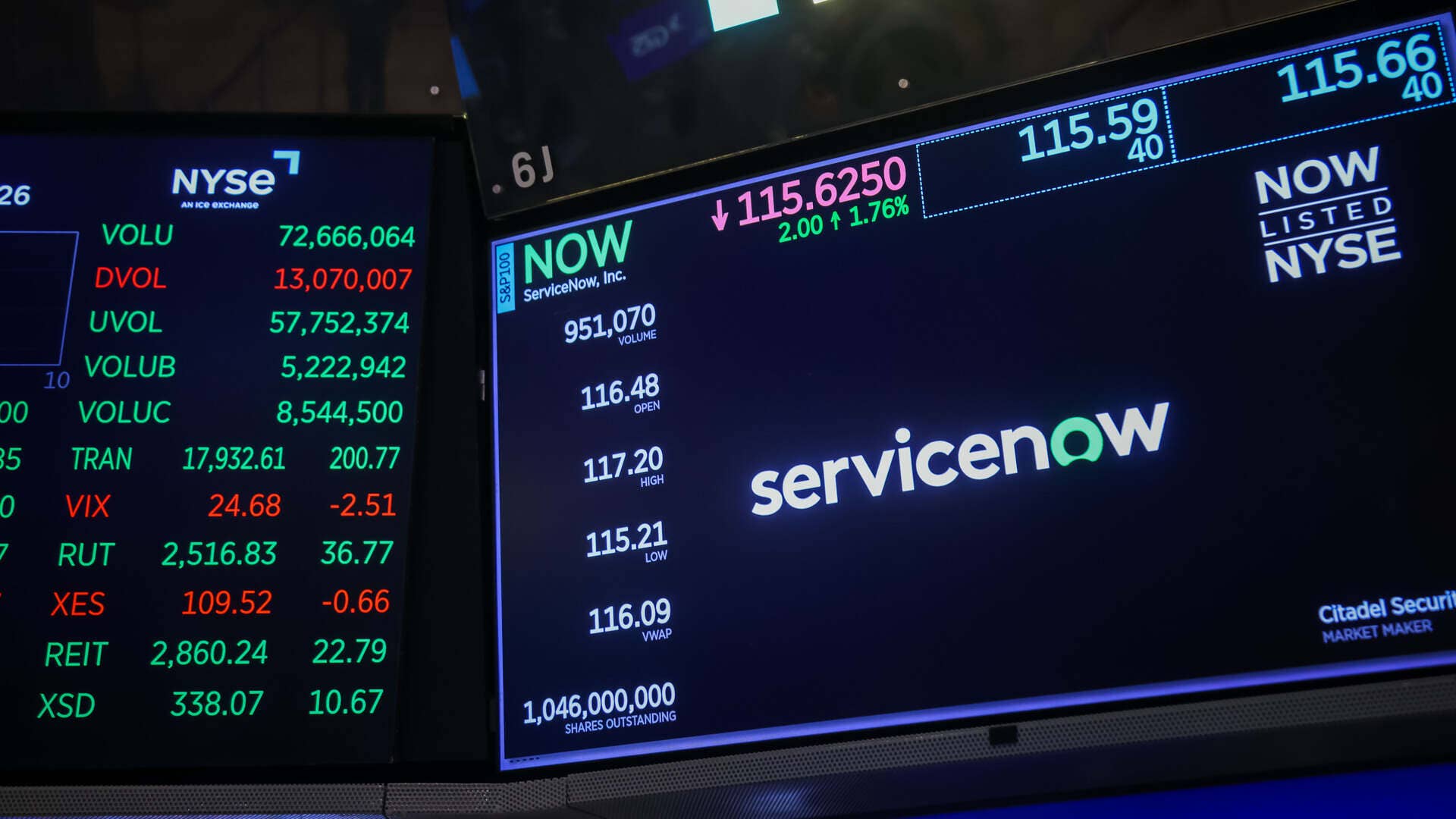 Bank of America raised ServiceNow’s stock price target to $150 from $130.
Michael Nagle/Bloomberg via Getty Images
The partnership ecosystem that keeps widening the moat
When I look at ServiceNow, what strikes me most about recent activity is the breadth of partnerships being signed. Second is how quickly the enterprise AI ecosystem is consolidating around its platform.
Anthropic joined as the first design partner for ServiceNow Action Fabric, connecting Claude directly to ServiceNow workflows. AWS Marketplace transactions surpassed $1 billion. NVIDIA deepened collaboration to extend agentic AI governance from desktops to data centers.
Microsoft integrated ServiceNow AI specialists into the Agent 365 ecosystem. Nearly all 50 U.S. states are now using the ServiceNow AI Platform for citizen services, achieving up to a 66% reduction in service desk costs, according to ServiceNow.
Related: ServiceNow CEO admits there’s a solution to AI’s biggest problem
That’s a company embedding itself deeper into the AI infrastructure stack from multiple directions simultaneously.
Tech Mahindra also announced an expanded multi-year partnership with ServiceNow on Aug. 20 specifically to accelerate enterprise AI from pilot deployments to production scale.
The timing isn’t coincidental. It’s another data point suggesting that large technology services firms see ServiceNow as the connective tissue for enterprise AI deployment.
Why the stock’s underperformance creates the opportunity Liani is flagging
NOW shares are down 15.34% year-to-date and 27.16% over the past year, according to Yahoo Finance. The S&P 500 returned 11.84% and 19.70% over those same periods.
That underperformance is the setup Liani is pointing at. A company growing subscription revenue at 24.5% YoY, crossing $1 billion in AI ACV, holding $29 billion in RPO, and trading at a forward price-to-earnings ratio of 29.15 times is priced more conservatively than its growth profile suggests it should be, according to Yahoo Finance valuation data.
Related: Bank of America sees ‘great convergence’ across America’s two economies
The market spent months pricing ServiceNow as if AI would hollow out its business. The Q2 results showed the opposite. Liani’s revised $150 target reflects a view that the re-rating from that misconception is still in its early innings.
From where I sit, having tracked this name since May, the fundamental story hasn’t changed. What’s changing is the market’s willingness to believe it.
Related: Bank of America’s latest Nvidia alert is a must-read for worried investors