
There is an old idea in business that the hardest number to measure is the money you never spent. A disaster avoided produces no press release. A bad deal declined shows up nowhere on the income statement. The executive who says no to the expensive thing gets punished immediately and vindicated years later, if at all, and usually after somebody else has claimed the credit.
For most of the past three years, the technology industry has been running the opposite experiment. Spending has been the strategy.
The four largest cloud companies plan to commit roughly $725 billion in capital expenditures during calendar 2026, up about 77% from the prior year, with the overwhelming majority going toward data centers, graphics chips and the power needed to run them, according to guidance compiled by ValueAdd VC.
Investors rewarded the spenders. Wall Street treated raw computing capacity as destiny. Any company that hesitated got written off as having missed the boat entirely.
One company hesitated far more than the rest. On Tuesday, it gets a new chief executive.
John Ternus becomes chief executive officer of Apple (AAPL) on Sept. 1, with Cook shifting to executive chairman of the board, Apple confirmed in its newsroom.
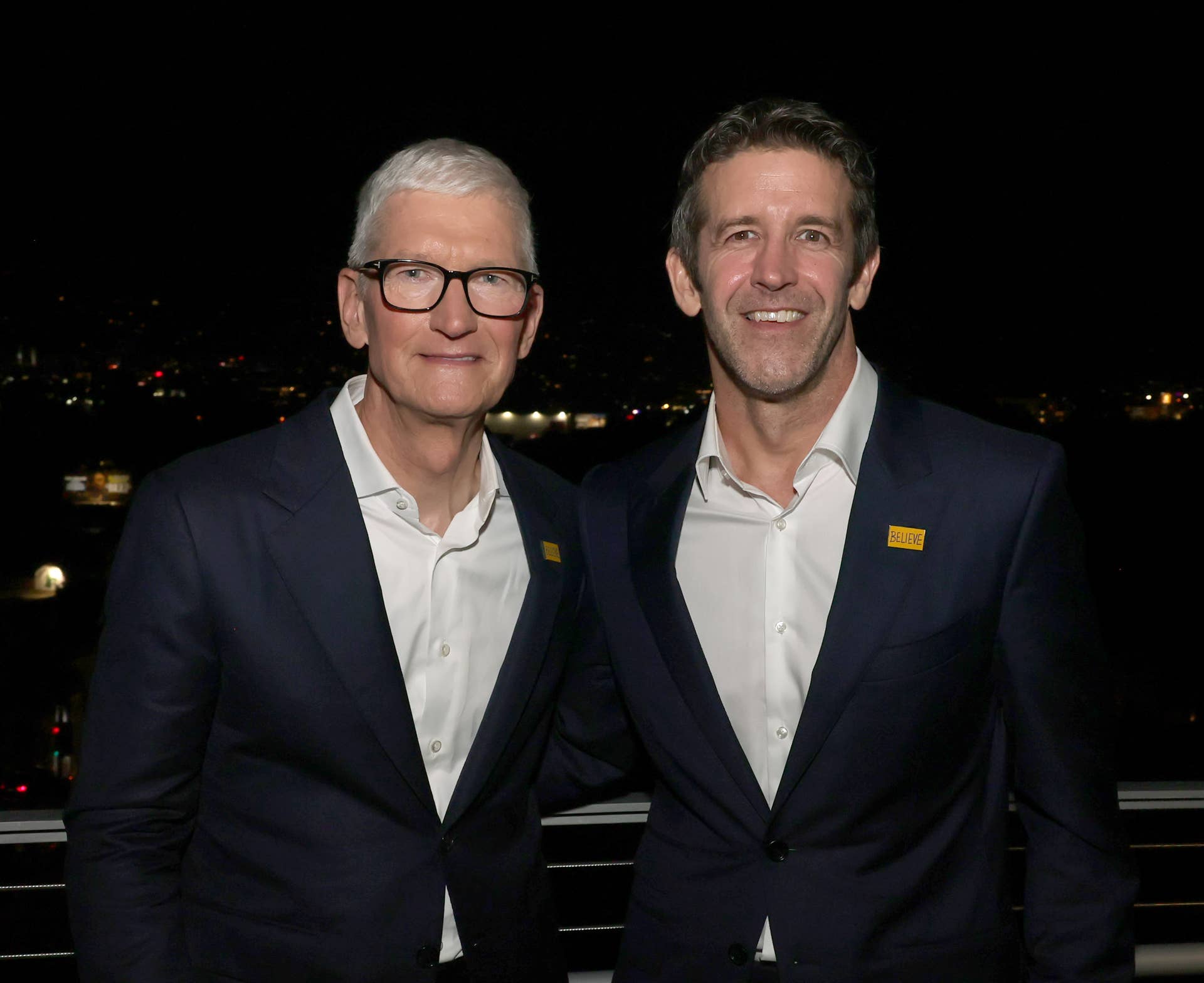 John Ternus becomes Apple CEO Sept. 1, inheriting $117 billion in cash and AI questions.
Kevin Winter/GA / Getty Images
What John Ternus actually inherits at Apple
The succession has been covered almost entirely as a personality question. Can a soft-spoken hardware engineer replace a supply chain legend? Is he visionary enough?
My analysis says that framing buries the more interesting number.
I pulled Apple’s fiscal third-quarter results filed with the Securities and Exchange Commission (SEC) and ran the arithmetic myself. Through the first nine months of fiscal 2026, Apple made $6.8 billion in payments for property, plant and equipment. In the same nine months a year earlier, that figure was $9.5 billion.
Apple’s capital spending fell roughly 28% during the largest capital spending boom the technology industry has ever produced.
Related: John Ternus’s net worth as Apple’s next CEO
Over those same nine months, the company generated $117 billion in cash from operating activities, up from $81.8 billion a year earlier. That puts capital expenditures at under 6% of operating cash flow.
Ternus is not inheriting a company that lost the artificial intelligence (AI) spending race. He is inheriting one that never entered it.
Why Apple’s AI spending gap matters for investors
The conventional read on all this has been damning. Apple ceded frontier model development to Google and OpenAI, watched Siri fall behind assistants like ChatGPT, and shipped a Vision Pro headset that never found its audience.
The competitive pressure is not theoretical either. Meta’s camera glasses built with Ray-Ban already sell well. OpenAI is developing a family of consumer hardware products with former Apple design chief Jony Ive. Apple sued OpenAI in July, alleging the company stole trade secrets through designers it poached, an allegation OpenAI has contested, reported Fortune.
More Apple News:
- Apple’s latest move could change how you use AI every day
- Bank of America predicts big changes for Apple after Tim Cook
- Wall Street is starting to warm to Apple’s $2,199 foldable gamble
There is a contrarian case, though, and it comes from someone who ran products at Apple long before Cook did.
“I see a bonfire of billions, trillions of dollars,” former Apple executive Jean-Louis Gassee said of industry spending on large language models, in comments to Fortune. His argument is that the models themselves are becoming commodities, and the money will be made further up the stack.
Apple’s bet is that most of the AI work customers actually care about can happen on the device in their pocket rather than in a rented data center. That architecture is the reason the capital expenditure line stays small.
The money is still going out the door. It just lands on a different line. Research and development spending reached $34 billion over the nine months, up from $25.7 billion a year earlier, an increase of about 32%.
Here is the gap in plain numbers.
- Apple committed $6.8 billion to property and equipment across the first nine months of fiscal 2026, according to the company’s quarterly results.
- Amazon (AMZN) expects roughly $200 billion in 2026 capital expenditures, CEO Andy Jassy said on a February earnings call, as reported by Fast Company.
- Microsoft (MSFT) is tracking toward about $190 billion for calendar 2026, driven mainly by its data center buildout, reported Fast Company.
- Alphabet (GOOGL) and Meta (META) together guided to more than $300 billion at the upper end of ranges both raised during 2026, according to ValueAdd VC.
The memory chip squeeze Ternus has to solve first
None of that fixes his most immediate problem.
Apple guided September quarter gross margin to between 47% and 48%, down from the 50.1% posted in the June quarter, with climbing memory costs the primary driver, the company told analysts on its July 30 earnings call.
Cook described the memory pricing environment as a 100-year flood and said Apple had reluctantly raised prices on Mac and iPad as a result.
Shares fell more than 6% in extended trading after that report, according to CNBC.
So Ternus takes over a business with real momentum and a real squeeze happening at the same time. June quarter revenue hit $109.4 billion, up 16%, with iPhone revenue up 22%, Apple reported.
Demand is not the problem. Securing enough parts at a price that protects the margin is the problem, and it is the first thing on his desk.
What Apple’s Sept. 9 event will not tell you
Ternus makes his debut as CEO at Apple’s Sept. 9 product event, where the company is expected to detail a rebuilt Siri and introduce its first foldable iPhone.
Watch the capital expenditure line instead.
Apple’s move away from a net cash neutral financial strategy suggests the company could direct more money toward research, capital spending and acquisitions, which may be required to keep pace in the AI era, Bank of America analyst Wamsi Mohan wrote in a recent note, according to Fortune.
That is the real tell. Cook spent 15 years building a machine that converts restraint into cash. Ternus is the first Apple CEO in more than a decade with an obvious reason to spend it.
This matters to you whether or not you have ever bought a single Apple share. Apple is among the largest holdings in nearly every S&P 500 index fund, which means it sits inside most 401(k) plans in the country. When a company that size changes how it allocates capital, the effect eventually reaches your retirement statement. You just do not get a vote, and you rarely get a warning.
If he does, he has room nobody else has. Apple closed the June quarter with roughly $146 billion in cash and marketable securities and returned $62 billion to shareholders through buybacks over nine months. Redirecting even a slice of that toward AI infrastructure or an acquisition would be the biggest strategic shift Apple has made since it began designing its own chips.
If he doesn’t, the on-device thesis had better be right, because there is no second act if it isn’t.
Either way, the answer is not arriving on Sept. 9. It arrives in the capital expenditure line of some quarterly filing in 2027 that nobody will livestream, and by then the market will have already decided what it thinks.
Related: Jim Cramer doubles down on Tim Cook and Apple verdict
