
A few years ago, quantum computing was the kind of technology that scientists talked about at conferences, and investors mostly ignored. The machines were too error-prone, the use cases too theoretical, and the timelines too fuzzy to build a serious investment thesis around.
That’s changing, and Bank of America just put a number on how quickly.
Sept. 28, analyst Vivek Arya initiated coverage on IonQ (IONQ) with a Buy rating and a $60 price target, according to a note shared with TheStreet.
Arya ranks 147th out of more than 12,500 Wall Street analysts on TipRanks, with a 59% success rate.
The stock was trading around $45 at initiation, meaning Arya sees 33% upside from current levels.
Arya argues that IonQ’s recent acquisitions could accelerate the timeline for the technology to become genuinely useful.
Also Read: IonQ Inc. Latest News and Stories
Why two IonQ acquisitions might matter more than any earnings beat
IonQ made two deals this year that, individually, might look like routine corporate development. Together, according to Bank of America, they could meaningfully compress the timeline to commercial-scale quantum computing.
In January, IonQ acquired Seed Innovations, an artificial intelligence (AI) and software development company that will help the firm manage and scale complex quantum workloads.
In July, it closed the acquisition of SkyWater Technology, a semiconductor foundry that gives IonQ direct control over chip development and manufacturing to support its next-generation Superion systems.
More AI:
- Nvidia just made a move Wall Street wasn’t ready for
- Microsoft just took sides in AI policy fight
- OpenAI just disclosed something genuinely alarming
That second deal is the more structurally significant one. Quantum computing has a hardware problem: the qubits that perform calculations are error-prone, and improving their fidelity while scaling qubit count requires extremely precise chip manufacturing.
By bringing that manufacturing in-house, IonQ eliminates a critical dependency that could otherwise slow its roadmap.
Arya described it as a “semiconductor-enabled path to scaling qubit count” that supports IonQ’s development of Superion 256, its next-generation platform targeting launch in Q2 2027.
The Superion 256 will be the first to integrate electronic qubit control, which Arya called “a significant architecture shift that could support substantial logical-qubit scaling,” according to the note.
Logical qubits — error-corrected qubits that can perform reliable computation — are the bridge between today’s error-prone machines and systems useful enough for real commercial problems in chemistry, materials science, optimization, and cryptography.
The IonQ’s revenue trajectory that makes BofA’s 2030 thesis legible
I’ll be honest: quantum computing revenue forecasts extending to 2030 require a significant degree of trust in trajectory rather than current performance. That’s a reasonable objection to any initiation in this space.
But IonQ’s recent numbers are harder to dismiss than most early-stage technology stories.
Q2 2026 revenue reached $80.05 million, up 287% year-over-year (YoY), beating analyst consensus, according to IonQ‘s statement. IonQ has now delivered five consecutive quarters of record results.
IonQ announced that following the SkyWater acquisition, IonQ raised its full-year 2026 revenue guidance to a midpoint of $455 million, up from a prior midpoint of $285 million.
Related: Nvidia once rattled IonQ stock. Now it plans to install IonQ tech
That guidance lift reflects both organic momentum and the foundry revenue stream IonQ is now building. Remaining performance obligations grew 297% YoY. That’s the clearest signal that customer commitments are expanding beyond one-time contracts into longer-duration relationships.
Bank of America’s valuation framework applies a 7.0x enterprise value-to-sales multiple to $2.5 billion in estimated fiscal 2030 quantum hardware and services revenue and a 2.0x multiple to $1.2 billion in estimated foundry revenue, according to the note.
That blended 5.4 times fiscal 2030 EV/S multiple implies a 69% compound annual growth rate in sales from fiscal 2026 to fiscal 2030.
My read is that growth rate requires everything to go right — engineering milestones hit, commercial adoption accelerating, and no significant competitive disruption from IBM, Google, or well-funded startups.
Arya acknowledged as much, noting that delays in machine delivery or commercial adoption could put the forecast at risk.
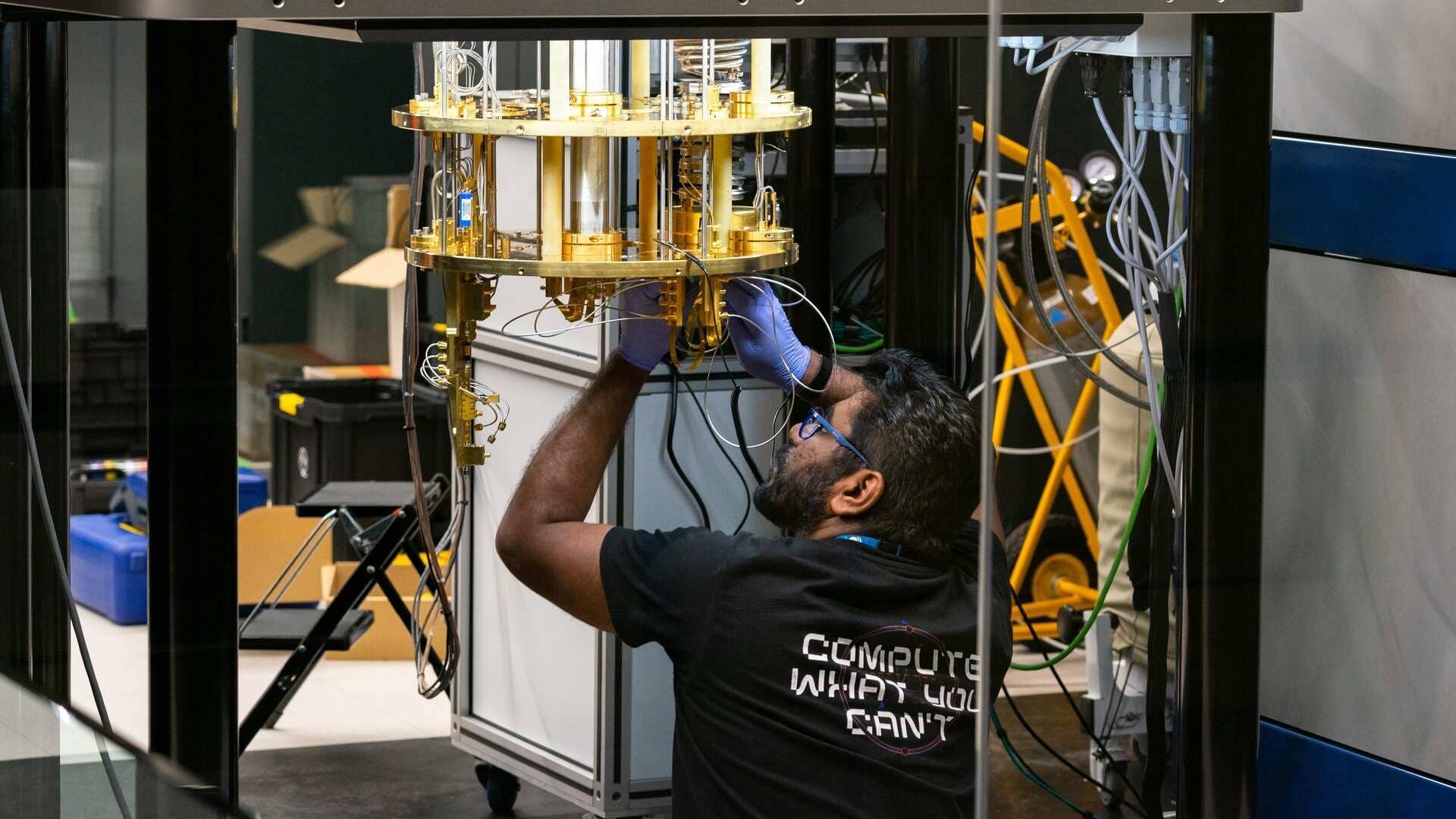 IBM uses superconducting qubits. IonQ uses trapped-ion technology.
What the IBM quantum computing comparison tells you about the timeline
I’ve covered IBM CEO Arvind Krishna’s quantum computing roadmap before. Krishna said in July that quantum computing would have “a measurable impact” on IBM’s top and bottom line by 2028 or 2029, with a potential $1 trillion in value created by the end of the 2030s.
IonQ is operating on a broadly similar timeline, but from a different architectural approach. IBM uses superconducting qubits. IonQ uses trapped-ion technology, which generally offers higher fidelity but faces different scaling challenges.
The semiconductor foundry acquisition addresses one of trapped-ion’s historical limitations — the ability to manufacture ion trap chips at scale with the precision required for higher qubit counts. IonQ CEO Niccolo de Masi has been unambiguous about the ambition.
Second quarter revenue of $80.1 million again exceeded our guidance, reflecting continued customer demand across our expanding quantum platform.
IONQ shares are up roughly 20% over the past month but have gained only 5% year-to-date, compared to the S&P 500’s 13% gain, according to Yahoo Finance.
It has underperformed the broader market in 2026, which is precisely why BofA sees entry value at current levels relative to the 2030 target.
