
Trust is the one thing no technology company can print. You either earn it from customers, or you borrow it from the rules that protect them.
For most of modern finance, you have leaned on the second kind. Banks answer to examiners, brokers answer to regulators and public companies answer to auditors who sign their names to the numbers.
That system is why you can hand your paycheck to a bank you have never visited. Somebody outside the company is checking the work.
Artificial intelligence has grown up without that referee. The same handful of companies now builds the chatbots you ask about your taxes, the tools scammers use to clone voices, and a large share of the stocks in your retirement account.
Lawmakers have argued for years about who should police that power. On Sept. 29, the industry gave its own answer, and it signed its name to it.
Meta Platforms (META) CEO Mark Zuckerberg stood with President Donald Trump at the White House and said the goal was to give Americans confidence in the technology.
The catch is who does the checking. Under the accord Zuckerberg signed, the companies largely police themselves.
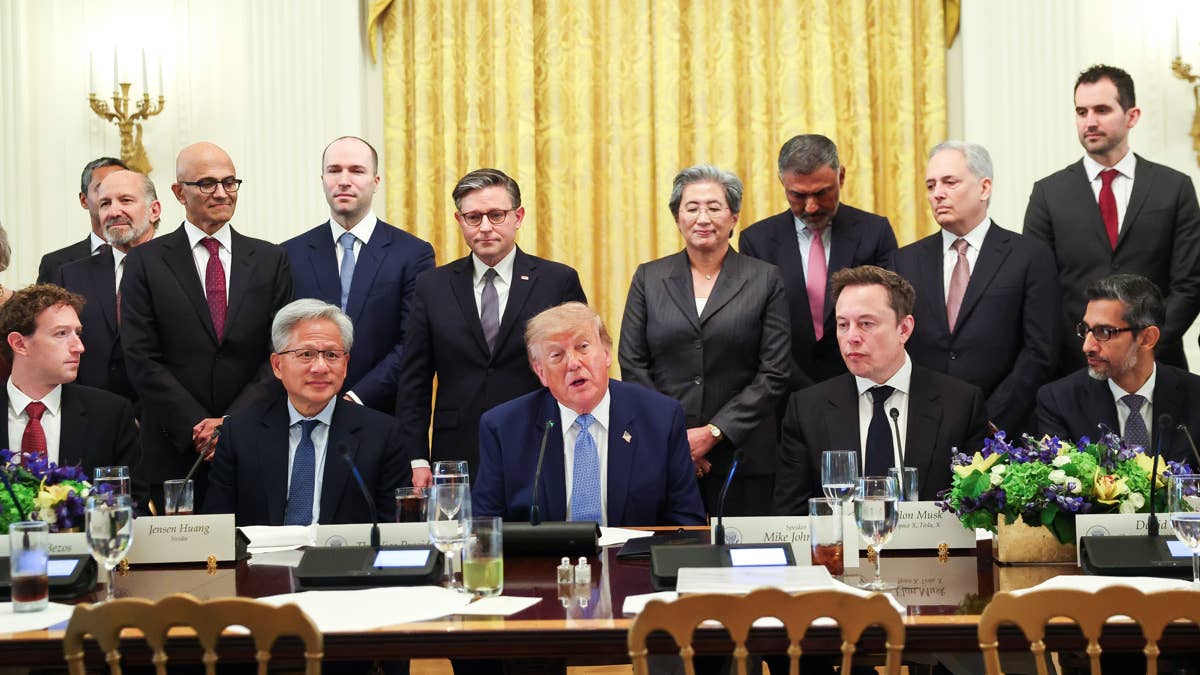 Six AI leaders signed a voluntary White House safety accord on Sept. 29.
Why tech giants want to write their own rules
The accord caps a fast-moving policy fight. Earlier this month, the White House dropped plans for an independent standards body that would have tested frontier AI models before release.
I reported on Sept. 19 that Zuckerberg, Elon Musk and Nvidia (NVDA) CEO Jensen Huang pushed back on that plan, arguing a testing queue would favor the biggest players. This accord is what replaced it.
Related: Mark Zuckerberg and Nvidia CEO weigh in on Anthropic AI proposal
The money at stake explains the urgency. Meta alone expects 2026 capital spending of $130 billion to $145 billion, much of it on AI infrastructure, according to its second-quarter earnings release.
A regulator that delays launches can delay the revenue meant to pay for that spending. A voluntary pledge does not.
What the White House AI accord actually requires
Six executives signed the document alongside Trump, according to Nextgov: Zuckerberg, Huang, Google CEO Sundar Pichai, Anthropic CEO Dario Amodei, OpenAI President Greg Brockman and xAI CEO Elon Musk.
More Artificial Intelligence:
- Bill Gates doubles down on AI warning after decades of optimism
- OpenAI paused training again, and Washington’s in the middle of it
- Huang says 1 number in the AI debate isn’t science-based at all
Google is owned by Alphabet (GOOGL). Anthropic, OpenAI and xAI are private companies.
According to Nextgov’s summary, the accord sets out four layers of control:
- Internal controls that monitor a model’s capabilities and behavior during training and deployment.
- An internal team responsible for making those controls work.
- Assessments by an independent outside auditor or evaluator.
- An independent board committee that receives the audit reports.
Zuckerberg framed it as a first step. “The basic idea is that we want to give the American people and our customers confidence that the technology works in the way that we intend,” he said, according to a Fox News live blog.
He added that the companies agreed to “multiple layers of auditing and controls,” according to CBS News. In the same clip, he called the meeting a “historic conversation.”
Trump called the pledge “morally binding” and “almost like a constitution,” CBS News reported. No agency is assigned to enforce it.
Critics say self-policing pledges fall short
Not everyone sees self-policing as protection. “What other trillion-dollar industry marks its own homework?” Toby Walsh of the UNSW AI Institute told Al Jazeera.
In Congress, Sen. Mark Warner (D-Va.) tried the same day to pass a bill creating an AI Safety Board at the Commerce Department, according to Roll Call.
The bill would give the board access to new models at least 45 days before release and require incident reports within 30 days.
Sen. Ted Cruz (R-Texas) objected, blocking the fast-track vote.
This is not the industry’s first promise, either. In July 2023, seven companies made voluntary commitments to the Biden White House that included testing models before release and labeling AI-generated content.
In my analysis, the 2026 version is stronger on governance and weaker on transparency. Board-level audit committees are new, but published summaries of the accord say nothing about telling you when content is AI-made.
How the deal affects your money and safety
Public trust is moving the wrong way for the industry. Only 27% of Americans trust businesses to use AI responsibly, down from 31% in 2025, according to a Bentley University-Gallup survey.
The share who say AI does more harm than good rose to 39% from 31%. Young adults turned most sharply, with trust among 18- to 29-year-olds falling to 20% from 30%.
That skepticism has a price tag. The FBI counted $893 million in 2025 losses tied to AI-related scams, including voice cloning and deepfake investment schemes, AARP reported.
An audit committee at an AI lab will not stop a cloned voice from calling your parents. Here’s what you can do while the rules catch up:
- Set up a family code word for any urgent call asking for money
- Hang up and call back on a number you already have before paying anyone
- Treat any “guaranteed” AI trading tool or celebrity investment video as a red flag
If you own an S&P 500 index fund, you already own a stake in three of the signers: Meta, Alphabet and Nvidia.
Watch whether those companies describe the new audit committees in their proxy statements, because that is where shareholders will learn whether the audits are real.
Where industry oversight goes next
The accord’s supporters say it can evolve. “The idea isn’t that this is the only thing that we will ever do,” Zuckerberg said, according to Fox News.
Critics will want proof before they believe it. The first real test is whether the promised outside audits happen, and whether any of their findings ever reach the public.
Until then, the checking falls to you. Guard your accounts as if no one else is watching, because for now, the watchers work for the companies.
Related: Zuckerberg, Musk, and Huang take key stand on huge AI issue
