
The question with Tesla has never really been whether it can sell cars. It’s whether the valuation that the market has assigned to it can ever actually be justified.
UBS looked at the third-quarter delivery report and came away with the same answer it had going in: not yet convinced. The bank held its Neutral rating and kept its price target right where it’s been.
Tesla beat delivery expectations in Q3, which is the headline. But its energy business fell short, and at roughly 345 times earnings, a single strong delivery quarter doesn’t do much to resolve the bigger question.
You need a lot more than one good month on vehicles to justify what the market is paying for this stock. That’s been UBS’s position, and nothing in this report changed it.
Better than feared isn’t a reason to pop champagne, but it keeps the story alive. The stock shrugged and moved on after the report. That probably tells you more about where the valuation debate actually stands than any single analyst note.
Also read: Bentley set to challenge Tesla and Ferrari after huge new launch
A delivery beat doesn’t close the valuation gap
Tesla shipped 486,500 vehicles in the third quarter, beating consensus estimates by roughly 5% to 6%. Model 3 and Model Y did the heavy lifting, as they usually do.
For a company that’s been dealing with slowing EV demand, more competition from every direction, and the phaseout of U.S. electric-vehicle tax incentives, clearing the bar by that margin is a meaningful result. It shows the core business isn’t in free fall.
Deliveries were still lower than they were a year ago, though. HSBC has a theory on that. The Inflation Reduction Act credits expiring pulled a bunch of buyers forward, which made earlier quarters look stronger than they really were.
Now you’re comparing against an inflated base. The beat happened. You just need to know what you’re actually looking at when you see it.
What it does tell you is that Tesla can still surprise people on the upside in its core business, even when conditions aren’t great. That’s worth noting. But it doesn’t answer the question that Wall Street keeps circling back to, which is whether any of this justifies what you’re paying for the stock.
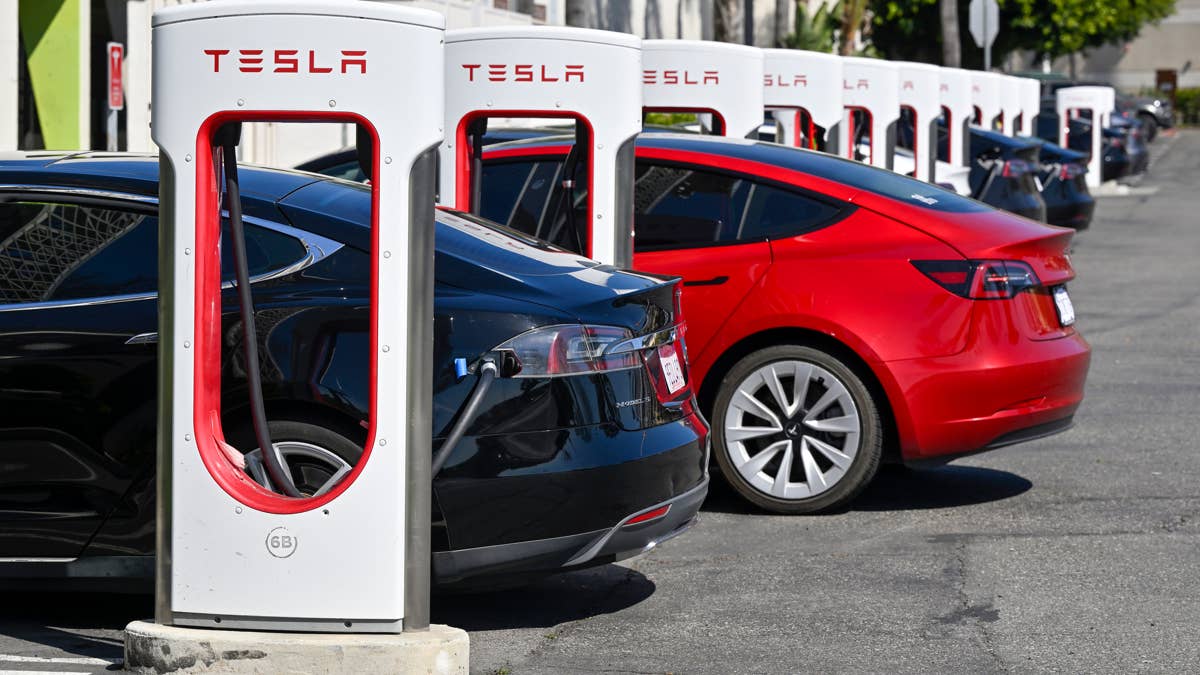 Tesla’s energy-storage business came in below what UBS was expecting, and that’s the number that deserves more attention than it’s getting.
MediaNews Group/Orange County Register via Getty Images / Getty Images
The one Tesla number Wall Street isn’t talking about
Tesla’s energy-storage business came in below what UBS was expecting, and that’s the number that deserves more attention than it’s getting.
The bank trimmed its earnings estimate slightly to account for the shortfall, but that’s not really the point. It’s that energy is quietly one of the more interesting parts of Tesla’s business right now, and it had a softer quarter.
UBS called it a lumpy business, meaning the results can swing significantly from one quarter to the next depending on when large contracts close. That’s fair, since one soft quarter in energy doesn’t tell you much about the longer-term trajectory.
But it is worth watching because energy generates above-average margins for Tesla compared to its vehicle business. Investors tracking growth beyond automotive should be paying close attention to how consistently this segment performs going forward.
A softer quarter isn’t a red flag. It’s a reminder that this part of the business is still unpredictable, and that investors pricing in Tesla’s energy future are doing so with limited visibility into the near term. That uncertainty is worth keeping in mind.
What paying 345 times earnings actually means
At around $378 per share, Tesla is trading at roughly 345 times earnings, according to Investing.com. UBS’s price target sits at $385, which is almost exactly where the stock is trading.
That’s not a coincidence. It’s the bank saying there’s no compelling case to buy or sell at these levels right now.
A multiple like 345 isn’t pricing in car sales. It’s pricing in full self-driving becoming a real commercial product, humanoid robotics becoming a business, AI generating meaningful revenue, and energy storage scaling up substantially, all happening within a reasonable timeframe.
Every single one of those things has to work. And most of them are still unproven.
More Tesla:
- Tesla sales rebound hides costly problem for investors
- Tesla record revenue masks cash burn, $1B SpaceX swing
- Elon Musk, Tesla and SpaceX face serious questions from investors
None of this makes Tesla a sell. The company has a track record of doing things people thought it couldn’t do.
But you’re paying a serious premium for what might happen, not for what’s happening today. UBS isn’t being negative about the company. It’s just refusing to get ahead of itself on the price.
From $157 to $475: why no two analysts see Tesla the same way
Look at the analyst spread after this report and you’ll see exactly why Tesla remains one of the most polarizing stocks on the market.
Baird came away with an Outperform rating and a $475 price target, calling the delivery beat a positive signal. Truist Securities held its ground at Hold with a $370 target. HSBC, which still carries a Reduce rating, actually raised its target, but only to $157.
The gap between the most bullish and most bearish targets for the same stock, after the same report, is enormous.
Part of the reason you get that kind of spread is that analysts are essentially betting on different versions of Tesla. The car company version. The AI company version. The robotics play.
Those aren’t the same bet, and the price target you land on depends almost entirely on which one you think wins. Baird is making one of those bets. HSBC is making another. UBS is saying it needs to see a lot more before it picks a side, and at these prices, that’s a defensible position.
The delivery numbers show the business isn’t falling apart. But a stock priced for perfection across multiple unproven businesses is one where you have to be sure before you step in.
Right now, there’s not enough certainty to be sure. And that’s exactly what UBS is saying.
Related: The Robotaxi payday Tesla promised owners isn’t coming
