
If the laptop you’re eyeing this fall comes with less storage than you expected, you’re not imagining it. PC brands are trimming SSD capacity in mainstream models to hold down costs, according to TrendForce.
The two biggest makers of the flash chips in those drives are Korean, according to TrendForce’s sales rankings. Both make much of it in China, at factories caught in a question Washington hasn’t answered.
Samsung Electronics Co. and SK Hynix Inc. (SKHY) are upgrading those plants to make more advanced chips, Reuters reported on Oct. 21. Both confirmed the work, saying it was happening in close consultation with Washington.
That phrase deserves scrutiny. In 2025, the Commerce Department said it intended to license the plants to keep running, but not to expand capacity or upgrade technology. Asked about approvals, it pointed Reuters back to that statement. Reuters could not determine how far U.S. licenses cover the new plans.
Samsung’s Xian plant, which makes about 40% of its NAND flash, is moving from about 200 layers to 286, according to Reuters’ sources.
SK Hynix wants to take its Dalian site from 192 layers to 240 or more, the sources said.
Also read: South Korea’s finance chief bets chip boom outlasts selloff
More layers mean more storage from the same plants
Samsung told Reuters the upgrade complies with U.S. export rules and adds no capacity or new facilities. That covers capacity, not the other half of the 2025 line: technology upgrades, which is exactly what more layers are.
More layers per chip mean more storage density and lower costs, Reuters noted. By my math, Samsung’s move adds about 43% more layers, and SK Hynix’s adds at least 25%.
The same buildings can then turn out more storage. Samsung aims for 5,000 wafers a month of the new chips this December and 40,000 by December 2027, one source told Reuters.
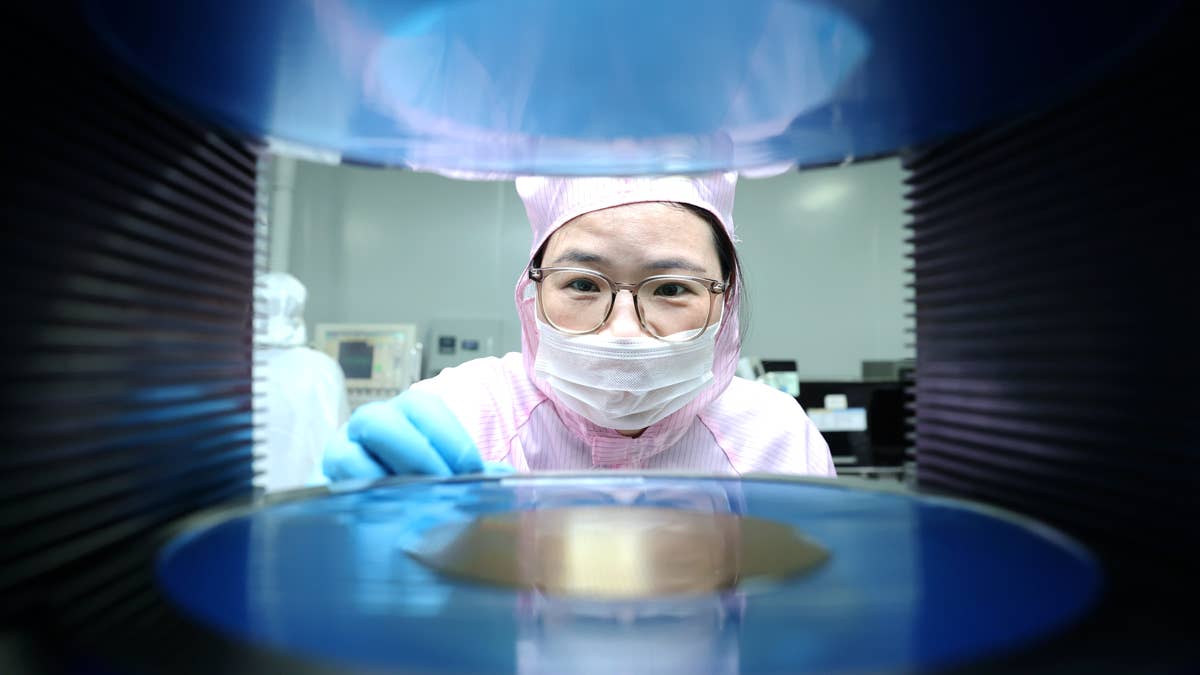 Samsung’s Xian plant, which produces about 40% of its NAND flash, is moving to 286-layer chips, despite a 2025 U.S. stance against upgrades.
SK Hynix is caught between Beijing and Washington
SK Hynix carries a second complication, and this one comes from Beijing. When China approved its purchase of Intel Corp.’s (INTC) NAND business in 2021, it required SK Hynix to keep raising production for five years, according to the company’s SEC filing.
Put simply, Beijing wants more output, while Washington has said it won’t license upgrades. Both pressures land on Dalian, the only flash plant for the Intel unit now called Solidigm. Beijing’s terms run through this December.
One source told Reuters that SK Hynix is already authorized to make chips with up to 240 layers at Dalian. The timing is unclear. If that permission is recent, Washington has quietly moved past its own 2025 line.
Solidigm has picked Goldman Sachs and Morgan Stanley for a US IPO that could raise about $10 billion, Bloomberg reported. SK Hynix said no specific plans have been confirmed. Buyers will judge that listing partly on how modern Dalian is.
SK Hynix is also discussing a U.S. NAND factory with the Trump administration, according to Reuters. I’d watch whether that factory becomes the price of Washington’s patience in Dalian.
YMTC’s China gains show what the curbs cost
Wuhan’s Yangtze Memory Technologies Co. (YMTC) has gained share from both in China, according to Omdia data cited by Reuters:
- China’s NAND leader in the second quarter was YMTC, with 38.5% of the market, up from 28% for all of 2025.
- Second place belongs to Samsung at 33.5%, down from 36%.
- Third place went to SK Hynix at 17%, down from 20%.
Reuters said the U.S. restrictions contributed to the share loss. That’s an awkward result for controls meant to slow China’s tech progress. Holding back the Korean plants helped hand business to China’s own champion.
More Artificial Intelligence:
- AI’s biggest business opportunity may not look like AI
- AI racks are outgrowing old power: 2 chipmakers have a strategy
- BofA splits software into winners and losers as AI agents arrive
What the upgrades mean for investors and shoppers
Samsung and SK Hynix shares each ended about 6% higher in Seoul after the report, Reuters said. The wider Korean market also rebounded that day, according to TipRanks.
SKHY, the Nasdaq listing of what Bloomberg calls the second-largest memory firm, rose about 3.5% in premarket trading, according to Benzinga.
Meanwhile, Wall Street already backed SK Hynix. Fifteen analysts polled by S&P Global rate SKHY a Strong Buy, with an average price target of $252.21, according to StockAnalysis. That average sits about 80% above Tuesday’s close. SK Hynix reports third-quarter results on Tuesday, Oct. 27, 2026.
Still, shoppers shouldn’t expect quick relief. TrendForce projects NAND contract prices will rise another 15% to 20% this quarter. Samsung’s full Xian target doesn’t land until December 2027.
Export controls work best when the target has nowhere else to turn. Memory never fit that mold, because China has its own supplier and the Korean plants already sit inside its borders.
Samsung even pitched its upgrade as serving customers “including those in the U.S.” Washington’s 2025 policy bet it could freeze these factories in place. The shortage is rewriting that bet one layer at a time.
Related: Chip toolmakers can’t catch a break, even as TSMC spends more
