
Gasoline prices are now doing in a big way what they usually do in the last two months of the year: They’re falling.
GasBuddy.com quoted the U.S. national gas price at $3.965 a gallon on Nov. 9, down 1.5% from $4.028 on Nov. 6, though up slightly from Nov. 8’s $3.961. The Nov. 8 price was the first below $4 a gallon since Aug. 10, when an escalation of missile and drone attacks in and around the Persian Gulf erupted.
AAA Fuel Prices showed the national average at $4.0093 per gallon, and its next report, due early on Nov. 10, should also show the price falling below $4.
While the direction of price declines is clear and steady, what you actually pay at the gas pump in the United States varies wildly.
On Nov. 9, the lowest statewide prices in the country were in North Carolina. GasBuddy said the price was $3.223, down about 20% from Oct. 9’s $4.069 and off 24% from its May 21 peak of $4.237 a gallon.
California still has the nation’s highest prices. The statewide average was $5.681 a gallon on Nov. 9. That was down 10% in a month and 11.2% from the statewide peak of $6.396 a gallon reached on Oct. 1.
At these levels, the U.S. national average has fallen more than 12.4% since hitting its peak in May.
The declines mirror the declines in crude oil prices globally. Light sweet crude, the U.S. benchmark, settled at $86.85 a barrel, down 4.4% on the day and down 23% since Oct. 30.
Brent crude closed on Nov. 9 at $92.57 per 42-gallon barrel, down 5.9% and down 19% just since Oct. 30.
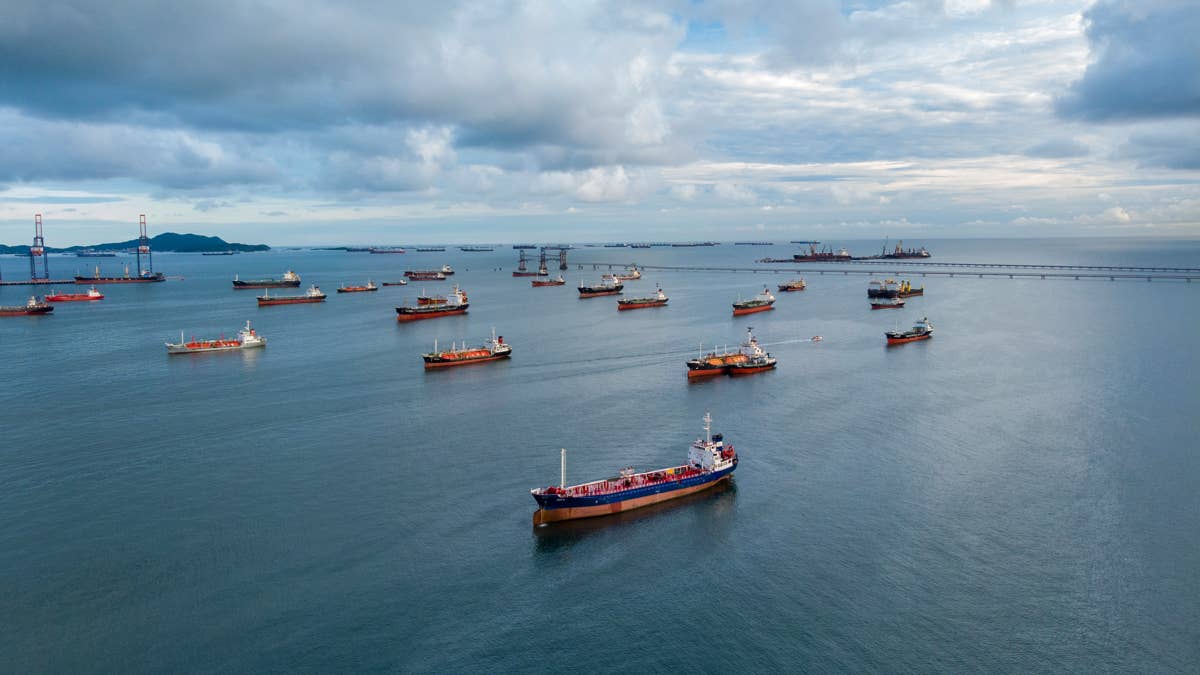 Tankers at anchor in the Middle East. Photos for You / Getty Images
Trump willing to hold back on new attacks on Iran
The immediate catalyst stemmed from President Trump’s comment on Nov. 9 that he wouldn’t start new attacks against Iran as long as peace talks were progressing.
At the same time, the Al Arabiya news service was reporting the Trump administration was prepared to allow Iran to continue enriching uranium to 3.67%, with Iran’s government supposedly agreeing to the proposed limit. OilPrice.com noted that the report cited unconfirmed reports.
Talks may be progressive, but prices held even as news reports suggested many skirmishes in and around the Persian Gulf and the Strait of Hormuz on Nov. 9. Before the U.S. and Israel attacked Iran in February, as much as 20% of the world’s crude flowed through the strait to global markets.
Why oil prices and gasoline prices may be headed lower
But the seasonal forces that affect oil prices are considerable. In the United States, consumers drive less in the fall because the summer vacation season is over. It gets a bit more complicated than that.
Airlines are still busy. Truckers and railroads are still moving freight, and the fall agricultural harvest is still going on.
More on oil and economy:
- Exxon now makes more turning oil into diesel than pumping it
- Stocks surge despite a hidden warning sign that traders can’t ignore
- World’s biggest oil CEO shares stark oil price warning as pressure builds and supplies run dry
So, the consumption of jet fuel and diesel doesn’t fall off as much as gasoline. But refiners have to produce gasoline as they make jet fuel and diesel.
As a result, wholesale and retail gas prices fall sharply in the fall and early winter until refiners start producing gasoline for the summer season.
Oil-price decline fuels stock market
The decline in oil and gasoline prices set off another big stock-market rally on Nov. 9.
The Dow Jones Industrial Average jumped 1,104 points to 52,390. The Standard & Poor’s 500 Index was up 173 points to 7,550, and the Nasdaq Composite Index rallied up 674 points to 25,253.
All 11 S&P 500 sectors, even energy, were higher on the day.
Related: Gas prices fall, but Goldman Sachs sees a $105 risk
