
Jim Cramer spent years telling investors to hold onto Nvidia stock (NVDA) through turbulence instead of timing every rally and sell-off.
But a growing controversy around Nvidia CEO Jensen Huang just prompted the “Mad Money” host to consider one of his strongest investing convictions. During the Nov. 9 episode of the hit show, Cramer warned that investors might need to prepare for a future without Huang at the top.
Though he still has plenty of conviction in the business, dependence on an extraordinary CEO just became doubly important for investors.
Cramer’s famous Nvidia rule suddenly comes with a serious warning
Cramer’s longstanding rule for Nvidia stock is pretty simple, “Own it, don’t trade it.”
In addition to Nvidia, he has advocated that rule for Apple stock as well, encouraging investors to hold exceptional businesses through short-term volatility instead of repeatedly buying and selling their shares.
More Nvidia:
- Microsoft just gave Nvidia shareholders a reason to pay attention
- Nvidia has a stake in SpaceX that came from an unexpected place
- Nvidia’s $12.9 billion deal could shape the AI apps you use
That mantra helped define Nvidia’s status as one of the CNBC Investing Club’s biggest investment successes. But on Nov. 9, Cramer acknowledged that Huang’s uncertain future might force an entirely different approach.
“Right now, Jensen is still working. He’s still CEO. And he still has the support of NVIDIA’s board of directors. But given the facts of the story, which seem to get worse with each update, we’re going to have to consider owning shares in a Jensen-less NVIDIA.”
Cramer went further, warning investors they might no longer be bound by the club’s familiar “own-it-don’t-trade-it mantra” if the company’s leadership changed.
That said, Cramer also cautioned against abandoning a remarkably successful company simply because its famous leader might be compelled to leave. He recalled how investors who sold Apple following Steve Jobs’ death missed years of massive gains under Tim Cook.
For perspective, Apple stock surged nearly 2,258% during Tim Cook’s 15-year tenure as CEO, from August 2011 through August 2026, outperforming the S&P 500’s 553% gain over the same period, which can be tracked through Yahoo Finance.
“We are not anxious to dump it,” Cramer said, explaining that Nvidia has capable executives and a product roadmap developed for years ahead.
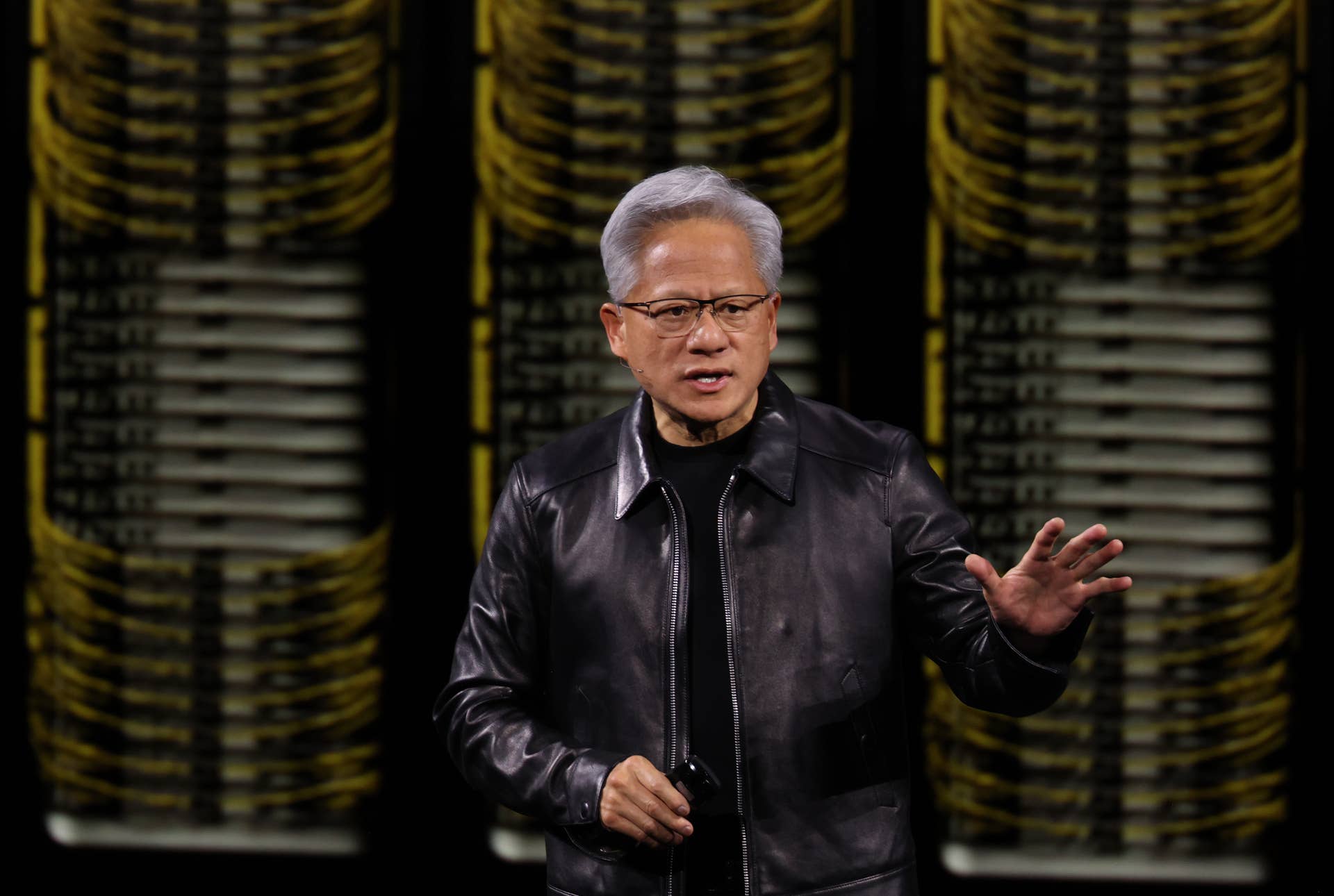 Jim Cramer says his Nvidia holding strategy could change amid Huang scrutiny.
Nvidia’s $190 billion sell-off reveals why the scandal threatens more than its CEO
The immediate issue for Nvidia is an independent investigation into whether Huang was targeted by a foreign intelligence operation, as reported by Reuters.
The inquiry followed reports about his relationship with Alice Huang, a former executive at Singapore-based technology company Megaspeed, whom U.S. intelligence officials suspect of gathering information for China.
The Nvidia CEO acknowledged in a Nov. 8 message to employees that he had been unfaithful to his wife. His public apology, though, didn’t name the person involved, and the intelligence allegations haven’t been established as fact.
Nvidia’s board announced that independent directors, supported by outside counsel, would have to investigate the matter. Still, the company said it had no reason to believe that national security or Nvidia’s confidential information had been compromised.
The board also expressed confidence in Huang’s leadership and said he would cooperate with the review.
Investors nonetheless reacted sharply.
Nvidia shares tanked 4.27% on Nov. 9, closing at $178.67 and erasing nearly $190 billion in market capitalization, according to Reuters.
For retirement investors, the situation matters quite a bit because Nvidia represents around 7% of the market-cap-weighted S&P 500. At that approximate weighting, a 4.27% decline in Nvidia alone would subtract about 0.3 percentage points from the index’s return, if we hold other components constant.
Additionally, a Nov. 9 shareholder lawsuit accused Nvidia and Jensen Huang of withholding information about an alleged relationship and national-security risks, though wrongdoing remains unproven for now, as reported by DW.
On top of that, Cramer pointed to growing opposition to AI data centers, as voters backed restrictions in 40 of 41 local Nov. 3 ballot contests.
He warned that stricter permitting and regulation might undermine financing for cloud operators that buy Nvidia chips.
“The company is worth less post-election than it was pre-election,” he said.
For shareholders, the question is whether these pressures threaten Nvidia’s growth or trigger temporary volatility.
Wall Street still backs Nvidia, but one outcome could change everything
Despite the controversy, Wall Street remains bullish on Nvidia.
For perspective, Bernstein analysts maintained their $400 price target, while Bank of America, Citi, and RBC Capital Markets retained targets of $350, $315, and $330, respectively, against Nvidia’s Nov. 9 close of $178.67.
In addition, Nvidia trades at roughly 25.7 times trailing earnings and 19.18 times forward earnings, according to Seeking Alpha, compared with the S&P 500’s forward P/E of 17.7, based on previously cited estimates.
Though that pricing setup has become attractive of late, it does leave investors weighing strong earnings expectations against growing uncertainty.
The Nov. 17 earnings report will test whether AI demand remains strong enough to support Nvidia’s growth outlook.
Cramer hasn’t abandoned the stock, either. “I still think NVIDIA is a buy, though we must be prepared for a change,” he said.
The question for those in it for the long haul is whether Nvidia’s earnings strength can outweigh leadership uncertainty and mounting regulatory risks.
