
For years, an oil spike mostly showed up at the gas pump and then faded without doing much to the rest of the price basket. That may no longer be the case.
Federal Reserve economists found that the effect of oil on core inflation, once “statistically indistinguishable from zero,” has risen to “an economically and statistically significant level,” according to a Federal Reserve note published on Nov. 9.
Brent fell 16% last week, its steepest weekly drop since the pandemic began, and fell again on Nov. 9 to its lowest point since late August.
For anyone counting on cheap oil to close the inflation chapter, the research indicates a complication: The damage from earlier spikes may outlast the prices that caused them.
What the Fed researchers found
The note was written by Andrea De Michelis, Musa Orak, Avani Pradhan, and Albert Queralto, who studied data from 2000 through the second quarter of 2026 across the U.S., Canada, the euro area, Japan, and the U.K., the Federal Reserve reported.
The authors stressed that the views are their own and that the results are not official forecasts.
Also read: Goldman Sachs resets oil price target for 2027
The change in how oil feeds through is striking. Before the pandemic, a 10-percentage-point jump in relative oil-price inflation lifted core inflation by about 0.01 percentage point, an effect that’s too small to matter.
Since 2021, that same jump has added about 0.14 of a percentage point, the researchers found.
Inflation has also become stickier. The persistence of core inflation roughly doubled to roughly 0.65 from 0.35 before the pandemic, which means that price pressures take longer to fade once they start.
Put simply, an energy shock now leaves a longer trail.
Together, those two shifts add up. A lasting 10% rise in oil prices would lift the core price level by about seven times as much after three years as it would have under pre-pandemic patterns, the researchers estimated.
That is the kind of change that matters for central banks trying to judge how much of a price spike will simply pass.
Why it matters with oil still high
This is not an abstract question in 2026. The U.S.-Israeli war against Iran began on Feb. 28, and by late October, Brent crude was up 89% for the year. Higher fuel costs have hit motorists, truckers, farmers, and airlines alike.
Prices at the pump have started to come down, though slowly. The national average for regular gas was about $4.11 a gallon on Nov. 4, after peaking at $4.66 in late May, according to TheStreet.
GasBuddy’s Patrick De Haan expects the average to fall below $4 soon, but that would still leave drivers paying far more than they did a year ago.
The spike has already shown up in the official numbers. Consumer prices rose 3.7% in September from a year earlier, above economists’ forecasts, while gasoline prices jumped 34.2%.
The Fed team’s projection shows where that could lead. Using the Brent futures curve from early August, they estimated that average core inflation across the five economies could climb to nearly 2.8% around mid-2027, roughly 0.6 percentage points above the path implied by pre-pandemic behavior.
The authors described that path as an upper bound rather than a central prediction, as the Fed note detailed.
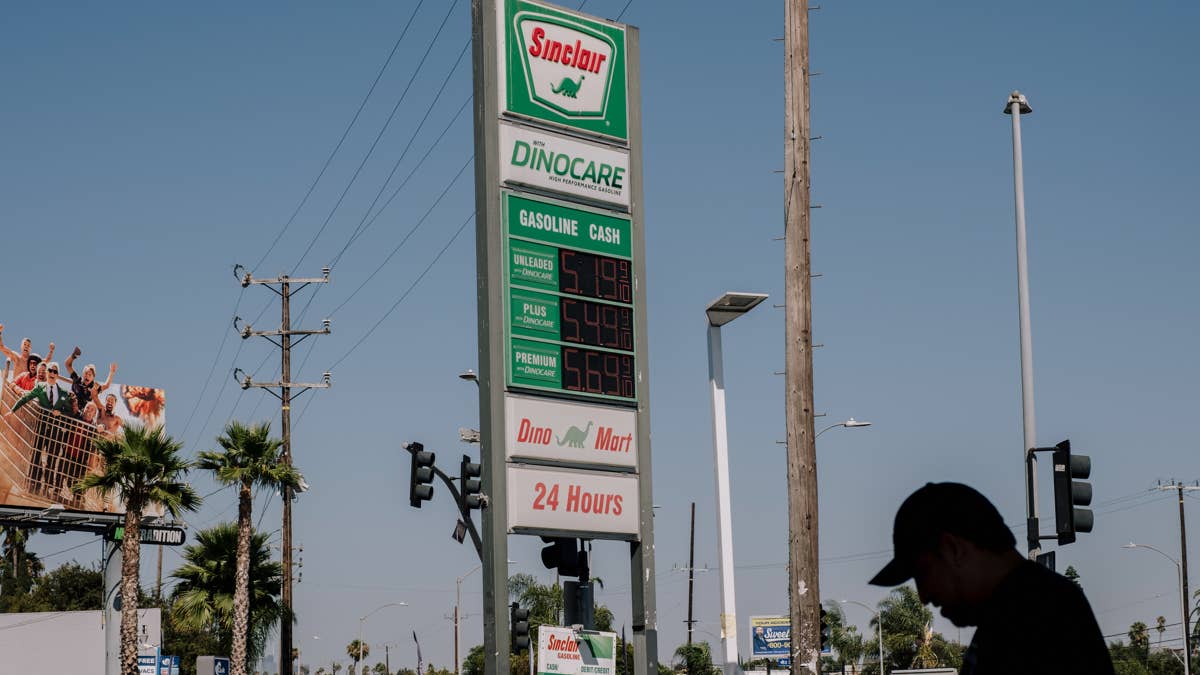 Prices at the pump have started to come down, though slowly.
A tougher trade-off for central banks
In their supply-cut scenario, the researchers pushed oil prices up by 10%. Economic output suffered about twice the damage it would have taken before the pandemic.
And borrowing costs still had to rise, as the Fed note explained, even with growth already under pressure. Policymakers were left with no good option on either side.
The Fed is already living that trade-off. It raised rates in September and held them at 3.75% to 4% in October, with two policymakers pushing for another hike.
“I expect that monetary policy will need to move to a restrictive stance,” Cleveland Fed President Beth Hammack said on Nov. 5, Reuters reported.
Gov. Christopher Waller went further on Nov. 10. He said he was “leaning toward supporting an increase in our policy rate of 25 basis points” in December and that a 50-basis-point hike “should be considered” if October’s monthly inflation reading comes in hot, as American Banker reported.
He also warned that even a quick end to the war would not bring immediate relief on diesel prices.
More Oil & Gas:
- Ahead of election, oil and gas prices take a breather
- Exxon, Chevron paint bullish pictures of the oil business
- Risk of more Mideast war boosts oil, threatens your wallet
Wall Street is not ruling out another oil jump, either. Goldman Sachs raised its December Brent forecast to $105 a barrel from $90, citing the possibility of renewed supply disruptions in the Middle East.
If that happens, the Fed’s research suggests core inflation would feel it more than it once did.
The caveats, and what comes next
The authors flagged real limits on what they could conclude. Their data only stretches across a handful of post-pandemic years, an unusually volatile window that makes it genuinely difficult to separate a durable structural change from a string of one-time events.
They put it plainly: “Second-round effects have not yet materialized; however, risks are mounting.”
The oil market may also be loosening. JPMorgan estimated a global surplus of about 1.4 million barrels a day in October, and President Donald Trump said he was highly unlikely to order new attacks on Iran while talks continue, CNN reported.
The next few data releases will show how much of the energy shock has seeped into everyday prices. October consumer inflation data will be released on Nov. 10, followed by the PCE report on Nov. 25.
If core prices stay firm even as crude cools, the Fed’s warning about a louder oil signal will be hard to ignore.
Related: Kevin Warsh changed something the Fed has not touched in decades
