
Picture a football Sunday where the game’s about to begin, friends are coming over, and somebody has to decide whether a platter of wings fits the budget.
Wingstop is looking to make that decision easier. Its watch-party offer is being pitched at roughly $7 per person, but even with that value-focused approach, Americans are visiting Wingstop a lot less frequently, and the company expects another difficult quarter.
That didn’t stop a remarkably bullish stock-market prediction.
On the Nov. 11 episode of CNBC’s “Mad Money,” Jim Cramer walked viewers through technical analyst Bob Lang’s jaw-dropping price target for Wingstop (WING) stock.
As restaurants fight for budget-conscious diners and investors rethink AI stocks, one question stands out: Could a restaurant stock soar before its customers return?
Jim Cramer reacts to Bob Lang’s nearly 50% Wingstop forecast
The tremendous uncertainty is what makes Lang’s prediction so unusual.
Cramer said Wingstop had rebounded 74% from its late-September lows. Lang nevertheless saw more upside, on the back of rising highs and lows, healthier trading volume, and a bullish momentum indicator known as MACD.
More Jim Cramer:
- Jim Cramer sends clear signal on Apple and Palantir stock
- Jim Cramer explains the ‘AI cheat code’ driving Apple stock higher
- Cramer thinks Boeing’s problems aren’t going away soon, says buy GE
For perspective, Bob Lang is the founder of Explosive Options, previously managed a $300 million pension and 401(k) portfolio, and regularly appears on “Mad Money” to discuss technical analysis.
A bullish MACD indicator shows that buyers are gaining momentum, supporting further price gains. He also believes the stock could reach $200 first, and eventually $250. From its roughly $167 price during the segment, that higher level implies about 50% upside.
Cramer’s reaction was revealing.
“This would shock me, and I don’t care for the stock,” he said, while stressing his respect for Lang’s analysis.
Lang also liked Shake Shack (SHAK), noting a 25% upside potential after shares recovered above a key long-term average.
Restaurant Brands International (QSR), the owner of Burger King, Popeyes, and Tim Hortons, offered another opportunity. Lang said a move above $81 to $82 could eventually open the path toward $100.
That said, these businesses aren’t experiencing the same consumer behavior.
Shake Shack’s Q3 comparable sales rose 2.5%, including a 0.8% traffic gain. Burger King’s U.S. comparable sales climbed 8.4%, helped by promotions and menu innovation as reported by Seeking Alpha.
Wingstop’s challenge is different, as its fundamentals seem disconnected from its stock-market performance.
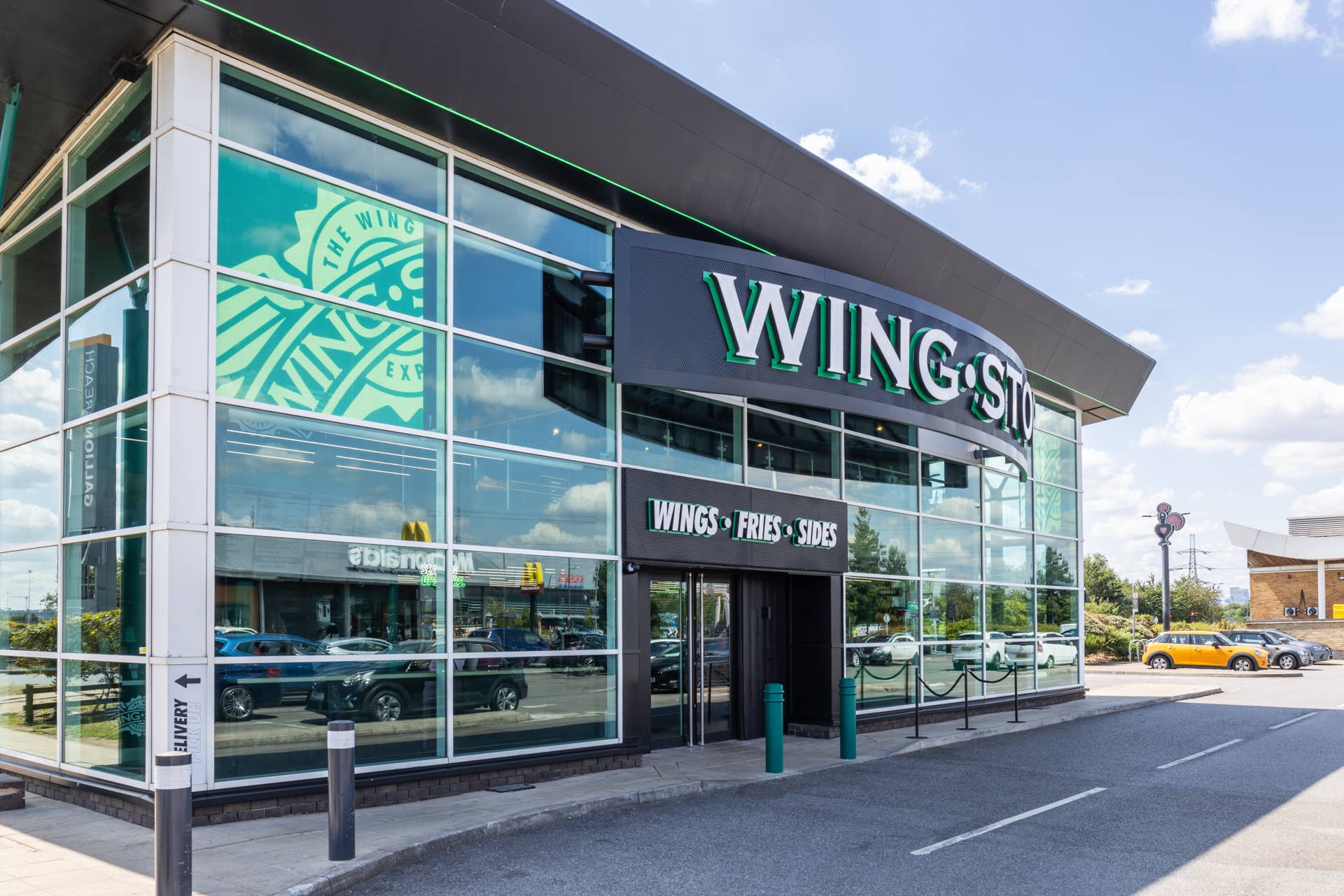 Jim Cramer discusses Bob Lang’s $250 Wingstop forecast, despite weaker restaurant sales.
Wingstop’s sales slump reveals how carefully Americans are spending
Wingstop’s same-store sales have taken a hit, suggesting that the company is struggling to persuade customers to return to its existing locations.
U.S. same-store sales in Q3 fell by 5.4%, on the back of fewer transactions. The decline followed a 5.6% drop a year earlier. The chain has now lowered its full-year domestic same-store outlook to a 6.5% to 7% decline.
Similarly, systemwide sales still rose 6% to $1.44 billion, largely due to the opening of more locations. Wingstop ended September with 3,331 restaurants worldwide, compared with 2,932 a year earlier.
That means new restaurants are helping the company grow, even as existing U.S. stores struggle. Also, quarterly net income rose 2.2% to $29.1 million, while adjusted earnings fell 3.5%, highlighting the uneven pace of the recovery in customer demand.
CEO Michael Skipworth talked about that problem on the Oct. 28 earnings call.
“We also are not waiting for the consumer environment to improve,” he said.
That environment is unforgiving.
Restaurant menu prices jumped 4% over the 13 months through October, compared to a 2.2% increase in grocery prices, the National Restaurant Association noted. In September, more restaurant operators reported falling customer traffic than rising traffic, the 19th such month out of 20.
Wingstop’s leadership says its ads promoted awareness without giving diners a compelling reason to return. Now it’s introducing a $30 wing bundle, football watch parties, targeted offers, and Club Wingstop, its first loyalty program.
Early results are encouraging but limited.
New loyalty members returned within 30 days at a rate 13 percentage points higher than nonmembers. At the same time, members with longer enrollment increased purchase frequency by nearly 20%.
Whether those improvements can offset the broader traffic slump remains to be seen.
Restaurant stocks offer an alternative to volatile AI shares, with a catch
The restaurant stock debate came as investors are rotating away from some technology and data-center names amid a remarkably choppy stretch for the AI trade.
For anyone whose retirement account is still heavy on big technology stocks, restaurants may offer a unique way to diversify. That doesn’t mean the stock is cheap, though. It trades at around 40 times forward non-GAAP earnings, although that valuation is roughly 50% below its five-year average, according to Seeking Alpha.
It also pays an attractive dividend, with a forward annual payout of $1.32, and has paid dividends for eight consecutive years.
People still need to eat, and certain chains are winning customers even while household budgets remain tight. That said, the restaurant industry isn’t one uniform safe haven.
Census data showed U.S. restaurant and bar sales rising to $92.9 billion in September. That broader improvement contrasts with declining traffic among many individual operators, which means customers are becoming much more selective.
For Wingstop investors, the next test will come from whether the chain can get diners back without sacrificing profitability. Needless to say, a $250 share price would require more than a good football promotion.
Related: Wells Fargo sends surprising message to RV buyers about Camping World
