
Strong earnings are no longer a guarantee of job security, even for employees at some of America’s largest technology companies.
The artificial intelligence boom has fueled demand for advanced processors and data-center infrastructure, encouraging semiconductor manufacturers to invest billions of dollars in additional production capacity.
But those investments are also taking place alongside efforts to restructure operations, reduce costs and compete more effectively in the AI race.
Intel is among the companies pursuing a leaner workforce despite improving business performance.
The California-based semiconductor giant reported a 21% increase in third-quarter revenue in October, driven by a 78% surge in its Data Center and AI business.
Yet the company continues to eliminate jobs.
Intel has disclosed plans to permanently cut another 57 positions across its Santa Clara facilities, according to a Nov. 16 Worker Adjustment and Retraining Notification (WARN) notice reviewed by TheStreet.
The latest reductions come as Intel’s reported global workforce has shrunk by 7,300 employees over the past year, even as CEO Lip-Bu Tan works to rebuild the company’s standing in the semiconductor industry.
Intel discloses another round of California layoffs
In its November WARN, Intel disclosed plans to permanently eliminate approximately 57 positions across four Santa Clara facilities.
The affected locations include its Robert Noyce Building at 2200 Mission College Boulevard and three additional facilities identified as SC-9, SC-11 and SC-12.
According to the notice, the first separations were scheduled to occur during a 14-day period beginning Nov. 15.
Intel’s California layoffs disclosed between July and November 2026
The latest reductions follow three earlier notices filed between July and October, covering Intel’s operations in Santa Clara and Folsom.
WARN notice date
Location
Jobs affected
First separation period begins
July 24, 2026
Santa Clara
103
Aug. 15, 2026
Sept. 18, 2026
Santa Clara
52
Sept. 30, 2026
Oct. 22, 2026
Folsom
67
Oct. 31, 2026
Nov. 16, 2026
Santa Clara
57
Nov. 15, 2026
Total
279
Source: Four original Intel WARN notices reviewed by TheStreet. The figures cover positions identified in these specific filings, not all layoffs announced by Intel in California or nationwide.
The documents show that the reductions extend into some of Intel’s engineering and technical operations.
The latest November filing includes a breakdown of the 57 affected positions.
At the Robert Noyce Building, 33 workers are affected, including 5 infrastructure and DevOps engineers, 3 software application development engineers, 2 security research engineers or scientists, and several other technical and administrative employees.
More Layoffs:
- Canva CEO apologizes to workers, makes unusual promise amid layoffs
- Disney eyes thousands more layoffs as major cost-cutting push widens
- Popular website builder cuts 19% of jobs as CEO signals major shift
Another 19 positions are affected at SC-12, including 5 platform hardware design engineers, four electronic design automation tools hardware engineers and two physical design engineers.
The remaining 5 positions are spread across SC-9 and SC-11.
The October notice covering Intel’s Folsom campus also identifies substantial reductions in engineering roles, including product development engineers, engineering managers, and software specialists.
The filings do not identify particular projects being discontinued or indicate that any of the affected facilities are closing.
According to Intel’s latest Form 10-Q filed with the Securities and Exchange Commission, employee severance and benefit-related charges totaled $290 million during the first nine months of 2026.
That included $55 million in the third quarter alone.
Related: Boeing’s 2,500 job cuts come with a troubling unanswered question
What Intel is offering affected employees
The WARN notices provide details about the support being offered to employees losing their jobs.
The company said affected workers were either being notified of their separations at least 60 days in advance or receiving shorter notice accompanied by nine weeks of pay and benefits in lieu of additional notice.
Under the October Folsom notice, the shorter notification period was approximately two weeks, compared with approximately four weeks in the Santa Clara notices.
Intel has also partnered with career transition firm Lee Hecht Harrison to provide outplacement and retraining services for up to 6 months.
The services include personal career coaching, résumé and LinkedIn profile support, interview preparation, job-search assistance and professional development resources.
The notices state that the affected employees are not represented by a union and do not have the right to displace other employees from their positions.
The documents do not establish Intel’s total worldwide layoffs for November or indicate whether additional reductions are planned beyond those identified in the filings.
Intel workforce shrinks despite stronger earnings
The latest cuts come amid a multiyear contraction in Intel’s workforce.
According to the company’s third-quarter earnings release, Intel had approximately 81,100 employees worldwide as of Sept. 26, 2026, including workers at Mobileye and other subsidiaries.
That compares with 88,400 a year earlier, representing a decline of 7,300 employees, or approximately 8.3%.
How Intel’s global workforce has changed
Intel’s reported workforce has fallen much further since the end of 2024.
Reporting period
Total employees
December 2024
108,900
September 2025
88,400
December 2025
85,100
June 2026
82,300
September 2026
81,100
Sources: Intel’s 2024 annual report, 2025 earnings release and third-quarter 2026 results. Figures include subsidiaries.
The figures represent an overall decline of approximately 27,800 employees since December 2024, although that total should not be interpreted as the number of people laid off.
Employee departures, hiring activity and business divestitures have all influenced the company’s reported headcount.
The shrinking workforce illustrates the scale of Intel’s restructuring over the past two years.
Meanwhile, its latest financial results suggest that some of those efforts are taking place alongside a substantial business recovery.
Intel generated $16.5 billion in third-quarter revenue, compared with $13.7 billion a year earlier.
Its Data Center and AI division reported revenue of $7.3 billion, up 78% year over year, as demand for server processors continued to accelerate.
Chief Financial Officer David Zinsner said the quarter marked the company’s strongest data-center revenue growth in 15 years.
However, the recovery remains uneven.
Intel’s Client Computing and Physical AI business reported a 5% decline in revenue, while its foundry division continued operating at a loss.
The company reported $3.3 billion in GAAP net income attributable to Intel, down 18% from the previous year, despite its higher revenue.
Intel also forecast fourth-quarter revenue of $15 billion to $16 billion, below the third quarter’s $16.5 billion, as weakness in the PC market and supply constraints continued to affect its outlook.
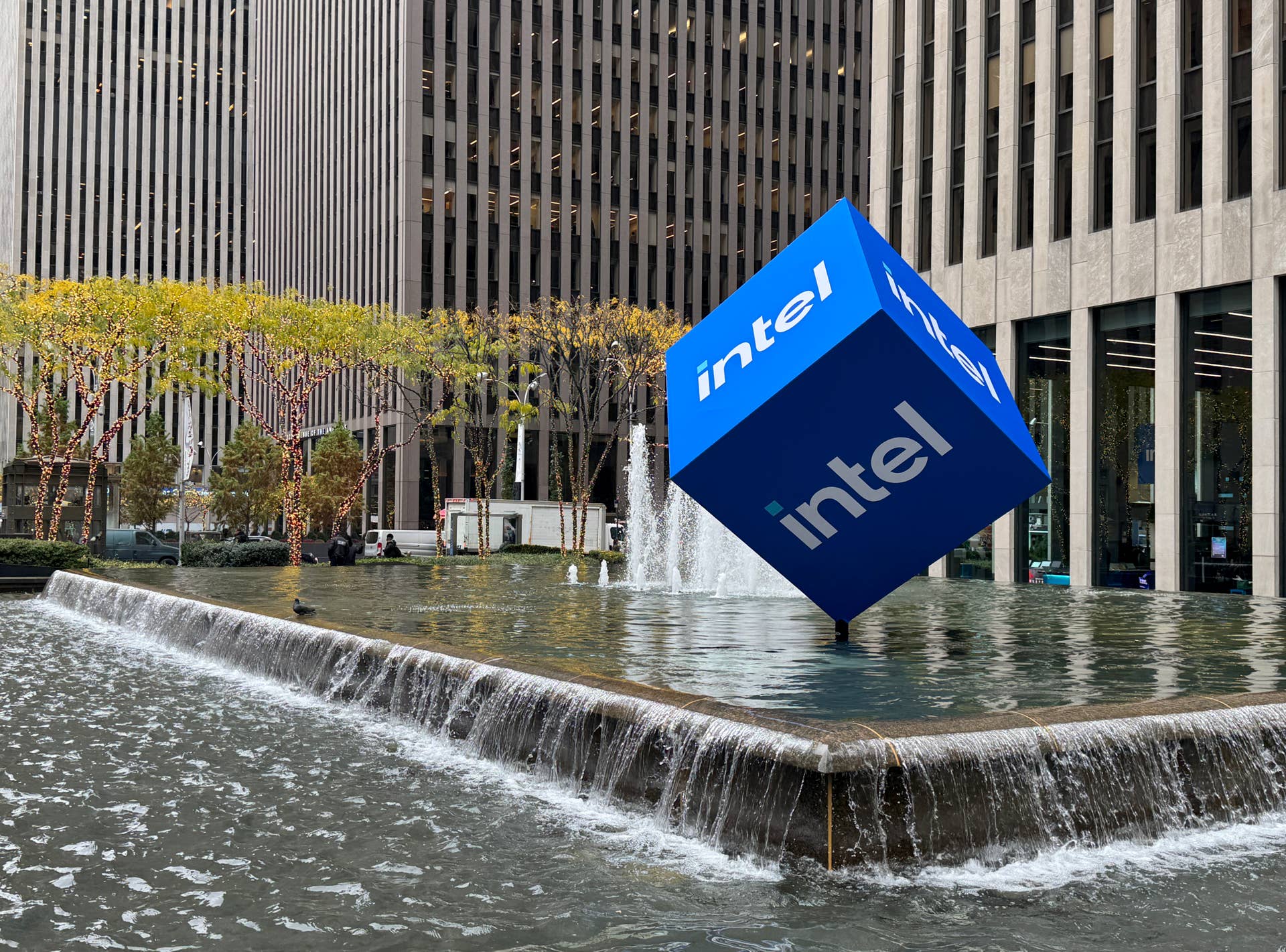 Intel continues its layoffs in 2026.
Roman Tiraspolsky / Getty Images
Intel CEO acknowledges dramatic workforce restructuring
During Intel’s October 29 earnings call, Tan discussed the scale of the changes undertaken during the company’s restructuring.
He described the progress as including “a dramatic resizing of our workforce, eliminating middle management and bureaucracy, streamlining our executive ranks”
Tan also said Intel had established a largely new leadership team and worked to restore an engineering-focused culture.
“We still have much more to do,” he said.
The remarks came as the company continued to invest in manufacturing technology and expand capacity to support growing demand for its processors.
Tan said Intel’s server business was experiencing particularly strong demand from customers building AI infrastructure.
CFO Zinsner also acknowledged that demand for the company’s Data Center and AI products continued to exceed available supply.
Intel expects capital expenditures and purchasing commitments to rise over the coming quarters as it attempts to address those supply constraints.
The contrast reflects the company’s restructuring strategy: Intel is reducing staffing and management costs in some areas while directing capital toward manufacturing capabilities and products it considers central to its future growth.
Although AI-related demand is helping drive Intel’s investment decisions, the company has not attributed the reductions to AI automation.
Intel’s recovery follows years of financial struggles
For decades, Intel was one of the dominant names in the semiconductor industry, helping power the personal computer revolution and supplying processors for servers around the world.
Unlike companies that primarily design chips and outsource their production, Intel built its business around developing and manufacturing its own processors.
But it came under increasing pressure as competitors gained ground in chip design and advanced manufacturing.
Nvidia emerged as a dominant supplier of processors used in artificial intelligence systems, while AMD strengthened its position in personal-computer and server chips.
Meanwhile, Taiwan Semiconductor Manufacturing Co., which manufactures chips for other companies, advanced its production technologies as Intel struggled with delays in its own manufacturing processes.
Intel acknowledged those difficulties in its 2025 annual report.
The company said delays in developing new manufacturing technologies had allowed competitors using TSMC to benefit from advanced processes introduced ahead of Intel.
It also acknowledged that it had “missed the significant shift in compute demand to GPUs optimized for AI workloads.”
That failure was costly.
Intel recorded approximately $922 million in inventory-related charges tied to its Gaudi AI accelerators in 2024 and another $375 million in 2025.
In August 2024, then-CEO Pat Gelsinger announced plans to eliminate roughly 15,000 positions as part of a cost-reduction initiative intended to deliver $10 billion in savings in 2025.
Gelsinger departed later that year, and Tan became CEO in March 2025.
Under Tan, Intel intensified efforts to reduce management layers, simplify operations and concentrate investment on its core client and server businesses.
The company’s annual GAAP net loss narrowed to approximately $300 million in 2025, while several business segments have reported improving performance in 2026.
But Intel has not fully recovered its former position.
Its foundry division, which manufactures semiconductors, reported approximately $6.7 billion in revenue for the third quarter of 2026, up 58% year over year.
However, much of that revenue came from transactions within Intel’s own operations. The foundry business still recorded an operating loss of approximately $1.9 billion during the quarter.
The company’s ongoing investments in advanced manufacturing therefore remain a significant part of its longer-term turnaround strategy.
Related: Tyson Foods changes course after meat plant closures
